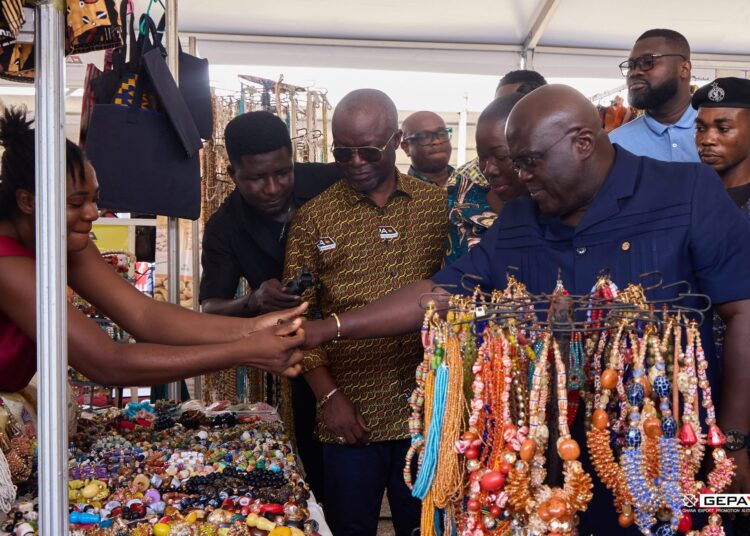
The Chief of Staff, Hon. Julius Debrah, together with the Minister for Trade, Agribusiness and Industry, Hon. Elizabeth Ofosu-Adjare, has toured the exhibition grounds of the Ghana Expo (GEXPO) 2026, engaging exhibitors and examining a wide range of locally manufactured products.
The visit, which forms part of government’s efforts to promote domestic production and strengthen Ghana’s industrial capacity, provided an opportunity for the officials to interact directly with businesses showcasing their products and services.
The tour highlighted the importance of supporting local enterprises, increasing the visibility of Ghanaian products and creating sustainable market opportunities for manufacturers, exporters and small and medium sized enterprises (SMEs).
“Supporting Made-in-Ghana products is essential to strengthening local businesses, expanding production and creating opportunities for Ghanaian enterprises to compete in both domestic and international markets.”
Chief of Staff, Hon. Julius Debrah
Strengthening Domestic Production For Market Expansion
GEXPO 2026 provides a platform for Ghanaian businesses to showcase their products, establish commercial partnerships and explore opportunities for market expansion.
The exhibition brings together more than 500 enterprises across different sectors, reflecting the growing diversity of Ghana’s productive economy and the potential of local businesses to contribute to industrial development.
Through engagements with exhibitors, the Chief of Staff and the Trade Minister underscored the importance of creating an enabling environment for local manufacturers to expand their operations, improve product quality and increase their competitiveness.
Government’s support for domestic enterprises is also linked to efforts to reduce dependence on imported goods, encourage value addition and strengthen the contribution of local industries to national economic growth.
For businesses participating in the exhibition, the platform offers opportunities to connect with potential buyers, distributors, investors and other industry stakeholders.
“The development of Ghanaian businesses must go beyond producing for the local market. Our enterprises must be supported to improve their capacity, meet international standards and compete effectively in global markets.”
Chief of Staff, Hon. Julius Debrah
Expanding Ghana’s Export Opportunities Through GEXPO 2026
Ghana’s non-traditional export sector continues to play an important role in the country’s economic diversification agenda.
According to export performance figures presented by the Ghana Export Promotion Authority (GEPA), the country’s non-traditional exports generated approximately US$5.01 billion in 2025, representing a 30.7 per cent increase over the previous year’s earnings.
The performance demonstrates the growing contribution of non-traditional exports to Ghana’s foreign exchange earnings and highlights opportunities for businesses to expand their participation in international trade.
Processed and value-added products remain particularly important to the country’s export ambitions, as increased local processing can improve earnings, create employment and strengthen Ghana’s position in international value chains.
Government has set an ambitious target of increasing non-traditional export earnings to US$10 billion by 2030, making the expansion of productive capacity and access to international markets critical to achieving the objective.
The African Continental Free Trade Area (AfCFTA) also presents opportunities for Ghanaian businesses to access a wider continental market.
However, local manufacturers must strengthen production capacity, maintain consistent quality and meet applicable standards to take advantage of the opportunities.
“Ghanaian businesses must position themselves to take advantage of the opportunities available under the African Continental Free Trade Area and other international trade arrangements.”
Chief of Staff, Hon. Julius Debrah
Promoting Local Enterprises and Investment At The GEXPO 2026
The GEXPO exhibition also reinforces the importance of collaboration between government and the private sector in building a competitive domestic economy.
Small and medium-sized enterprises, which form a significant part of Ghana’s business landscape, require access to finance, technology, markets and business development support to scale their operations.
Increased domestic patronage of locally manufactured products can provide businesses with a stronger market base, encourage further investment and support the expansion of production facilities.
Beyond local consumption, sustained investment in manufacturing, agro-processing, packaging and product development will be necessary to improve the competitiveness of Ghanaian goods.
The engagement between government officials and exhibitors therefore provides an opportunity to identify challenges confronting businesses and strengthen collaboration towards addressing constraints affecting production and market access.
“Promoting Made-in-Ghana products requires a collective effort involving government, manufacturers, exporters and consumers. Supporting local businesses ultimately contributes to job creation, industrial growth and national economic development.”
Chief of Staff, Hon. Julius Debrah
The exhibition is expected to further strengthen the visibility of Ghanaian products while creating opportunities for business networking, investment partnerships and access to new markets.
Through initiatives such as GEXPO 2026, government and private-sector stakeholders are seeking to position Ghanaian enterprises to play a stronger role in domestic and international trade.
READ ALSO:BoG Warns Ghana’s Economic Recovery and Inflation Gains Could Reverse in 2027