Ghana’s customs brokers are facing renewed pressure to tighten their professional standards and protect government revenue as the Ghana Revenue Authority (GRA) intensifies efforts to close a staggering GH¢14.35 billion revenue gap before the end of the year.
The Commissioner of the Customs Division of the GRA, Mr. Aaron Kanor, has challenged customs brokers to take greater responsibility for revenue mobilisation, warning that their actions within the trade and customs clearance chain could significantly influence the country’s ability to meet its revenue targets.
Speaking at the 2026 Annual General Meeting (AGM) of the Customs Brokers Association Ghana (CUBAG) in Sogakope, Mr. Kanor described customs brokers as indispensable partners in Ghana’s trade ecosystem, stressing that the integrity of customs administration depends heavily on their professionalism and commitment to compliance.
His appeal comes at a critical time when the GRA is working to bridge the remaining GH¢14.35 billion shortfall, placing customs operations, trade declarations and revenue protection under renewed scrutiny.
GH¢14.35bn Gap Puts Brokers in the Spotlight
The Commissioner told participants that customs brokers occupy a strategic position in the revenue collection process because their declarations directly influence the amount of duties and taxes paid on imported goods.
He explained that brokers serve as the first line of assessment in the customs value chain, making accurate declarations, proper classification and adherence to customs regulations essential to protecting national revenue.
However, he raised concerns about persistent practices that continue to undermine revenue collection, including under-declaration, misclassification, falsification of documents and diversion of transit cargo.
More troubling, some of these infractions involve licensed agents who are expected to uphold the highest standards of professionalism.
Mr. Kanor consequently urged brokers to embrace what he described as a “new covenant of compliance”, indicating that the Customs Division would strengthen facilitation measures for operators who consistently demonstrate adherence to the law.
The challenge presents a significant test for customs brokers, whose responsibilities extend beyond processing import documents to ensuring that government receives the appropriate revenue from international trade activities.
Customs Fraud Threatens Revenue Mobilisation
The concerns raised by the Commissioner highlight the financial consequences of weaknesses within Ghana’s customs administration.
When importers under-declare the value of goods, misclassify products or submit falsified documentation, the government risks collecting less revenue than it is legally entitled to receive.
Similarly, the diversion of transit cargo can create opportunities for goods intended to move through Ghana under specific customs arrangements to enter the domestic market without the appropriate duties and taxes being paid.
These practices do not only affect revenue mobilisation. They can also undermine fair competition, disadvantage compliant businesses and weaken confidence in the country’s trading system.
Mr. Kanor therefore wants customs brokers to become stronger partners in closing loopholes that allow revenue leakages to persist.
The Commissioner also pointed to ongoing reforms designed to improve transparency and efficiency across customs operations.
These include the Integrated Customs Management System (ICUMS), pre-arrival processing, mandatory scanning and measures to decongest the ports.
The reforms are intended to create a more predictable trading environment while strengthening the ability of customs authorities to identify irregularities and enforce compliance.
CUBAG Pushes Compliance as Professional Survival Strategy
The President of CUBAG, Nana Fredua Ofori-Atta, acknowledged the importance of compliance, revealing that the association had adopted it as a professional culture and survival strategy in an era of digital customs administration and stricter enforcement.
He disclosed that more than 600 members had undergone training in freight forwarding, valuation, classification and rules of origin through the CUBAG Training Institute.
The training initiative reflects the association’s efforts to equip its members with the technical knowledge required to operate within an increasingly demanding customs environment.
Beyond professional development, CUBAG is also pursuing digital transformation to improve how its members access services and participate in the association’s activities.
Mr. Ofori-Atta announced the completion of the MyCUBAG App, which he described as the first dedicated mobile application and web portal for customs brokers and freight forwarders in Ghana.
The platform will allow members to pay dues, access industry information, register for training programmes, obtain legal support, participate in surveys and vote electronically during association elections.
He also called for the full integration of all ICUMS modules, a genuinely operational 24-hour port ecosystem and stronger stakeholder participation in the development of customs systems.
Port Congestion Adds to Trade Facilitation Challenges
The revenue mobilisation drive is unfolding alongside efforts to address operational difficulties within Ghana’s maritime and shipping sector.
Delivering a solidarity message on behalf of the Chief Executive Officer of the Ghana Shippers’ Authority (GSA), Deputy CEO Mrs. Sylvia Asana Dauda-Owu described CUBAG as a strategic partner in building a transparent, predictable and competitive trade environment.
She emphasised that compliance and institutional reforms were necessary to reduce clearance bottlenecks, minimise demurrage costs and protect government revenue.
Mrs. Dauda-Owu also highlighted ongoing initiatives to develop Standard Operating Procedures and service standards for Ghana’s commercial shipping sector, with the objective of improving cargo clearance efficiency and reducing the cost of doing business.
Meanwhile, a goodwill message delivered on behalf of the Director-General of the Ghana Ports and Harbours Authority (GPHA), Major General Paul Seidu Tanye-Kulono, reaffirmed the Authority’s commitment to working closely with customs brokers.
The message, delivered by Senior Marketing and Corporate Affairs Officer Mr. Solomon Anderson, acknowledged operational challenges around the port enclave arising from increased cargo traffic and the accumulation of empty containers.
Measures including the procurement of trucks, improved traffic management and closer stakeholder coordination have been implemented to ease the congestion.
The Authority also urged brokers to make prompt declarations, facilitate faster cargo evacuation and support greater utilisation of 24-hour port operations.
Revenue Recovery Requires Stronger Industry Collaboration
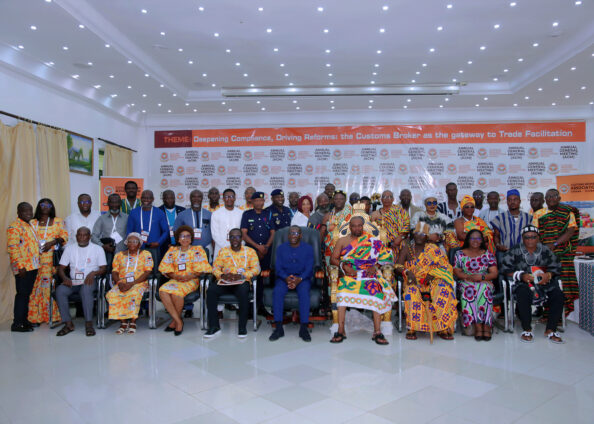
The 2026 CUBAG AGM, held under the theme “Deepening Compliance, Driving Reforms; the Customs Broker as the Gateway to Trade Facilitation,” brought together customs officials, freight forwarders, logistics operators and other stakeholders.
Chaired by Togbe Atsuga Soga II, Dufiaga of Sogakope, the gathering also received solidarity messages from the Ghana Institute of Freight Forwarders and the Association of Customs House Agents of Ghana, both of which called for unity within the freight forwarding industry.
Ultimately, the GH¢14.35 billion revenue gap places considerable importance on the relationship between the GRA, customs brokers, shipping authorities and other trade stakeholders.
While stronger enforcement and digital reforms can improve customs administration, their effectiveness will depend significantly on the accuracy of declarations, ethical conduct and cooperation across the industry.
With the year-end revenue target approaching, customs brokers are under growing pressure to demonstrate that they can be trusted partners in protecting the public purse while ensuring that legitimate trade continues without unnecessary delays.