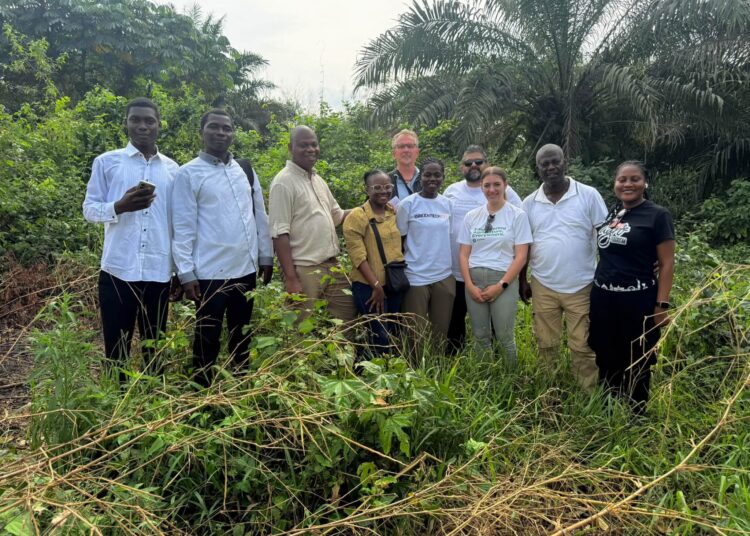
Ghana’s efforts to reduce its dependence on imported tomatoes and strengthen domestic agricultural production are gaining renewed momentum, as FarmMate Africa brings together investors, greenhouse technology specialists, seed and fertilizer experts, and landowners in the Eastern Region to explore opportunities for commercial tomato cultivation.
The initiative, undertaken this week with participation from The Ghanaian Farmer, is aimed at mobilising land, investment, agricultural expertise and modern production technologies to expand tomato farming and create a more sustainable supply of the crop for local markets and food-processing industries.
The engagement forms part of a broader effort to address longstanding challenges confronting Ghana’s tomato industry, including inadequate production, seasonal shortages, post harvest losses, limited access to financing and the country’s reliance on imported tomatoes and tomato paste.
“The mission is to grow more tomatoes, create wealth for farmers, feed our factories and end post harvest losses.”
FarmMate Africa
Investment and Technology for Commercial Farming
The engagement between FarmMate Africa and landowners highlights the growing importance of private sector investment in modern agricultural production, particularly as Ghana seeks to improve food security and strengthen the competitiveness of its agribusiness sector.
Tomato cultivation in Ghana has traditionally been dominated by smallholder farmers operating under rain fed conditions, with production affected by unpredictable rainfall, pest and disease outbreaks, limited irrigation infrastructure and the high cost of agricultural inputs.
‘’The introduction of greenhouse technology and improved farming systems could help address some of these constraints by creating more controlled production environments, improving water management and supporting more consistent crop yields.’’
FarmMate Africa
The participation of greenhouse specialists, seed suppliers and fertilizer experts in the engagement is expected to provide prospective farmers with technical guidance on suitable varieties, soil preparation, nutrient management, irrigation systems and production planning.
Modern greenhouse systems, when properly managed, can improve productivity per unit of land and reduce exposure to adverse weather conditions.
However, their commercial viability depends on the availability of reliable energy and water supplies, affordable infrastructure, market access and effective farm management.
FarmMate Africa’s engagement with landowners is therefore significant in identifying potential agricultural sites and creating the foundation for partnerships that could combine land resources with investment and technical support.
The approach could also provide an avenue for landowners to move beyond traditional land leasing arrangements into more structured agricultural partnerships, depending on the financing and ownership models adopted.
Addressing Ghana’s Tomato Supply Gap
Tomatoes remain one of Ghana’s most important food crops, supporting household consumption, food vendors, restaurants, retailers and agro processing companies.
Despite the crop’s importance, domestic production has struggled to meet demand consistently, particularly during periods of seasonal shortages, when prices rise and traders increasingly depend on supplies from neighbouring countries.
Ghana’s tomato value chain faces challenges extending beyond cultivation. Inadequate transportation, poor storage facilities, limited cold chain infrastructure and insufficient processing capacity contribute to losses between farms and consumers.
According to the Food and Agriculture Organization, food losses in developing countries are particularly significant during harvesting, handling, transportation and storage, making improvements across the supply chain critical to agricultural productivity and food security.
Expanding commercial tomato production could help stabilise supply, reduce pressure on prices during periods of scarcity and improve access to raw materials for Ghana’s food processing industry.
“Grow more tomatoes, create wealth for farmers, feed our factories and end post-harvest losses.”
Food and Agricultural Organisation
Creating Wealth Across the Value Chain
Beyond increasing production, the tomato initiative presents opportunities for employment creation and income generation across the agricultural value chain.
Commercial tomato farms require workers for land preparation, planting, irrigation, crop management, harvesting, sorting and packaging.
Additional opportunities could emerge in transportation, input distribution, equipment maintenance, processing and marketing.
The involvement of investors and agricultural experts could also improve access to technical knowledge and business management skills, particularly for farmers seeking to transition from subsistence or small-scale production into commercially oriented agriculture.
For landowners in the Eastern Region, the engagement could open opportunities to utilise available land for productive agricultural ventures, provided the proposed partnerships establish clear arrangements on land ownership, investment responsibilities, revenue sharing and long-term sustainability.
The initiative also reflects the increasing recognition that agricultural transformation requires collaboration among farmers, financiers, technology providers, government institutions, researchers and private businesses, “Could this be the beginning of Ghana’s tomato independence?,” FarmMate Africa.
The question captures the broader ambition of the initiative: to build a domestic tomato industry capable of supplying consumers and processors while reducing the economic vulnerability associated with import dependence.
Building a Sustainable Tomato Industry
Ghana’s tomato sector has considerable potential to contribute to agricultural industrialisation, but unlocking that potential requires sustained investment and coordinated development across the entire value chain.
The FarmMate Africa initiative could contribute to this transformation by bringing together landowners and investors while facilitating access to modern agricultural technology and specialised expertise.
The success of the initiative will ultimately depend on the scale of investment mobilised, the number of farms established, production targets, the adoption of efficient farming practices and the development of dependable markets for harvested tomatoes.
It will also be important to incorporate smallholder farmers into the emerging production system through outgrower arrangements, training programmes, access to inputs and structured purchasing agreements with commercial farms and processors.
Such arrangements could help ensure that the benefits of agricultural investment extend beyond large-scale commercial operators to rural communities and existing farmers.
“A stronger tomato industry could create opportunities for farmers, investors, processors and consumers while reducing losses and improving Ghana’s food supply.”
FarmMate Africa
As Ghana continues to pursue agricultural modernisation and industrial development, initiatives that connect land, investment, technology and markets could play an important role in strengthening domestic production.
READ ALSO:Mahama Calls for More Ghanaian-Owned Processing Factories Nationwide