
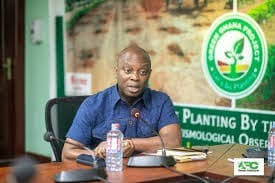
Ghana has secured approximately 6.5 million verified carbon credits, with buyers committing to purchase four million credits valued at about US$43 million, according to Forestry Commission Chief Executive Officer Dr Hugh Clement Adokwei Brown.
Speaking at a press briefing at the Ministry of Lands and Natural Resources, Dr Brown disclosed that the committed purchases, including participation from the LEAF Coalition, were priced between US$10 and US$13 per tonne of carbon.
He explained that about 2.5 million credits remained available for further transactions, potentially generating an additional US$25 million.
“Out of the approximately 6.5 million credits issued, buyers including participants to the LEAF Coalition, have committed to purchase 4 million tons of carbon credits valued at approximately $43 million”.
Forestry Commission Chief Executive Officer Dr Hugh Clement Adokwei Brown.
Ghana’s Carbon Credits Create New Climate Finance Opportunity
The issuance marks an important step in Ghana’s efforts to mobilise climate finance through forest conservation and sustainable land management. However, Dr Brown stressed that the issuance of verified credits must not be confused with the receipt of revenue.
Ghana has secured the credits, but the corresponding funds have not yet been received. Government will therefore pursue transactions that deliver appropriate value for the country, preserve the integrity of the programme and remain consistent with national climate commitments.
The potential proceeds are expected to provide additional resources for forest protection, restoration and sustainable forest management. They could also support efforts to improve livelihoods in communities whose residents contribute to conserving forest landscapes.
Communities to Receive 46 Percent of Benefits
The Forestry Commission CEO emphasised that farmers, forest-fringe communities and traditional authorities had contributed directly to the achievement and had a legitimate interest in how the resulting benefits would be distributed.
He stated that government remained committed to transparent and equitable benefit-sharing arrangements that connect forest protection with improved community livelihoods.
Ghana, he noted, had experience implementing such arrangements through the Ghana Cocoa Forest REDD+ Programme, supported by the Forest Carbon Partnership Facility. Between 2023 and 2024, the country received approximately US$21.8 million under that programme.
Dr Brown explained that the funding supported forest protection and landscape restoration, while benefits to communities included farming inputs, boreholes, Community-based Health Planning and Services compounds, school blocks and school furniture.
Under the benefit-sharing arrangement approved for the current carbon transactions, communities, including farmers and traditional authorities, are allocated 46 percent of the benefits. Government institutions receive 39 percent, while environmental non-governmental organisations receive two percent and the private sector receives three percent.
A further 10 percent is assigned as a fixed cost for project management units. Dr Brown explained that this allocation covers verification, validation and the processes required to secure the issuance of carbon credits.
The government allocation includes the Forestry Commission, Metropolitan, Municipal and District Assemblies, COCOBOD and the Ghana National Farm Service, according to the briefing.
Benefit-Sharing Framework Links Conservation to Livelihoods
The government has also emphasised that the benefit-sharing system is intended to make the distribution of proceeds predictable and accountable. The approved percentages identify the interests of communities, public institutions, environmental organisations, private sector participants and the units responsible for managing the projects.
The 10 percent project management allocation is distinct from the shares assigned to beneficiaries. It covers the technical and administrative work required to validate and verify emissions reductions and complete the processes leading to credit issuance. These steps are necessary to maintain the credibility of the credits offered to buyers.
The 39 percent government allocation is shared among institutions with responsibilities in forest governance and local administration. The inclusion of district assemblies is particularly relevant because local authorities work directly with communities and support development priorities within forest landscapes.
For farmers and traditional authorities, the 46 percent allocation provides a defined share under the approved arrangement. Its impact, however, will depend on how the benefits are implemented and reach the people whose activities directly support forest protection.
Sustaining Ghana’s Carbon Credit Gains
Dr Brown cautioned that securing the credits was not the end of the process, signalling the need to sustain the results achieved and maintain the conditions that make the programme credible

“The issuance is not the end of the journey,” he told the briefing. With buyers committed to four million credits and approximately 2.5 million remaining for further transactions, Ghana has established a significant opportunity to attract climate finance. However, the estimated proceeds will depend on completing transactions and receiving payment.
READ ALSO: ACEP Warns Ghana’s Manganese Target Could Strain Power Supply