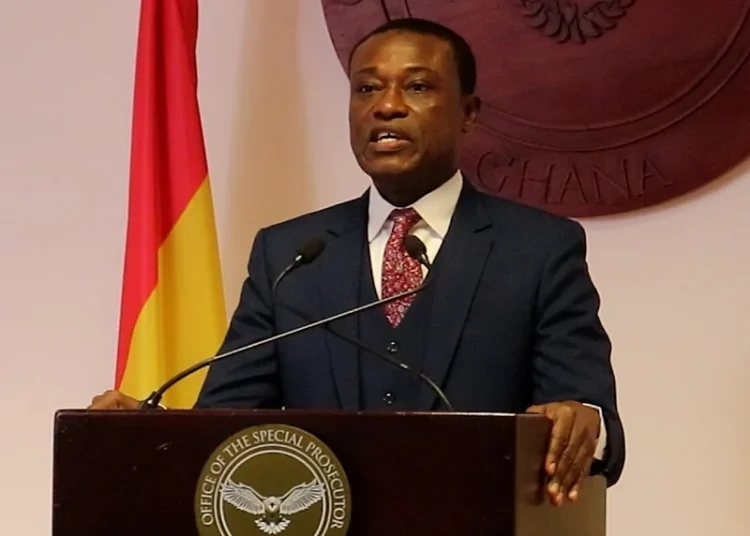
Ghana’s Special Prosecutor, Kissi Agyebeng, has warned that corruption undermines young people’s future by diverting public resources, denying opportunities and deepening inequality.
Addressing the Youth Against Corruption (YAC) Summit, Governance and Integrity Edition, organised by the Office of the Special Prosecutor (OSP), he urged young Ghanaians to make integrity a personal responsibility as future leaders.
“Corruption is not an abstract offence. It has consequences in the lives of ordinary persons. It diverts resources meant for schools, hospitals, roads, and jobs. It denies persons opportunities and places an unfair burden on those who can least afford it”.
Kissi Agyebeng, Special Prosecutor, Ghana
Mr Agyebeng argued that Ghana’s long-term success in fighting corruption would depend not only on investigations and prosecutions, but also on the values instilled in the generation expected to inherit and lead the country.
He highlighted corruption prevention as a central part of the OSP’s mandate and called on young people to reject dishonest practices in their everyday decisions, in their schools, communities and future workplaces.
The Special Prosecutor urged participants to understand corruption beyond its legal definition, describing it as a practice with direct consequences for ordinary citizens. “Above all, it diminishes the prospects of the young,” Mr Agyebeng stressed, arguing that corruption reduces opportunities for the generation expected to shape Ghana’s future.

He challenged participants to consider the responsibilities they would assume as public officers, business managers, institutional leaders and professionals. He asked whether they would regard integrity as a duty or an inconvenience.
OSP Mandate Extends Beyond Prosecution
Kiss Agyebeng also sought to broaden public understanding of the OSP’s responsibilities, explaining that prosecution represents only one part of its four-fold mandate.
He outlined the office’s functions as preventing corruption, investigating specific cases of corruption and corruption-related offences, prosecuting such cases, and recovering ill-gotten assets.
He identified prevention as the aspect of the mandate particularly close to his heart, arguing that stopping corrupt practices before they take root can reduce the need for investigations and prosecutions.
“What we prevent does not have to be investigated. What we stop from taking root does not have to be prosecuted.”
Kissi Agyebeng, Special Prosecutor, Ghana
He said he hoped to change the national conversation by encouraging shifts in institutional, social and cultural attitudes. The fight, in his view, should not depend solely on courts and law enforcement, but must also discourage corrupt behaviour before it becomes entrenched.
Youth Against Corruption Initiative Seeks Cultural Change
Mr Agyebeng explained that this preventive approach informed the establishment of the Youth Against Corruption initiative. He credited Sammy Darko, the OSP’s Director of Strategy, Research and Communication, with developing the idea after being tasked with proposing a new initiative for the institution.
He recalled asking Sammy Darko to develop something that would be “new for the ages” and disclosed that the proposal emerged within weeks. Mr Agyebeng acknowledged his colleague’s contribution, emphasising that the initiative was Mr Darko’s idea

The programme seeks to engage young people in building integrity rather than relying only on enforcement after wrongdoing.
Agyebeng Urges Students to Reject Everyday Corruption
The Special Prosecutor called on young people to recognise that the fight against corruption begins with ordinary choices, including refusing to buy examination success, rejecting vote buying in student elections, and declining to offer or demand bribes.
He also challenged participants to reconsider how society celebrates wealth, warning that admiration for riches acquired dishonestly can encourage young people to pursue money through corrupt means.
He argued that Ghana must change the standards by which it measures success, placing greater value on honest effort and achievement than on the ability to accumulate wealth without explanation.
He urged individuals and society to reject dishonesty and questionable wealth.
Integrity Must Be Built Beyond the OSP
Mr Agyebeng challenged the youth to reflect on the kind of leaders they intend to become and the country they would leave for future generations. He also invited them to imagine a future in which some might occupy the office of Special Prosecutor and guide the next generation

He acknowledged that the OSP could investigate corruption, prosecute offenders, recover stolen assets and undertake preventive education. However, he cautioned that institutional powers had limits.
“No institution, not even the OSP, can by itself manufacture integrity in the nation.”
Kissi Agyebeng, Special Prosecutor, Ghana
His closing argument reinforced the summit’s central message: although law enforcement remains necessary, sustainable progress against corruption requires a broader commitment to ethical conduct across society.
For Mr Agyebeng, Ghana’s anti-corruption future rests substantially on whether young people choose integrity before they acquire the authority and opportunities that will test it.
READ ALSO: Mahama Commits GH¢200 Million to Complete Police Hospital