
President John Dramani Mahama has allocated GH¢200 million in the 2027 national budget to complete the expansion of the Police Hospital in Accra, a project expected to increase the facility’s capacity to more than 300 beds. He announced the allocation during the Police Memorial Day ceremony at the cenotaph in Accra.
The funding forms part of a broader government commitment to improve healthcare delivery for police officers, strengthen operational protection and provide continued welfare support for families of personnel who die in the line of duty.
“We have also allocated GH¢200 million in the budget for the completion of the Police Hospital expansion in Accra next year.”
President John Dramani Mahama
President Mahama explained that the allocation would support the completion of the ongoing Police Hospital expansion, which is expected to raise the facility’s capacity beyond 300 beds.
The announcement builds on the recent commissioning of an 84-bed hospital complex at the facility, which the President attended alongside the Inspector-General of Police. The development represents an earlier phase of efforts to expand healthcare infrastructure for police personnel.
The additional GH¢200 million is intended to finance the completion of the wider expansion project in 2027. However, President Mahama did not provide a detailed breakdown of the allocation or a specific completion date for the remaining works.

Police Hospitals in Kumasi and Tamale Expand National Coverage
The President also highlighted investments in police healthcare facilities outside Accra, indicating that the government’s hospital development programme extends across the country.
He disclosed that the 63-bed Police Hospital in Kumasi had been equipped and was operational, while the 125-bed facility in Tamale was undergoing equipment installation. Together with the expansion in Accra, the two facilities are expected to strengthen access to medical services for police officers across different parts of the country.
The projects form part of a broader effort to improve the healthcare infrastructure available to personnel who face occupational risks in the discharge of their duties.
“We are improving access to medical care for police officers who get injured in the course of their duties.”
President John Dramani Mahama
The President linked the healthcare investment to the dangers associated with police work, citing a reduction in reported police deaths from 20 in 2025 to nine so far in 2026.
According to him, five of the nine officers died in accidents, while four lost their lives in violent encounters. The figures, he indicated, reinforce the need to strengthen medical support for personnel who sustain injuries while serving the country.
The planned expansion of police hospitals is therefore expected to complement other interventions aimed at improving officers’ safety and welfare.
Government Expects 60 More Armoured Vehicles
President Mahama further outlined measures to strengthen the operational protection of police personnel, including the provision of armoured vehicles and other protective equipment.
He recalled that the government handed over 50 armoured vehicles to the Ghana Police Service in December 2025 and disclosed that another 60 vehicles were expected within four weeks. The government has also procured body armour and is pursuing the acquisition of tasers as additional protective equipment for officers confronting violent threats.
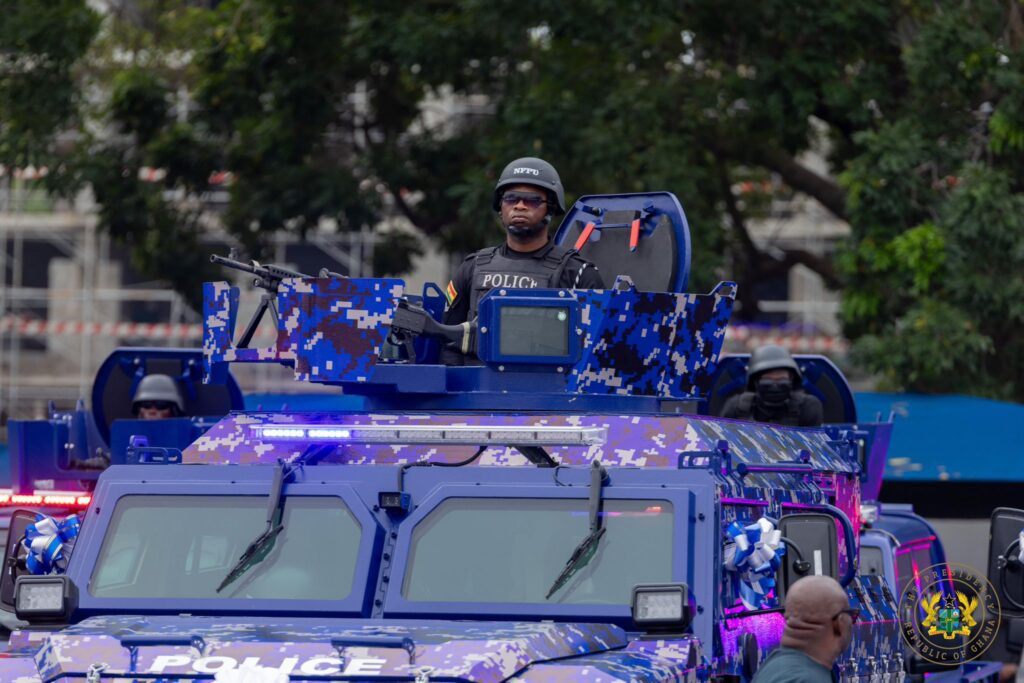
The President presented these interventions as complementary to healthcare investments, stressing that the state’s responsibility to police personnel extends to preventing injuries as well as treating them when they occur.
However, he did not disclose the financial value of the additional vehicles, the quantity of body armour procured or a specific delivery timeline for the tasers.
Mahama Pledges Continued Welfare Support for Bereaved Families
The President also reaffirmed the government’s commitment to supporting families of police officers who lose their lives in the line of duty, arguing that the state’s responsibility does not end with memorial ceremonies.
“Our obligation to the families of fallen officers continues long after this ceremony.”
President John Dramani Mahama
President Mahama disclosed that the government would work with the police administration to strengthen welfare support for bereaved families. He maintained that honouring fallen personnel must involve sustained assistance to the relatives they leave behind, alongside measures to make policing safer for serving officers.
Although the President did not outline the specific components of the proposed welfare package, he presented the commitment as part of a wider approach to improving the conditions of service within the Ghana Police Service.
GH¢300 Million Police Housing Commitment Complements Welfare Measures
The latest announcement follows another commitment by the President to improve accommodation for police personnel. Earlier this month, President Mahama unveiled a GH¢300 million allocation for the construction of 250 police apartments, adding housing infrastructure to the government’s stated priorities on police welfare.
The housing commitment, hospital expansion and provision of protective equipment collectively reflect the administration’s stated intention to address several aspects of police service conditions.
Despite the range of commitments outlined during the ceremony, some implementation details remain unclear. President Mahama did not specify the structure of the proposed support for bereaved families, including whether it would cover pensions, allowances, counselling or other forms of assistance.
The President also provided no detailed timelines for the completion of the hospital expansion beyond its inclusion in the 2027 budget, while the procurement details for some protective equipment remain undisclosed.
The GH¢200 million hospital allocation nevertheless provides a defined financial commitment towards expanding police healthcare infrastructure in Accra. Its implementation, alongside the operationalisation of the Kumasi and Tamale facilities, will be central to determining the extent to which the announced investments improve medical access and welfare support for police personnel.