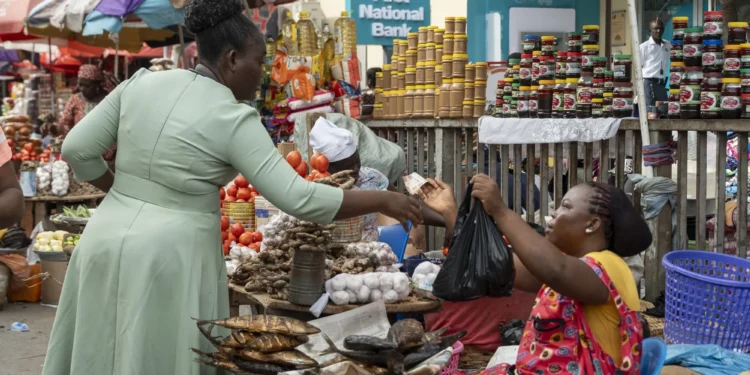
IMANI Africa’s Vice President, Selorm Branttie, has urged the Ministry of Local Government to launch a sweeping crackdown on street hawking, which he indicated continues to fuel urban congestion and disorder in Ghana’s cities.
The growing problem of street hawking, he argued, is a direct threat to pedestrian safety, vehicle movement, and city sanitation — and must be addressed with urgency and consistency.
Branttie, a well-known policy analyst, stressed that the Minister should direct all Metropolitan, Municipal, and District Chief Executives (MMDCEs) to decongest major streets and restore pavements for pedestrian use.
According to him, the current situation—where traders occupy walkways and parts of roads—has spiraled into a daily hazard for both motorists and pedestrians alike.
“We need to begin to let traders know that pavements are not shopping areas. We should task all town and country people to mark out areas for street markets and limit the street markets ONLY on those streets to take up the overflows.”
Selorm Branttie
Accordingly, he called for proper zoning by Town and Country Planning departments to designate clearly marked locations where street markets can be legally established.

Such market zoning, he said, should be strictly enforced to prevent illegal expansions that disrupt city life and undermine law enforcement efforts.


The impact of uncontrolled street hawking is visible in nearly every major urban center in the country.
“It is very annoying as a driver to have to navigate through heavy human traffic, have your car banged on and scratched by people, risk the lives of pedestrians, and create fertile grounds for thieves and lawlessness.”
Selorm Branttie
He further argued that the country must move away from politicizing the issue and instead approach it with discipline and resolve.
Street Hawking Undermines Urban Planning
Furthermore, Selorm Branttie did not mince words when describing the current state of urban movement, saying that even walking a short distance can become an ordeal because of the disorderly use of space.
He stressed that “these street pavements are for people to walk to and fro, and not rubbish dumps or hawking points.” Without decisive intervention, he warned, the growing chaos will continue to undermine public trust in local governance.
The IMANI executive urged authorities to “normalize sanitizing the streets,” adding that street order should not be seen as a one-time campaign but a continuous civic obligation.

His statements come at a time when urban residents have grown increasingly frustrated over deteriorating conditions in central business districts.
Meanwhile, the Mayor of Accra, Michael Kpakpo Allotey, appears to be taking steps in line with Branttie’s recommendations.
Speaking on efforts to restore order in the capital, Allotey outlined his strategy to engage directly with market leaders, rather than relying on top-down instructions that often fail to produce long-term results.
He noted that “I’m going to work with the market women. The market women understand that we have to fix this,” arguing that the lack of direct engagement with traders has historically undermined efforts to sustain urban cleanliness and order.
As part of his plan, Allotey intends to reinstitute the red line system—a demarcation originally introduced by former Mayor Oko Vanderpuije to limit how far traders could extend their stalls. This time, however, Allotey is adding a new layer of enforcement.
“They want me to have leaders from their camp. Maybe I’ll pick four or five of them to be their leaders. So I’m going to reintroduce the red line. So they’re going to stay back in the line, and the leaders will control them. It’s not a nine-day wonder thing, but it’s something that’s come to stay.”
Michael Kpakpo Allotey
Red Line Enforcement Begins Across Accra
To strengthen compliance, Michael Allotey also revealed his plans to deploy over a thousand enforcement personnel to operate in rotating shifts, ensuring round-the-clock monitoring of the red line areas. “This time I’m bringing over a thousand boys to run day and night. A 24-hour economy.”

He added that the Accra Metropolitan Assembly (AMA) would be the starting point for this new model.
“AMA is going to start 24-hour ticketing claims and a task force. We’re going to work to make sure the city stays alive till morning,” he said, stressing that his administration is committed to making the plan sustainable beyond his tenure.
Although the red line initiative failed to hold permanently during its previous iteration, Allotey is confident that with constant supervision and collaboration with market stakeholders, this new approach will lead to lasting results.
What remains critical, however, is consistency. Both Branttie and Allotey agree that without ongoing political will and institutional support, any gains made could quickly be reversed.
The renewed focus on addressing street hawking sends a clear signal that Ghana’s urban future hinges on order, planning, and civic discipline.
Whether other municipalities will adopt similar strategies remains to be seen, but for now, Accra appears poised to lead the charge toward restoring sanity to its streets.
READ ALSO: UK Suspends Trade Talks With Israel, Imposes Further Sanctions