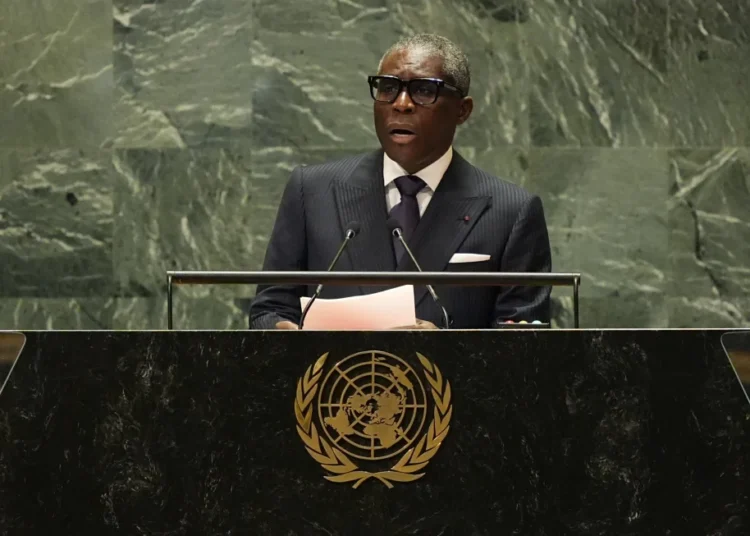
Equatorial Guinea has once again locked horns with France at the International Court of Justice (ICJ), urging judges to halt the sale of a lavish Paris mansion seized during a high-profile corruption case. The West African nation accused Paris of “neo-colonial” conduct and demanded the immediate return of the multimillion-dollar property, reigniting a complex legal and diplomatic battle over sovereignty, justice, and international law.
The dispute centers on a luxurious residence located on Avenue Foch, one of the most exclusive streets in Paris. The mansion, which boasts extravagant amenities including a private cinema, nightclub, and hammam, was confiscated by French authorities following a 2017 conviction of Teodoro Nguema Obiang Mangue, son of Equatorial Guinea’s long-time president.
French courts found Obiang guilty of embezzling public funds and laundering millions of dollars through lavish purchases abroad. He was handed a three-year suspended sentence, and his assets, including the mansion, a fleet of luxury cars, and vast sums of money, were seized as part of the legal proceedings.
On Tuesday, lawyers representing Equatorial Guinea challenged France’s ongoing control over the mansion.
“France’s approach may be described as paternalistic and even neo-colonial. We cannot accept such disdain for our sovereignty from France.”
Carmelo Nvono-Ncá, Equatorial Guinea’s representative to the court
The government is seeking a series of provisional measures to stop the French government from proceeding with the sale of the mansion and to compel the return of the property. They argue that the seizure violates international law and contravenes commitments under the United Nations Convention Against Corruption, to which both countries are signatories.
This is not the first time Equatorial Guinea has brought the issue before the ICJ. In 2020, the court ruled against its claim that the property qualified as a diplomatic mission, rejecting assertions that France had breached international protocols by confiscating the building. Nevertheless, the government returned to The Hague in 2022, filing a new case and asserting that Paris is now violating international obligations under the anti-corruption treaty.
The legal battle has drawn wider scrutiny due to Obiang’s international record. In 2021, the United Kingdom imposed sanctions on him, citing extravagant misuse of state funds, including the infamous $275,000 purchase of Michael Jackson’s crystal-studded glove. Investigations into his financial conduct have also been launched in Switzerland and Brazil.
Despite its abundant oil and gas reserves, Equatorial Guinea remains one of the most unequal nations globally, with wealth concentrated among the ruling elite. President Teodoro Obiang Nguema Mbasogo, the longest-serving head of state in Africa, has governed since 1979, while his son has been widely seen as his potential successor.

Colonial Legacies Still Echo Today
While Equatorial Guinea was historically Spain’s only colony in sub-Saharan Africa, France’s influence on its development has been significant. The nation’s proximity to former French colonies like Gabon and the Republic of Congo placed it within the orbit of France’s colonial ambitions in the region.
During the 19th and 20th centuries, France expanded its territorial reach in Central Africa by signing a network of cession and protectorate treaties with local rulers. These treaties, often signed under duress or misunderstood by indigenous leaders, gave France sweeping control over trade, law, and foreign policy. Though not directly colonized by France, Equatorial Guinea was affected by these maneuvers, with its borders, politics, and trade influenced by neighboring French territories.
French colonial strategies throughout the region were marked by harsh economic exploitation and cultural suppression. A system of concession companies operating under French rule inflicted widespread abuses, from forced labor to mutilation and displacement. The profits from these operations flowed back to Europe, entrenching patterns of poverty and instability that still cast shadows over the region today.
READ ALSO: Xi Voices China’s Readiness To Bolster Ties With Australia