

Ghana’s oil industry is once again in the spotlight as analysts call for greater operational efficiency among international oil companies, following a sharp financial downturn for Tullow Oil Plc.
Energy analyst and Executive Director of the Centre for Environmental Management and Sustainable Energy, Benjamin Nsiah, told reporters that oil companies can no longer depend solely on favourable crude prices to deliver strong returns.
“National and international oil companies must improve operations and increase output to remain profitable, especially since oil prices are unlikely to rise much higher than current levels.”
Benjamin Nsiah, Executive Director of the Centre for Environmental Management and Sustainable Energy
The London-listed producer announced a $61 million post-tax loss for the first half of 2025, a striking reversal from the $196 million profit recorded during the same period last year.
The results, which highlight the fragility of profits in the current oil market, have prompted industry watchers to urge a rethink of operational strategies.
“If prices stay flat and production remains constant, revenues will decline.
“Continued losses could eventually force some companies into liquidation.”
Benjamin Nsiah, Executive Director of the Centre for Environmental Management and Sustainable Energy

Mr. Nsiah emphasised that the current market environment calls for decisive action from producers.
He argued that increasing production volumes, coupled with cost-cutting and process optimisation, could help companies shield themselves from price volatility.
“The reality is that the market is not going to hand out windfalls forever.
“Firms need to take control of the factors they can influence — efficiency, output, and cost discipline.”
Benjamin Nsiah, Executive Director of the Centre for Environmental Management and Sustainable Energy
Tullow’s financial disclosures underline the pressure it is under. As of June 30, 2025, net debt stood at $1.6 billion, a marginal improvement from $1.7 billion in the same period last year.
The company reported cash gearing at 1.9 times net debt to EBITDAX, or 2.1 times excluding Gabon, down from 2.3 times at the close of 2024.
However, liquidity headroom, a key measure of financial flexibility fell to $0.2 billion from $0.7 billion a year earlier, signalling tighter cash conditions.
The company’s Chief Financial Officer and Interim CEO, Richard Miller, acknowledged the challenging landscape but insisted that management remains focused on delivering its long-term strategy.
“We are committed to refinancing our capital structure, optimising production, growing reserves, and managing costs.
“While the first half results reflect the realities of the market, our priorities remain unchanged, positioning the company for sustainable growth and value creation.”
Richard Miller, Chief Financial Officer and Interim CEO of Tullow
Oil Sector Strains

The current situation comes at a time when oil companies globally are grappling with a delicate balance between capital discipline and the need for growth.
Many producers, including Tullow, are operating in an environment where oil prices have stabilised but remain below the peaks of recent years, compressing margins.
Mr. Nsiah believes the lesson from this period is clear — operational excellence will determine which companies thrive and which struggle.
“In a flat price environment, every barrel matters. Improving well performance, reducing downtime, and streamlining operations can deliver gains that go straight to the bottom line.
“Companies that fail to adapt could see their market share erode and their financial resilience weaken.”
Benjamin Nsiah, Executive Director of the Centre for Environmental Management and Sustainable Energy
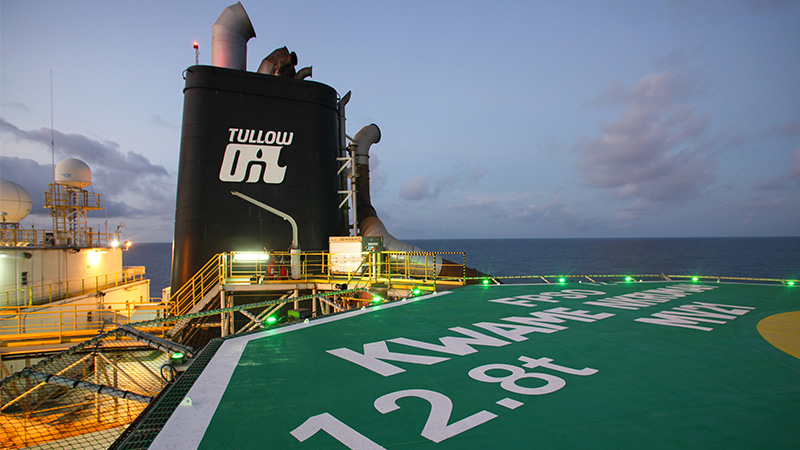
Despite the headwinds, Tullow’s leadership is signalling determination to press ahead with efficiency measures.
The company has previously outlined plans to optimise existing fields in Ghana, where it operates the Jubilee and TEN oil fields, and to pursue targeted drilling campaigns aimed at sustaining production levels.
Success in these areas could help offset the financial strain caused by soft prices and high debt servicing costs.
With petroleum revenues forming an important part of Ghana’s fiscal resources, the health of operators like Tullow directly impacts government budgets and the broader economy.
Looking ahead, much will depend on whether companies can adapt quickly enough to the new market dynamics.
While oil prices remain unpredictable, the consensus among analysts is that relying on price spikes to restore profitability is no longer a sustainable strategy.
If these measures are implemented effectively, the second half of 2025 could offer an opportunity for recovery. But without them, analysts warn that continued losses could test the patience of investors and lenders, potentially forcing tough decisions on asset sales or restructuring.
READ ALSO: IMF Urges BoG to Hold Tight on Policy Rate to Cement Disinflation Gains