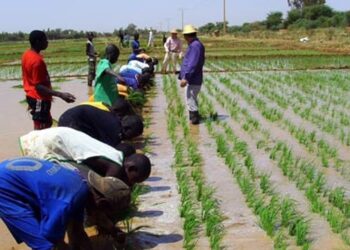

The Executive Director for Africa Education Watch (Eduwatch), Mr. Kofi Asare, has cited the ban on rice exports in the previous year for blame in wake of the worrying situation of food glut currently being experienced across farming communities in the country and has demanded that the National Food Buffer Stock Company (NAFCO) be well resourced to avert future occurrences.
Mr. Asare noted that while the government anticipated drought-induced food shortages, that has not been the case, as food gluts have become a major challenge for farmers across the country, with some even threatening to boycott the National Farmers’ Day scheduled to take place in December 2025.
“This is because prior to the ban, smuggling of paddy to sell in Nigeria at a higher price was big business, reducing national rice output. With the ban being enforced, given good weather and value chain support, such gluts could not have been unanticipated.”
Mr. Kofi Asare, Executive Director, Africa Education Watch (Eduwatch)

In August 2024, the government of Ghana placed a ban on the export of grains such as rice, corn, and soybeans in anticipation of drought-induced food shortages, as crop production in many parts of the country was severely impacted negatively by drought.
A year on after that decision by the government, farmers across the country are complaining over the lack of buyers for their produce from the previous harvesting season and fear that this year’s harvest may face the same fate if the government does not come to their aid.
Some farmer associations have even threatened to boycott this year’s Farmers’ Day celebrations, as they perceive that their call on government to take action has fallen on deaf ears.
Mr. Asare emphasized that gluts such as this highlight the critical role of the National Food Buffer Stock Company (NAFCO), which was created to stabilize food supply and prices by purchasing surplus grains during harvest periods, storing them safely, and releasing them strategically during lean seasons. The company ensures food security and supports farmers’ livelihoods across the country.

However, while the role of the National Food Buffer Stock Company (NAFCO), as copiously stated above, may seem as the perfect fit for the current challenges of food glut in the country, the Eduwatch Executive Director noted that the company faces significant operational constraints that hinder its effectiveness.
Chief among these are limited storage facilities, which restrict the volume of grains it can safely hold, and inadequate financial liquidity, which reduces its ability to purchase surplus produce during peak harvest periods. These challenges, he emphasized, undermine the company’s mission to stabilize food supply and support farmers.
“Its current effective warehouse capacity is around 10K MT, against a glut estimated at 200K MT for rice and maize alone from the last farming season. I understand Buffer Stock required GHC 700 million from the Government of Ghana to manage the glut but had access to only GHC 100 million.”
Mr. Kofi Asare, Executive Director, Africa Education Watch (Eduwatch)
Mr. Asare’s diagnosis of the problem is corroborated by the farmers themselves, as they have also complained that the government’s financial allocation to NAFCO is way inadequate to fulfill its mandate, citing the low prices NAFCO has proposed for the purchase of their surplus goods. The reason for their call on government to regulate the importation of rice in favor of locally produced rice, and purchasing same for its institutions

As notable personalities such as investigative journalist and anti-corruption campaigner Manasseh Azure Awuni have amplified the farmers’ call on government to, through the purchase of foodstuffs for its institutions such as prisons, armed forces, boarding schools, and special initiatives such as the School Feeding Programme, direct that all such purchases be made on the locally produced food that is being abandoned, Mr. Asare is also of the view that adequate resourcing of the National Food Buffer Stock Company (NAFCO) should be a priority for government in order to contain such challenges of food gluts in the future.
“Ensuring that Buffer Stock is adequately resourced to focus on its core mandate of food security, rather than Free SHS food procurement, is essential to preventing such gluts in the future. They need more warehouses, more cash, and more focus on managing food buffers.”
Mr. Kofi Asare, Executive Director, Africa Education Watch (Eduwatch)
With NAFCO constrained by limited storage space and currently underfinanced, making it unable to carry out its mandate of buying the surplus farm produce in a prompt response to the call by the farmers, it remains to be seen what decisions the government will take to solve the problem promptly.
READ ALSO: S&P Upgrades Ghana’s Credit Rating to ‘B-/B’ With Stable Outlook