
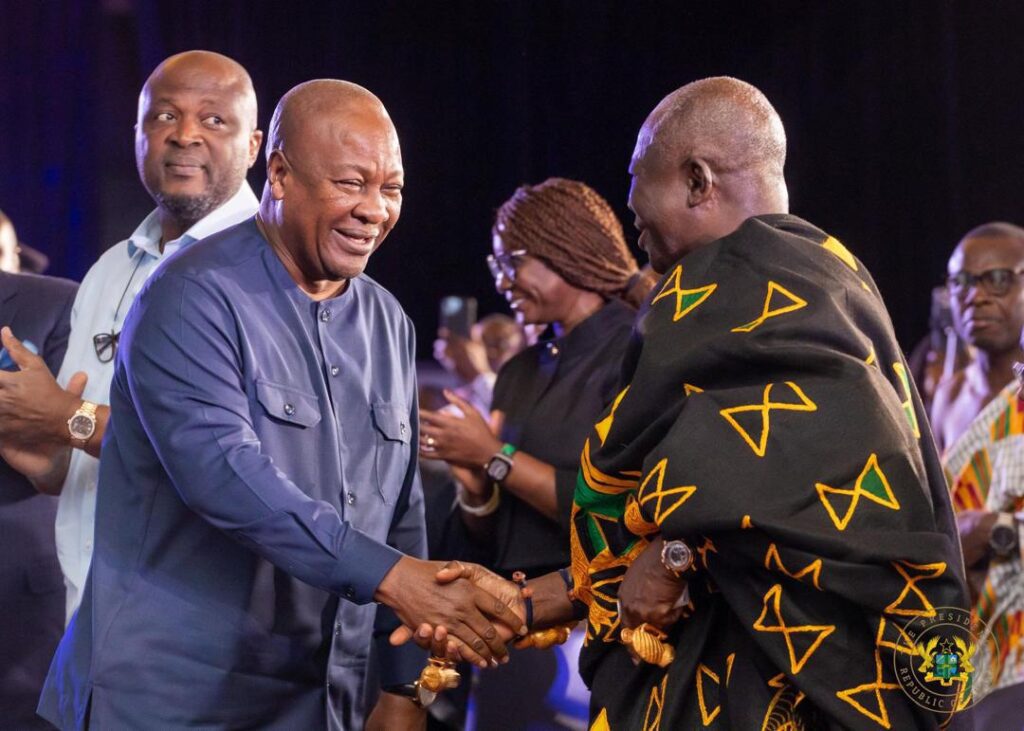
The government has announced that His Royal Majesty Otumfuo Osei Tutu II, Asantehene, will formally present his report and recommendations on the Bawku conflict mediation to President John Dramani Mahama on Tuesday, 16th December 2025.
The ceremony, scheduled for 4 p.m. at the Presidency, marks a crucial moment in Ghana’s renewed national effort to bring lasting peace to one of the country’s most complex and enduring conflicts.
In a statement issued by Felix Kwakye Ofosu, Minister for Government Communications and Presidential Spokesperson, the Presidency confirmed the upcoming presentation, describing it as a significant step toward consolidating the progress made in recent months.
“His Royal Majesty, The Asantehene, Otumfuo Osei Tutu II, will present the report on the mediation in the Bawku conflict to President John Dramani Mahama,” the statement noted, emphasizing the government’s appreciation for the Asantehene’s leadership in this delicate national assignment.
The presentation follows the completion of the final phase of the Asantehene’s mediation process, which culminated on Monday, 1st December 2025, at the Manhyia Palace Jubilee Hall in Kumasi.
After months of consultations, shuttle diplomacy, and discreet stakeholder engagements, the Asantehene succeeded in bringing the principal feuding factions together for their first face-to-face meeting under his mediation.
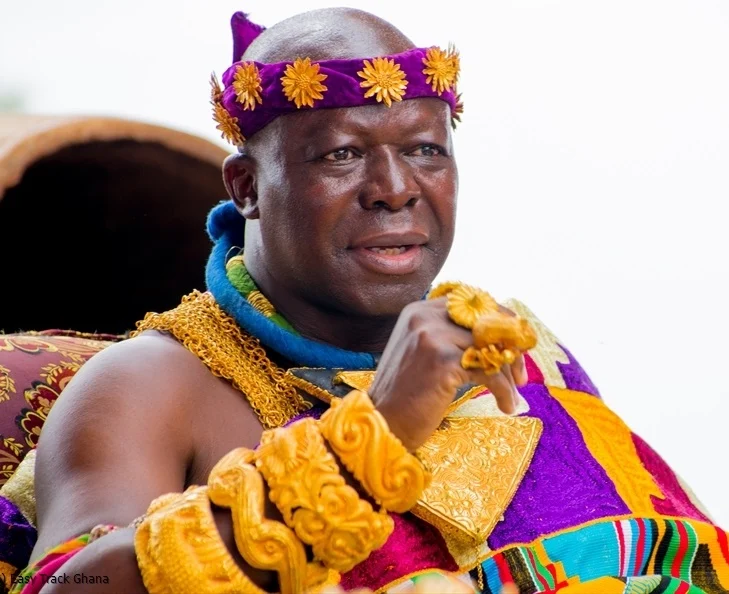
This landmark encounter, held under the authority and moral weight of the Golden Stool, was widely acknowledged as a turning point in efforts to rebuild trust among the communities of the Bawku traditional area.
For decades, Bawku has grappled with a deeply rooted and often volatile chieftaincy conflict that has fractured community relations, undermined economic activity, and left families and institutions living under recurring tension.
Periods of calm have repeatedly been disrupted by episodes of violence, making mediation efforts both urgent and challenging. Against this backdrop, Otumfuo’s intervention has carried significant national and cultural resonance.
His reputation as a unifying figure, coupled with his track record in conflict resolution, has been seen as uniquely suited to bridging long-standing divides.
Sources close to the mediation process have described the Asantehene’s approach as patient, thorough, and grounded in traditional wisdom. He is believed to have insisted that dialogue—not imposition—must lead the path to peace.
His sessions with elders, representatives of the feuding gates, youth leaders, security officials, and civil society were aimed at understanding grievances, clarifying historical claims, and building a framework for coexistence.
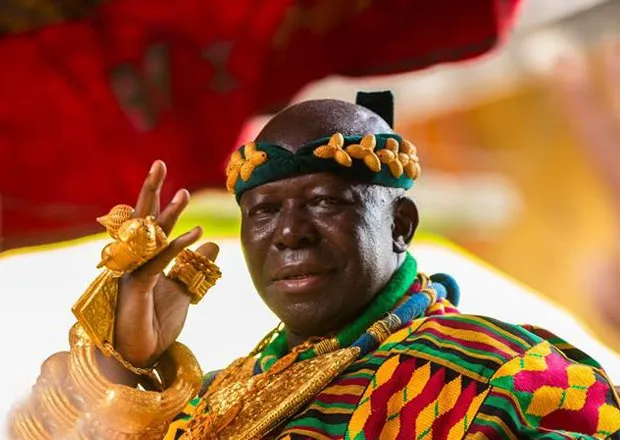
The report he will present to the President is expected to reflect both the specific recommendations reached during the final mediation engagements and a broader roadmap for sustainable peacebuilding.
President Mahama, who has repeatedly affirmed that peace in Bawku remains a top national priority, views the Asantehene’s report as central to shaping the next phase of state action.
Looking Ahead
The President is expected to consult the National Security Council, relevant ministries, and stakeholders in the Bawku traditional area once the report is received.
There is strong anticipation that the recommendations will inform a comprehensive government-led peace implementation plan anchored on community dialogue, strengthened security arrangements, and socio-economic interventions.
The symbolic significance of the Asantehene’s involvement has not been lost on observers. Many Ghanaian leaders, including chiefs, peacebuilding experts, and religious authorities, have hailed his willingness to assume a mediatory role in a conflict outside his kingdom.
They argue that his leadership underscores a broader national truth—that ensuring peace and cohesion in any part of Ghana is a responsibility shared by all. The upcoming presentation at the Presidency also reflects a deepening collaboration between traditional authority and the state in addressing intractable conflicts.
Analysts note that while political actors play crucial roles in restoring law and order, traditional institutions often hold the cultural legitimacy necessary for resolving disputes rooted in history, lineage, and identity.
As the nation awaits the details of the Asantehene’s report, hopes are high that it will provide a credible pathway to ending one of Ghana’s longest-running communal conflicts.
For residents of Bawku—farmers, traders, youth, elders, and displaced families—the desire for normalcy has been urgent and longstanding. The recent face-to-face meeting in Kumasi signaled what many describe as the most promising opening in years, raising expectations that 2025 could mark a decisive turn toward peace.
By formally receiving the Asantehene’s recommendations, President Mahama is set to usher in a new chapter in the national quest to stabilize the Bawku area.
The event on December 16 is expected to attract significant national attention, not only for its political importance but also for what it represents: a convergence of state power and traditional authority in the service of unity.
READ ALSO: BoG Battles Seasonality Storm as Cedi Slips Against Major Currencies