
The Electricity Company of Ghana (ECG) has assured consumers of continuous power supply despite acknowledging that the latest tariff increase approved by the Public Utilities Regulatory Commission (PURC) is insufficient to support its full operational and investment needs.
According to the company, the nearly 10 percent upward adjustment is far lower than what it requested, but ECG says it will “do everything possible” to keep the lights on even if it requires borrowing to finance critical activities.
Speaking in an interview, Energy Economist at ECG, Ebenezer Baiden, explained that although the PURC attempted to strike a fair balance between consumer affordability and utility requirements, the approved adjustment does not provide the financial cushion ECG had sought.
“We have said it’s not enough, but we will make sure the lights are on.
“And if we have to even borrow to make sure we finance such services, we’ll do that.”
Ebenezer Baiden, Energy Economist at ECG
Mr. Baiden said the PURC’s decision reflects what regulators believe consumers can reasonably afford at this time.
“For us, PURC has done the balancing act. Though we require a number, what they say is, this is what consumers can afford.
“So we’re going to now take whatever has been given and then work with it.”
Ebenezer Baiden, Energy Economist at ECG
Outstanding Investment Commitments Remain a Concern

ECG has accumulated major investment obligations over the years, particularly for projects designed to stabilise and modernise the distribution network. Mr. Baiden said the new tariff level provides only a narrow margin to begin clearing these commitments.
“We’re supposed to do our best out of the revenues that we’ve been given. We are in a situation where investments have been made. We’ve not been able to pay for it.
“Now we’ve been given some 9% or 10% for us to be able to recover as part of this cost… and pay for it. We’re able to clean our books.”
Ebenezer Baiden, Energy Economist at ECG
He explained that ECG’s request had been significantly higher. The company had pushed for a rebasing of its distribution tariff, something he said had not been reviewed “for a long period,” resulting in a projection of 46 percent industry-wide tariff adjustment.
“When you put the 2 to 5% for ECG, the 56% for VRA, and then up to 100% for GRIDCo, all come up to 46%.
“So we’re talking about a 46% adjustment that we put before PURC, and then PURC says, I’m doing 9.86%.”
Ebenezer Baiden, Energy Economist at ECG
Cash Waterfall Mechanism Providing Some Relief
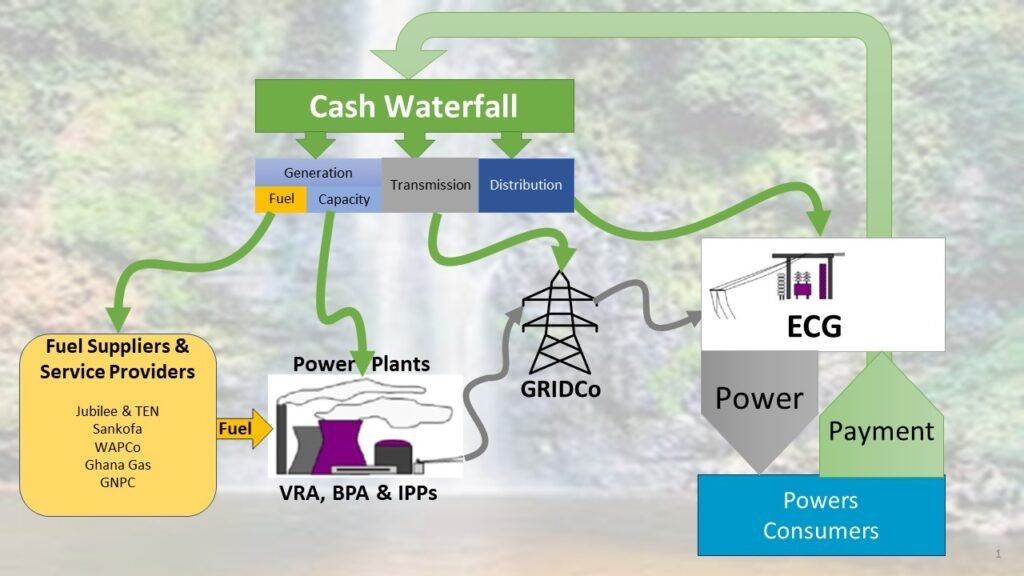
One of the bright spots, Mr. Baiden revealed, is the improved functioning of the Cash Waterfall Mechanism (CWM), which ensures that power sector revenues are distributed transparently across generators, transmission companies and distributors.
“Last month, Cash Waterfall was able to pay for most of the invoices that came from upstream providers and the SOEs.
“So it’s looking good. We’ll work with what we have, and then make sure that we please our customers.”
Ebenezer Baiden, Energy Economist at ECG
He added that the sector’s financial environment has improved compared to previous years.
“From where we are coming from and where we are today, we think that it can be better… It’s better.
“Whatever we have, we take it, we work with it, and make sure that we deliver services to our customers.”
Ebenezer Baiden, Energy Economist at ECG
Mr. Baiden acknowledged that the structure of the sector continues to place heavy cost burdens on distribution. “Generation cost is up to about 65 to 70% of the total buildup,” he explained.
He credited recent government renegotiations of generation contracts with easing some of the pressure, noting that the reforms “had quite some impact” on moderating the cost of supply.
ECG Points to Customer-Facing Improvements
Despite financial constraints, ECG insists it is investing in technologies and systems aimed at improving customer experience and service delivery.
“Look at the customer service centres. Look at the automation now; the Power App, you can report faults… and all these were some of the issues.”
Ebenezer Baiden, Energy Economist at ECG
According to him, these enhancements are beginning to ease customer frustrations while improving operational efficiency across ECG’s network.
When pressed on whether the tariff increment was enough to guarantee stability, Mr. Baiden was frank: “It’s not enough,” he said. But he maintained that ECG is committed to ensuring reliable power supply regardless of the financial strain.
His message to consumers was clear: even though the company wanted more, it would operate within its means and continue working toward a more stable power distribution system.
READ ALSO: Developing Countries Restructure $90bn in Debt — But Rising Costs Spell Trouble for Ghana