The Public Utilities Regulatory Commission (PURC) has confirmed that the Electricity Company of Ghana (ECG) fully complied with the approved Cash Waterfall Mechanism (CWM) allocations for October 2025, disbursing more than GHS 1.33 billion across power sector entities.
The confirmation was contained in the Commission’s latest validation report, which outlines how revenue collected from the regulated electricity market was distributed to Independent Power Producers (IPPs), State-Owned Enterprises (SOEs) and regulators.
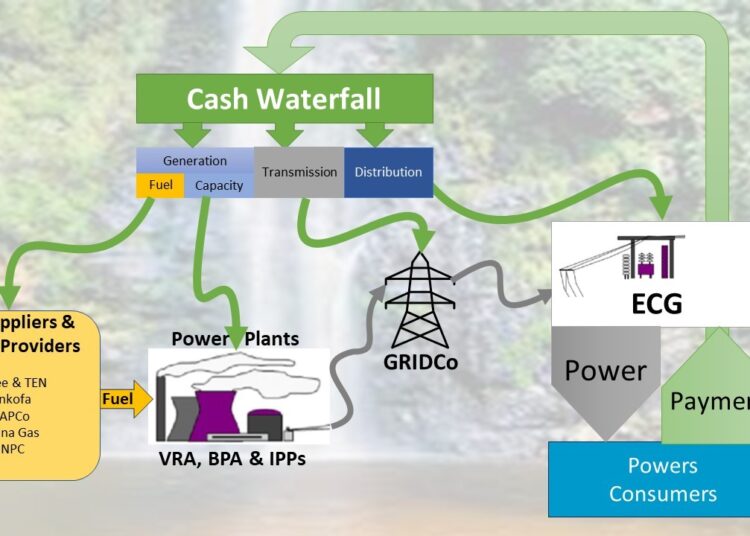
According to PURC, the CWM remains a critical tool to ensure “equitable and transparent” allocation of funds across the electricity value chain, thereby supporting financial sustainability in a sector long burdened by revenue shortfalls and payment delays .
“ECG recorded total revenue of GHS 1,428,110,224.05 for October 2025, forming the basis for that month’s allocation under the revised Cash Waterfall Mechanism.”
Public Utilities Regulatory Commission (PURC)
Of this, “GHS 640,610,056.04 representing the statutory fixed payments for Level A beneficiaries,” was disbursed to IPPs and the West African Gas Pipeline Company (WAPCo).
The remaining revenue, after deducting statutory payments of GHS 95,475,021.01, left GHS 692,025,147.00 available for allocation to SOEs and regulators under Level B.
PURC’s report stresses that this two-tiered approach ensures that IPPs who account for a large share of power generation, receive predictable payments, while also safeguarding the financial obligations of state power utilities.
Payments to Independent Power Producers
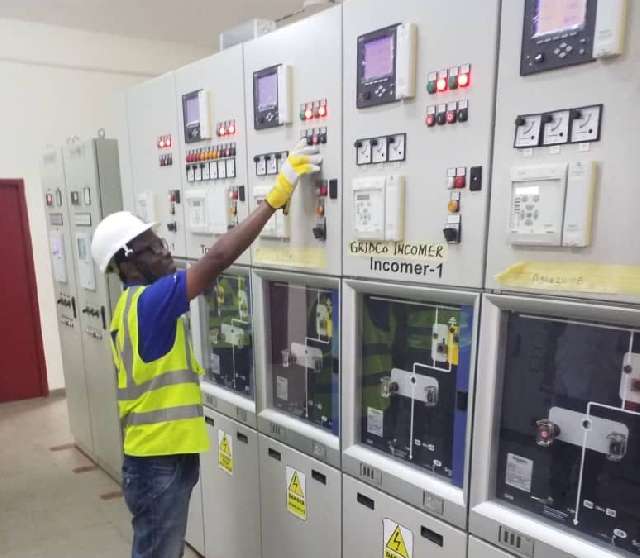
The Commission’s breakdown of Level A payments shows that all IPPs received the full amounts approved under the model. The total of USD 59,042,401.48, equivalent to GHS 640.61 million, was paid without deviation.
Cenpower, Karpower, Asogli Power and other major generating companies all received their expected disbursements. For instance, Karpower was paid GHS 154.9 million, while Cenpower received GHS 130.2 million, amounts that matched exactly what had been approved in the CWM model.
PURC noted that this adherence to approved payments is significant given past tensions between ECG and IPPs over arrears and inconsistent transfers.
The Commission emphasised that the October 2025 outcome demonstrates improved discipline in the revenue allocation system.
SOEs and Regulators Receive Expected Transfers
Level B institutions, including the Volta River Authority (VRA), Bui Power Authority, Ghana Grid Company (GRIDCo), Ghana National Gas Company (Ghana Gas), and regulatory bodies also received the exact amounts approved for them.
The report confirms that VRA received GHS 145.6 million, GRIDCo received GHS 94.15 million, and ECG itself retained GHS 273.1 million to support ongoing operational costs. Regulatory levies, including allocations for the PURC, Energy Commission and Ministry of Energy, were all transferred in full as scheduled.
PURC stated, “This reflects ECG’s compliance with the approved payment to Level A and Level B,” adding that the Commission will continue to work closely with stakeholders to “ensure transparency in the sector”.
Significance for the Power Sector

The validation comes at a time when Ghana’s energy sector faces continued liquidity challenges, largely driven by foreign exchange pressures, increasing generation costs, and rising system losses.
The Cash Waterfall Mechanism, first revised and approved by Cabinet in May 2025, was designed to tackle these structural issues by ensuring predictable cash flows along the power sector value chain.
Industry analysts note that timely payments to IPPs are particularly critical, as delays have historically triggered threats to shut down generation plants, potential disruptions to supply, and strained government–producer relations.
The October compliance results, therefore, signal improving fiscal discipline and a more stable operational environment for both private and state-owned power providers.
PURC concluded its validation report with a commitment to deepen transparency and policing of power sector payments.
“The Commission has validated payments and receipts from stakeholders along the energy value chain,” it said, reaffirming its role in maintaining accountability across the sector .
With future CWM cycles scheduled monthly, PURC stated it would continue to publish validation outcomes to give the public and industry participants full visibility into how electricity revenues are allocated.
As the country enters a period of wider energy sector reforms, including tariff reviews, demand management measures, and potential restructuring of energy SOEs, stakeholders say that the strengthened CWM provides a more reliable foundation for financial planning and sector stability.
READ ALSO: GSE Indices Fight Back as Composite and Financial Stocks Hit Fresh Highs for December