India and New Zealand have reached a free trade deal, seeking to deepen economic ties and shore up growth at a time of mounting global trade uncertainties.
The move comes as New Delhi accelerates efforts to diversify export destinations as part of a broader strategy to offset the impact of steep US import tariffs.
The India-New Zealand trade agreement, negotiated over nine months, aims to lower tariffs, ease regulatory barriers and expand cooperation across goods, services and investments.
It emphasizes India’s push to lock in trade partnerships beyond traditional markets as global commerce faces strains from unpredictable tariffs and geopolitical tensions, slowing growth and raising protectionism.
As part of the deal, India would get zero-duty-export access for all its goods to New Zealand while Wellington would get duty concessions and market access for about 70% of New Delhi’s tariff lines, covering 95% of its exports in a phased manner, officials said.
India’s major sectors that will gain from tax free exports include textiles, apparel, engineering goods, leather and footwear, and marine products, while New Zealand’s major gains will be in horticulture, wood exports and sheep wool, among others.
New Zealand has committed investments worth $20 billion in India over a period of 15 years as part of the agreement, India’s Trade Ministry said.
New Delhi has excluded from the deal dairy imports such as milk, cream, whey, yoghurt, and cheese, along with animal and vegetable products, including goat meat, onions and almonds, citing “domestic sensitivities.”
New Zealand Prime Minister Christopher Luxon said in a post on X that he spoke to his Indian counterpart Narendra Modi on conclusion of the talks.
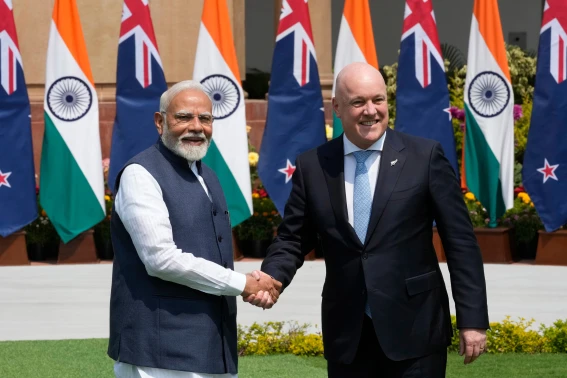
He stated that New Zealand’s exports to India are forecast to increase by $1.1 billion to $1.3 billion annually over the coming two decades as a result of the agreement. “Boosting trade means more Kiwi jobs, higher wages and more opportunities for hard working New Zealanders,” he said.
New Zealand Trade Minister, Todd McClay said that the agreement gives the country access to markets that India has not provided to any other country.
“New Zealand is the first country to secure any access for apples and honey into India in an FTA. We have secured the best access for kiwi fruit into India of any country in the world.”
Todd McClay
A statement from Modi’s office said that the trade agreement would serve as a catalyst for greater trade, investment, innovation and shared opportunities between both countries.
Formal Signing Between India, New Zealand Expected Early Next Year
India’s Chief Negotiator, Petal Dhillon told reporters that a formal signing of the agreement between India and New Zealand is expected in the first quarter of next year after legal scrubbing of the negotiated text.
Bilateral trade between India and New Zealand remains modest compared with New Delhi’s bigger partners, but officials said that the deal has strong growth potential.
Trade Secretary Rajesh Agarwal said that two-way trade that includes merchandise goods and services stood at $2.4 billion in 2024, which the two sides hope to double in about five years.
Indian Trade Minister, Piyush Goyal said that the agreement demonstrates India was “rapidly expanding” its trade relations with countries that complement the Indian economy rather than competing with it.
India is betting that a wider network of trade agreements will help cushion external shocks and anchor its export ambitions. In recent months, New Delhi has accelerated a push to finalize several free trade agreements.
The country is in advanced talks with the European Union and Chile, among others, and hopes to finalize terms of reference soon to negotiate a pact with Canada.
READ ALSO: High Interest Rates Here to Stay as IC Securities Flags Tough Monetary Stance into 2026