

Findings from the December 2025 polls conducted by Global InfoAnalytics suggest that the National Democratic Congress continues to enjoy broad support across generational, educational, and regional lines, while the New Patriotic Party faces growing challenges, particularly among younger voters and those with higher levels of education.
The data points to shifting political dynamics that could shape future electoral contests if current trends persist. According to the survey, the NDC leads the NPP in every age category captured in the poll. Among voters aged 18 to 24, the NDC records 42 percent support compared to 22 percent for the NPP, with a sizeable 19 percent identifying as floating voters.
Similar patterns appear in the 25 to 34 and 35 to 44 age brackets, where the NDC maintains around 40 to 42 percent support, while the NPP trails by double digit margins. Even among voters aged 55 to 64, a demographic often considered more stable in its political preferences, the NDC holds a five point lead over the NPP.

The data indicates that undecided voters remain significant across generations, ranging from 10 to 16 percent, suggesting that while the NDC currently dominates, voter loyalty is not entirely fixed. Analysts note that this pool of undecided and floating voters could still influence outcomes, especially if economic conditions or campaign messaging shift.
Educational Affiliation: NPP Struggles at all Levels
Educational attainment appears to be another critical factor shaping party support. The poll shows that the NPP is struggling across most education levels, with its sharpest decline recorded among tertiary educated voters.
Among respondents with tertiary education nationwide, the NDC commands 43 percent support, while the NPP records just 21 percent. Floating voters make up 22 percent of this group, underscoring uncertainty among educated voters who may be dissatisfied with both major parties but currently lean away from the NPP.
At the senior high school and junior high school levels, the NDC also maintains clear leads. Among SHS graduates, 40 percent support the NDC compared to 28 percent for the NPP. The pattern is similar at the JHS level, where the NDC records 43 percent support against the NPP’s 28 percent.
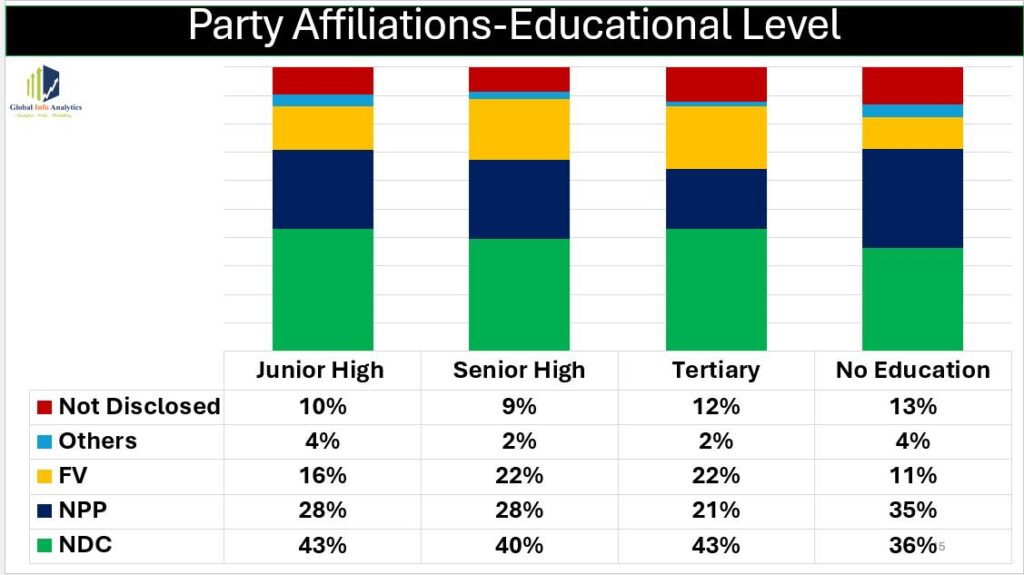
The only category where the NPP comes close to parity is among voters with no formal education, where it secures 35 percent support compared to the NDC’s 36 percent. Even here, a notable proportion of voters remain undecided.
Regional Breakdowns
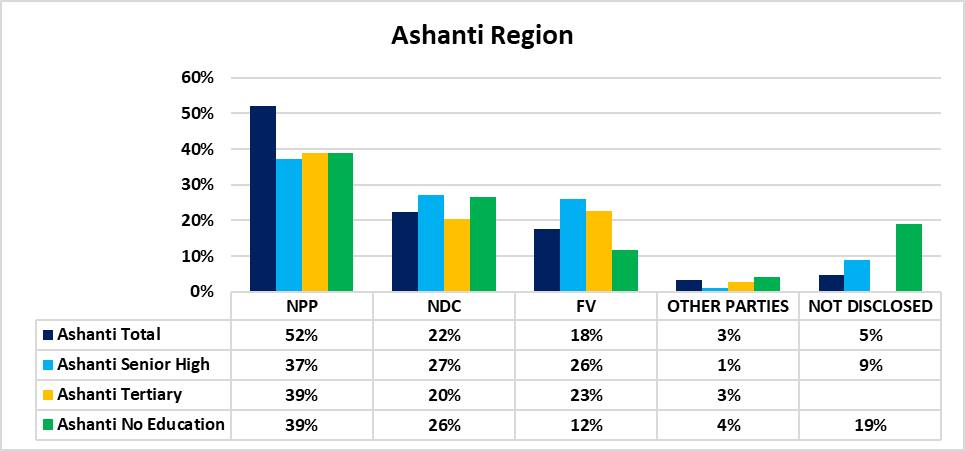
Regional breakdowns further illustrate the complexity of voter behaviour. In the Ashanti Region, traditionally considered a stronghold of the NPP, the party still leads overall with 52 percent support. However, among SHS and tertiary educated voters in the region, the NPP’s dominance weakens significantly.
Tertiary-educated voters in Ashanti show 39 percent support for the NPP against 20 percent for the NDC, with a substantial proportion identifying as floating voters. This suggests that education is softening traditional regional loyalties.
In the Central Region, the NDC demonstrates overwhelming strength across nearly all education levels. Among tertiary educated voters, the NDC records a striking 67 percent support, while the NPP trails at 23 percent. Similar margins are seen among SHS and JHS educated voters, reinforcing the region’s growing alignment with the NDC.
The Eastern Region presents a more competitive picture. While the NDC leads among JHS and SHS educated voters, the NPP edges ahead among those with no formal education and slightly among tertiary graduates. High levels of undisclosed and floating voters in this region point to volatility and the potential for shifts depending on political developments.
The Politically Fluid Region Favors NDC
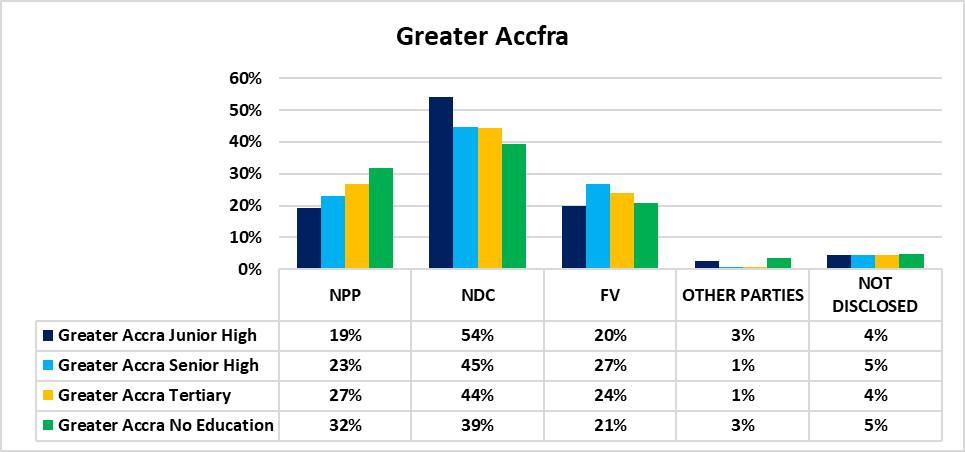
Greater Accra continues to reflect its status as a politically fluid region. Across JHS, SHS and tertiary education levels, the NDC maintains clear leads, particularly among less educated voters.
However, the proportion of floating voters is high, especially among SHS and tertiary groups, highlighting the capital’s openness to persuasion and issue driven politics.
In the Northern Region, the data reveals a more mixed outcome. Among voters with no education and JHS qualifications, the NPP shows stronger numbers, while the NDC edges ahead among SHS and tertiary educated voters.
This suggests that educational attainment is playing a decisive role in reshaping political preferences and choices even in traditional regions with established voting patterns.
The Volta Region remains firmly aligned with the NDC across all education levels, though the presence of floating voters and support for other parties is more pronounced than in the past.
Similarly, in the Western Region, the NDC leads across most categories, but with notable support for other parties and a high proportion of undisclosed respondents.
Overall, the Global InfoAnalytics poll paints a picture of an electorate in transition. The NDC’s dominance across generations and education levels points to sustained appeal, while the NPP’s losses among younger and more educated voters raise strategic questions for the party.
With significant numbers of floating and undecided voters nationwide, the data suggests that future elections will depend not only on traditional loyalties but also on how parties respond to evolving voter expectations.
READ ALSO: Anthony Joshua Pulled From Wreckage After Horror Nigeria Crash That Claims Two Lives