
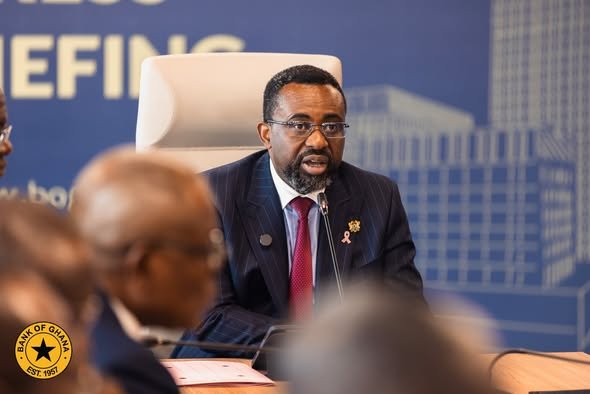
The Bank of Ghana has disclosed that losses incurred under its Domestic Gold Purchase Programme (DGPP) amounted to approximately GHS 5.66 billion as of December 2024, directly contradicting claims by the New Patriotic Party Minority Caucus in Parliament that the programme recorded no losses between 2021 and 2024.
The clarification was contained in an official response dated January 12, 2026, from the Bank of Ghana to the Multimedia Group, following a formal request for information on the performance of the programme since its inception in June 2021.
The data provided by the central bank outlined gold quantities purchased, their total value, and the associated financial losses recorded over the period under review.
According to the Bank of Ghana, the Domestic Gold Purchase Programme was introduced as a strategic intervention to support currency stability, which is a core mandate of the central bank.
The programme seeks to increase and diversify Ghana’s foreign exchange reserves through the domestic purchase of gold, particularly from the artisanal and small-scale mining sector, while strengthening confidence in the economy by improving reserve buffers.

The figures released by the Financial Markets Department show that in 2022, the programme recorded relatively low volumes and losses. Total gold purchases stood at 3.47 tonnes, including 0.76 tonnes from the artisanal and small scale mining sector, with a total value of 194.43 million United States dollars.
Losses for the year amounted to GHS 74.44 million, reflecting early operational and pricing challenges associated with the programme. Activity under the programme expanded significantly in 2023. Total gold purchases rose to 37.02 tonnes, with 24.87 tonnes sourced from artisanal miners.
The total value of gold acquired during the year was estimated at 1.55 billion United States dollars. However, losses also increased sharply. Net losses from G40 transactions were recorded at GHS 317.69 million, while net losses under the Gold for Reserves framework stood at GHS 1.054 billion, bringing total losses for 2023 to about GHS 1.37 billion.
In 2024, the scale of operations intensified further as the Bank of Ghana increased gold purchases to support the cedi amid heightened macroeconomic pressures. Total gold purchases for the year reached 56.47 tonnes, including 45.33 tonnes from the artisanal and small scale mining sector.
The value of gold purchased rose to approximately 4.07 billion United States dollars. Correspondingly, losses escalated, with net G40 losses of GHS 1.82 billion and net G4R losses of GHS 3.84 billion. This brought total losses for 2024 alone to GHS 5.66 billion.
Explanation of Losses
The central bank explained that the reported losses include losses from artisanal and small scale mining gold purchases for the years 2022, 2023, and 2024, which amounted to GHS 74 million, GHS 2.15 billion, and GHS 4.84 billion respectively.
It further clarified that net G40 losses include losses from both gold and oil transactions under the programme, while net G4R losses reflect losses from artisanal gold purchases and other segments of the Gold for Reserves initiative.
Figures for 2025, according to the Bank of Ghana, are still pending external audit confirmation and were therefore not included in the loss totals disclosed. The Bank noted that gold purchases in 2025 increased substantially to 110.99 tonnes, with 100.60 tonnes sourced from artisanal miners, valued at approximately 11.4 billion United States dollars.
However, it stressed that audited loss figures for the year will only be confirmed after the completion of external reviews. The disclosure directly challenges assertions by the NPP Minority Caucus in Parliament, which had publicly claimed that the Domestic Gold Purchase Programme did not record any losses between 2021 and 2024.
The Bank of Ghana’s data provides a detailed breakdown that clearly indicates otherwise, highlighting cumulative losses that grew sharply as the programme scaled up over the period.
BoG Defends Programme
Despite acknowledging the losses, the Bank of Ghana defended the programme as a non commercial, policy driven intervention aimed at safeguarding macroeconomic stability rather than generating short term financial gains.
The central bank argued that the costs should be assessed against the broader economic benefits of improved foreign exchange reserves, reduced pressure on the cedi, and enhanced confidence in the economy during periods of external financing constraints.
The Bank maintained that currency stability is a public good that often requires difficult trade offs, particularly in times of economic stress. It emphasized that the Domestic Gold Purchase Programme contributed to strengthening Ghana’s reserve position and moderating exchange rate volatility, even though these outcomes came at a measurable financial cost.

In its response, the Bank of Ghana reiterated its commitment to transparency and accountability, noting that some of the figures for earlier years were drawn from audited accounts of different segments of the Gold for Reserves programme. It also assured stakeholders that audited figures for 2025 would be made public once the external audit process is completed.
As public debate intensifies over the effectiveness and cost of the Domestic Gold Purchase Programme, the latest disclosure places fresh focus on the balance between financial losses and macroeconomic stabilization.
The Bank of Ghana’s detailed data underscores the scale of the intervention and sets the stage for continued scrutiny of unconventional monetary tools used to manage Ghana’s economy in recent years.
READ ALSO: Mahama Attends World Economic Forum, Set to Hold Meeting on Accra Reset Initiative