
The Chief Executive Officer (CEO) of the Tree Crops Development Authority (TCDA), Dr. Andy Osei Okrah, has unveiled an ambitious roadmap to double Ghana’s cashew revenues through a new national pricing framework, asserting that the sector is currently sitting on an untapped annual potential of US$660 million.
Speaking during a high-level stakeholder engagement in the Bono Region, Dr. Okrah confirmed that the authority is moving to overhaul the industry through strict regulatory reforms. For Dr. Okrah, the transition from a raw-material exporter to an industrial processing hub is no longer a choice but a necessity to protect the livelihoods of over 500,000 Ghanaians tethered to the value chain.
“The country’s cashew industry could generate more than US$660 million in annual revenue if the sector is supported with effective regulation, adequate processing infrastructure and strong export facilitation.
“Our goal goes beyond exporting raw nuts to building a robust cashew economy that promotes industrial processing, job creation and higher export earnings for the country”
Dr. Andy Osei Okrah, CEO of the Tree Crops Development Authority
The TCDA boss emphasized that while cashew remains one of Ghana’s most vital non-traditional exports, the lack of a cohesive regulatory structure has allowed inconsistent pricing and market exploitation to thrive.

Currently, the economy generates roughly US$300 million from the crop annually, but the vast majority of this value is lost because more than 90 percent of production is shipped as raw nuts to processing plants in Vietnam and India.
By enforcing new licensing requirements and stabilizing the farm-gate price, Dr. Okrah intends to create the predictability required to attract private investment into local processing facilities.
Protecting the Farm-Gate Economy
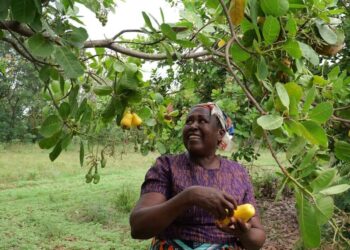
A central pillar of the TCDA’s strategy is the implementation of a national pricing framework designed to safeguard the 300,000 farmers who form the backbone of the sector.
In hubs like Bono, Bono East, and Ahafo, farmers have long been vulnerable to price volatility and the whims of aggregators. Dr. Okrah’s team is now implementing systems to ensure that price discovery is transparent.
“The authority is currently rolling out measures to stabilise farm-gate prices, enforce licensing requirements and ensure transparency across the value chain.
“These interventions are intended to protect farmers from market exploitation, attract investment into local processing facilities and strengthen the country’s position as a leading cashew exporter in West Africa”
Dr. Andy Osei Okrah, CEO of the Tree Crops Development Authority
This focus on transparency is part of a broader “Tree Crops Development Agenda,” which identifies cashew as one of six high-value crops capable of diversifying Ghana’s export earnings away from a heavy reliance on cocoa.
By introducing a standardized licensing system for buyers and exporters, the TCDA aims to flush out “fly-by-night” traders who disrupt the market, ensuring that only licensed entities with a commitment to fair trade can operate within the seven major production regions.
Capturing the Value-Addition Gap
The disparity between Ghana’s production and its processing capacity remains the industry’s greatest challenge. Despite exporting over 139,000 metric tonnes of raw cashew nuts in recent years, the domestic processing sub-sector remains underdeveloped.
Dr. Okrah is advocating for a policy shift that incentivizes the conversion of raw nuts into kernels locally. According to him, this move would not only double the revenue potential but also create an estimated 200,000 additional jobs in transport, sorting, and industrial processing.
Industry experts believe that with the right infrastructure, Ghana can rival regional giants like Côte d’Ivoire and Nigeria. The TCDA’s engagement with traditional leaders and processors in the Bono Region is a strategic attempt to build the local consensus needed to support these industrial goals.
By aligning traditional oversight with modern regulatory standards, the authority hopes to build a resilient agricultural economy that can withstand global commodity shocks.

As the TCDA intensifies its export facilitation efforts, the focus is shifting toward innovation and market expansion. The Bono forum served as a platform to deepen the understanding of how TCDA regulations will integrate with the government’s wider industrialization drive.
For the 500,000 people involved in the trade, the new pricing mechanisms and export strategies represent a lifeline toward sustainable income and economic stability. Ultimately, Dr. Andy Osei Okrah’s vision for a $660 million cashew industry is predicated on the successful enforcement of these new rules.
By moving away from the “raw-nut-only” model and embracing a value-added future, the TCDA is positioning Ghana to capture the full economic weight of its “grey gold.”
READ ALSO: COMAC Says Fuel Price Drops Were Long Anticipated