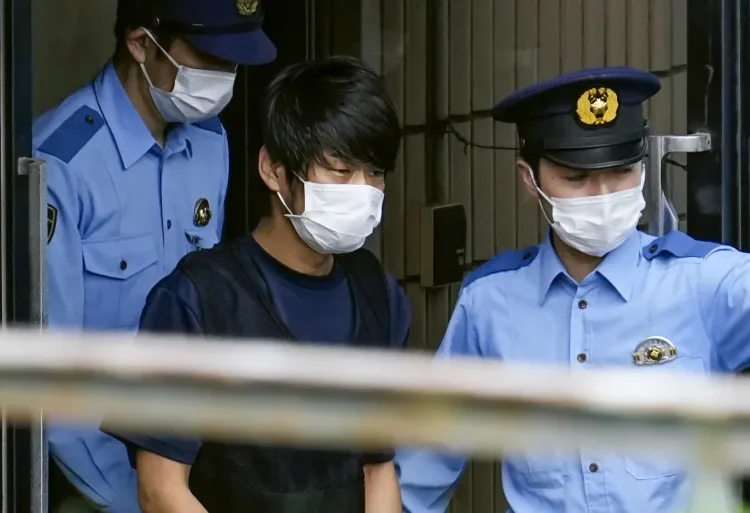
The gunman who killed Japan’s former Prime Minister Shinzo Abe has been sentenced to life in prison.
Judge Shinichi Tanaka handed down the sentence against Tetsuya Yamagami at a court in the city of Nara, more than three years after the politician’s assassination in broad daylight shocked the world.
People queued to get tickets to enter the Nara courtroom, highlighting the intense public interest in the trial.

Tetsuya Yamagami shot Abe in broad daylight with a gun he fashioned at home, while the former leader was giving a campaign speech on a street in the western city of Nara in 2022.
Abe had stepped down as Prime Minister in 2020 over health reasons but he was still politically active and wielded enormous influence as Japan’s longest-serving Premier.
Yamagami, now 45, was arrested at the scene and indicted the following year on murder and firearms charges.
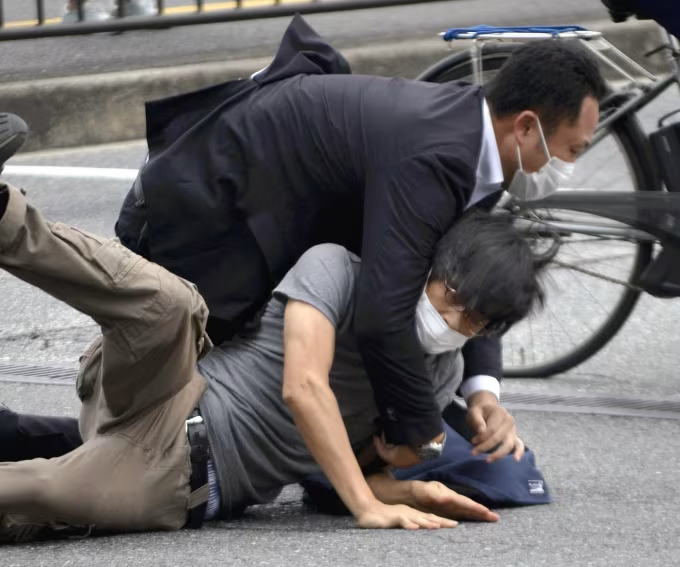
Yamagami, 45, had admitted to fatally shooting Abe in 2022 in a crime that convulsed Japan, where gun violence is extremely rare.
In Japan, a sentence of life imprisonment leaves open the possibility of parole, though experts say that many of those who receive the penalty die while incarcerated.
Prosecutors had sought a life sentence for Yamagami, calling the murder “unprecedented in our post-war history” and citing the “extremely serious consequences” it had on society.
At the opening of Yamagami’s trial in October, prosecutors argued that the accused had been motivated to kill Abe by a desire tarnish the image of the Unification Church.
Yamagami “thought if he killed someone as influential as former Prime Minister Abe, he could draw public attention to the Church and fuel public criticism of it,” a prosecutor said.
Yamagami’s lawyers had argued for a maximum punishment of 20 years imprisonment, citing hardship suffered by his family after his mother donated her life savings to the church.
Yamagami blames the sect for bankrupting his family through excessive donations from his mother, a member. He had claimed he targeted Abe because he believed the former leader was associated with the church, which originated in South Korea.

Abe served as Prime Minister for two separate terms, before stepping down in September 2020, citing health reasons.
Abe was the first foreign leader to meet Trump after his 2016 election victory, and the two went on to forge a close bond over rounds of golf in the US and Japan.
His protegee Sanae Takaichi now leads Japan and the LDP, but the party’s grip on power has diminished following the loss of its majorities in both houses of parliament. Takaichi has repeatedly referenced her friendship with Abe in her own dealings with Trump.
Links Between LDP And Unification Church Exposed By Shinzo Abe’s Killing
Yamagami’s killing of Abe exposed deep links between Japan’s ruling Liberal Democratic Party (LDP) and the Unification Church, an organisation many consider a cult.
An internal party investigation found that more than a hundred lawmakers had dealings with the church, leading many voters to shun the LDP, which has ruled Japan almost continuously since World Word II.
Japanese media quoted Yamagami telling the court that he took out his anger on Abe because the former Prime Minister had once sent a video message to an event held by a group affiliated with the church.
A subsequent government investigation found that the group had violated Japanese regulations by allegedly pressuring followers to make exorbitant donations – prompting a court to order the church to dissolve last March. The sect is appealing that decision.
Founded in South Korea in 1954, the Unification Church is famous for its mass weddings and counts Japanese followers as a key source of income.
READ ALSO: Sanchez Vows Transparent Investigation In Train Crash Aftermath