President John Dramani Mahama has confirmed that the establishment of the Ghana Gold Board (Goldbod) has fundamentally secured the nation’s authority over its gold exports, marking a decisive shift in the management of the extractive sector.
By centralizing the trade and export of precious minerals under a single regulatory umbrella, the government has successfully re-engineered the gold value chain to ensure that the wealth generated from Ghana’s subsoil directly fuels the national economy.
This institutional reform was specifically designed to rectify decades of fragmented oversight that allowed significant portions of the country’s mineral wealth to exit through unregulated channels, depriving the state of essential revenue.
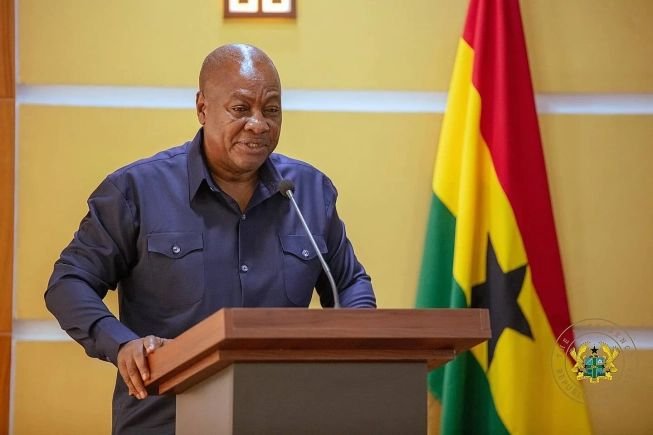
“In Ghana, I will give a simple example. We’re exercising greater sovereignty over our natural resources, and the establishment of the Ghana Goldbod has given us greater control over our gold export.”
President John Dramani Mahama

The impact of this strategic move is reflected in the unprecedented performance of the small-scale mining sector, which saw exports climb to a record 104 tonnes in 2025 following Goldbod’s inception in April of that year.
This represents a monumental leap from the 63 tonnes recorded in 2024, a period characterized by significant leakages where approximately 23 tonnes of gold failed to see their foreign exchange earnings repatriated to the state.
Under the new regime, the President disclosed that 100% of foreign exchange from these exports is now repatriated through the Bank of Ghana, effectively plugging the “nation–wrecking” loopholes of the past.


Economic Resilience and the ASM Transformation

The formalization of the Artisanal and Small-Scale Mining (ASM) sector under Goldbod has evolved from a mere regulatory exercise into a cornerstone of Ghana’s macroeconomic stability.
By acting as the sole legal aggregator and exporter, Goldbod has dismantled exploitative informal networks and replaced them with a transparent framework that offers miners up to 98% of international market prices.
This competitive pricing strategy has significantly de-incentivized smuggling, effectively “routing gold back into the formal economy.”
Expert analysis suggests that the initiative generated over $10 billion in foreign exchange revenue in 2025 alone, providing a critical non-debt buffer that has strengthened the Ghana Cedi and boosted national reserves to approximately 37 tonnes.
Resource Sovereignty and the Global Market

Minister of Trade, Industry, and Agribusiness, Elizabeth Ofosu Adjare, emphasized that this move is a signal to the global market that Africa is ready for industrial-scale business growth on its own terms.
The shift toward “resource sovereignty” is intended to break the colonial pattern of large foreign concessions extracting value solely for external interests.
President Mahama noted that the “Resetting Ghana Agenda” aims to extend this model of value addition to other commodities like manganese, bauxite, and lithium.
By ensuring that raw materials are processed and traded through state-backed mechanisms, the administration is positioning Ghana to lead the continent in claiming a “fairer share of our natural resource endowment.”
A Blueprint for Continental Trade Integration
The Executive Chair of the African Trade Chamber, Benedicta Lasi, hailed the summit as a platform for moving beyond rhetoric to actionable solutions for the continent’s financing challenges.
With the theme focused on “Financing Africa’s industrialization,” the success of Gold board serves as a practical blueprint for other African nations looking to integrate their industrial value chains.
The summit concluded with a clear consensus: the transition from “extraction to transformation” is no longer optional but a prerequisite for sustainable development.
As the extractive sector continues to formalize, the government remains committed to ensuring that every ounce of gold exported contributes to the collective prosperity of the Ghanaian people.
READ ALSO: Government Seals Joint Venture to Complete Saglemi Housing Project