Ghana’s ambition to achieve 50 per cent household liquefied petroleum gas (LPG) penetration by 2030 is facing mounting challenges, with new data revealing a worrying reversal in access to clean cooking fuels.
Energy analyst Benjamin Nsiah, Executive Director of the Center for Environmental Management and Sustainable Energy, has warned that unless urgent corrective measures are taken, the country risks missing a target that is central to public health, environmental protection, and social equity.
Speaking on the state of clean cooking in Ghana, Mr. Nsiah described the situation as a “sobering reality check,” noting that progress made over the past decade appears to be slipping rather than accelerating.
Despite years of policy interventions and public awareness campaigns, biomass remains the dominant cooking fuel for most Ghanaian households. According to the 2022 Ghana Demographic and Health Survey (GDHS), more than 70 per cent of households continue to rely on firewood and charcoal for cooking.

The reliance on biomass is not only an environmental concern but also a major public health issue, contributing to indoor air pollution, respiratory illnesses, and avoidable deaths, particularly among women and children who spend more time around cooking fires.
Mr. Nsiah noted that while national averages already signal concern, the situation is far more severe in rural communities.
“The disparity is especially sharp between rural and urban areas.
“Access to clean cooking fuels drops to just 12% in rural zones, compared to about 45% in urban centers.”
Benjamin Nsiah, Executive Director of the Center for Environmental Management and Sustainable Energy
This urban-rural divide, he warned, threatens to entrench inequality, leaving millions of rural households exposed to health risks and environmental degradation.
A Reversal in LPG Adoption Trends

Perhaps most alarming, according to the energy analyst, is evidence that LPG adoption is not merely stagnating but declining.
Data from the 2021 Population and Housing Census indicated that LPG access stood at 36.9 per cent. However, the more recent GDHS suggests that access had fallen sharply to just 22.4 per cent by 2023.
He described the drop of over 14 percentage points in just two years as a red flag for policymakers.
“This dramatic decline… places Ghana’s target of 50% LPG penetration by 2030 in serious jeopardy, raising alarms about public health, deforestation, and gender inequality.”
Benjamin Nsiah, Executive Director of the Center for Environmental Management and Sustainable Energy
Under its clean cooking agenda, Ghana aims to increase household LPG adoption from about 30 per cent to 50 per cent by 2030. This would mean providing clean cooking solutions to an additional three million households within the next few years.
While the goal aligns with climate commitments, health objectives, and international development targets, Mr. Nsiah cautioned that the pace of progress is currently misaligned with the scale of the ambition.
He acknowledged that initiatives such as the Cylinder Recirculation Model (CRM) represent important steps toward improving safety and streamlining LPG distribution. By shifting responsibility for cylinder maintenance to marketers, the model reduces risks associated with faulty cylinders and improves consumer confidence.
However, he stressed that safety improvements alone are not enough to drive widespread adoption.
Affordability Remains a Major Barrier
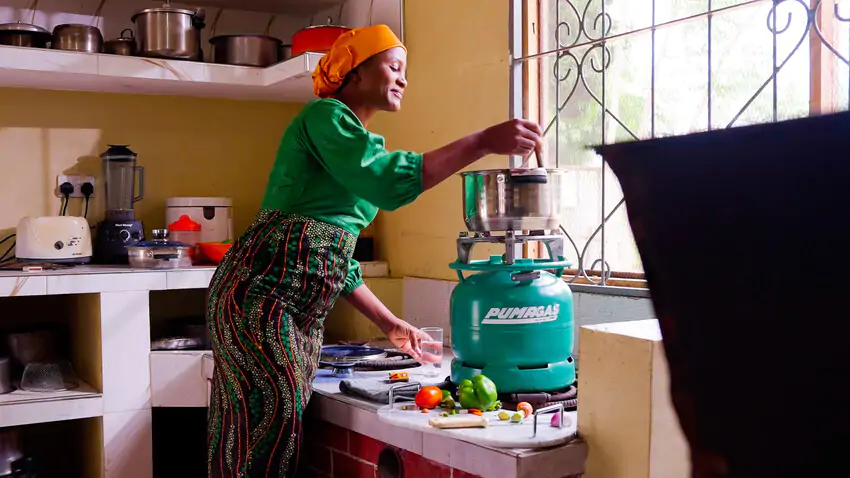
For many households, particularly in low-income and rural communities, the cost of transitioning to LPG remains prohibitive. Mr. Nsiah pointed out that even under the CRM, the upfront deposit required to access a cylinder continues to exclude many potential users.
While CRM represents a significant step forward in improving safety and accessibility, it does not fully eliminate affordability challenges.
He argued that without additional support mechanisms, millions of households will remain locked out of clean cooking solutions.
For many households, even the deposit for a cylinder remains a hurdle, this underscores the need for targeted subsidies, flexible financing schemes, or donor-supported interventions to ensure inclusive access.
The slow uptake of LPG has far-reaching consequences beyond energy statistics. Continued dependence on charcoal and firewood accelerates deforestation, increases carbon emissions, and places additional pressure on women, who often bear the burden of fuel collection and cooking.
Mr. Nsiah warned that failing to reverse current trends would undermine Ghana’s broader development goals, including climate resilience, gender equity, and improved health outcomes.
As Ghana moves closer to the 2030 deadline, the analyst called for a renewed, data-driven approach to clean cooking policy. He urged government and development partners to treat LPG adoption not as a standalone energy issue, but as a cross-cutting development priority.
Without decisive action, he cautioned, Ghana’s clean cooking ambition risks becoming another missed opportunity, with lasting consequences for households, forests, and future generations.
READ ALSO: Data Protection Commission to Sanction Non-Compliant Institutions