
The landscape of Ghana’s fisheries sector has been fundamentally transformed following the official announcement that the nation’s tuna industry has achieved the Marine Stewardship Council (MSC) certification.
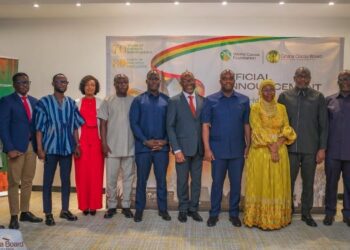
This globally recognized gold standard for sustainable fishing was officially presented during a high-level meeting between the Ghana Tuna Association and the Minister for Fisheries and Aquaculture Development, Hon. Emelia Arthur, at the Ministry in Accra.
According to the Ministry of Fisheries and Aquaculture Development (MoFAD), this milestone serves as a scientific validation of years of regulatory reform and industry-wide collaboration, marking a definitive victory for Ghana’s Industrialization agenda.
“Describing the achievement as a significant step forward, the Minister said the MSC certification strengthens Ghana’s commitment to responsible fisheries management and positions the country’s tuna industry competitively within the global sustainable seafood market”
Ministry of Fisheries and Aquaculture Development
Hon. Arthur explained that the MSC certification is not merely a badge of honor but a critical market access tool that opens doors to premium retail markets in Europe, North America, and Asia, where consumers and major supermarket chains increasingly refuse to stock seafood that does not bear the MSC “blue fish,” label.



For Ghana, this means higher export value and long-term security for thousands of jobs in the tuna value chain.
A Science-Based Triumph
The road to MSC certification has been a grueling multi-year journey involving intense scientific scrutiny. Minister Emelia Arthur emphasized that the award is granted only to fisheries that can prove, through hard data, that they are not depleting stocks or damaging the marine ecosystem.

Ghana’s success in this regard is a testament to the enhanced governance systems implemented by the Ministry of Fisheries and Aquaculture Development and the Fisheries Commission.
Key to this achievement was the overhaul of data collection methods and the significant increase in “observer coverage” on tuna vessels. By placing trained observers on ships to monitor catch composition and by-catch, Ghana has demonstrated a level of transparency that few other regional players can match.
Furthermore, the industry’s transition to responsible Fish Aggregating Device (FAD) management has drastically reduced the incidental catch of non-target species, a primary requirement for the MSC standard.
While the certification is an industry-wide achievement, the Minister singled out the leadership of Pioneer Food Cannery (PFC) for its pivotal role in driving the certification process.
As a major player in the global tuna supply chain, PFC’s commitment to sustainability acted as a catalyst for other members of the Ghana Tuna Association to upgrade their operational standards. This synergy between private sector leadership and state regulation is exactly what the Administration aims to replicate across other sectors of the economy.
The certification specifically “covers the Atlantic skipjack and yellowfin tuna fisheries,” which are the backbone of Ghana’s canning industry. By securing this status, Ghana has effectively protected its “national pride,” in the fisheries sector.
It ensures that “Made in Ghana,” tuna is synonymous with “Sustainably Sourced,” a branding advantage that is expected to drive a surge in foreign direct investment into local processing facilities and cold-chain infrastructure.
Expanding Global Market Reach
The Executive Director of the Fisheries Commission, Prof. Benjamin Campion, provided a pragmatic outlook on what this means for the national treasury.

He noted that the global demand for sustainable seafood is no longer a niche trend but a mandatory requirement for large-scale international trade, as with the MSC label, Ghanaian tuna will no longer be sold as a “commodity” at lower price points but can now command the “sustainability premium,” in high-end global markets.
Prof. Campion also used the platform to call for a broader national culture of responsible fishing, stressing that while the tuna industry has reached this milestone, the battle against Illegal, Unreported and Unregulated (IUU) fishing in other sectors of the maritime domain must continue.
The success of the tuna sector provides a “blueprint for reform,” that the Commission intends to apply to other commercial species, ensuring that Ghana’s entire “Blue Economy,“ is managed under the same rigorous, science-based principles as global consumers increasingly demand sustainably harvested seafood.
The Ministry was quick to point out that MSC certification is not a one-time award but an “ongoing responsibility,” with the industry being subject to annual audits and periodic re-assessments to ensure that standards do not slip.
This means that the enhanced monitoring and compliance systems – including the 24-hour satellite tracking of vessels and the strict reporting of landed weights – must be maintained indefinitely.
For the Mahama Administration, this certification is a pillar of the Industrialization drive. It demonstrates that Ghana is moving away from a “harvest-and-export” model toward a sophisticated, “value-added and certified,” export strategy.
This shift is expected to create a more resilient economy, less susceptible to the volatility of global commodity prices and more attractive to ethical investors who prioritize Environmental, Social, and Governance (ESG) standards.
“The Ministry and the Fisheries Commission reaffirmed their commitment to maintaining the certification standards, stressing that sustainability is an ongoing responsibility. Stakeholders expressed optimism that the MSC certification will not only boost Ghana’s tuna exports but also drive broader reforms across the country’s fisheries sector”
Ministry of Fisheries and Aquaculture Development

As Ghana celebrates this milestone, the message to the international community is clear: the nation’s waters are open for business, but only for those who are willing to play by the rules of sustainability.
The MSC “blue fish,” label on Ghanaian tuna is now a symbol of a nation that has successfully balanced economic growth with the preservation of its natural heritage for future generations.
READ ALSO: NPA Orders Uniform Fuel Pricing at Pumps