India has begun the world’s largest national population census. This will be the 16th census in the series and the 8th since Independence.
Population data collected through the census could reshape the distribution of government welfare programs and a wide range of public policies.
It could also prompt a redrawing of India’s political map, as seats in the lower house of Parliament and state legislatures may be increased to reflect population growth. A 2023 law reserves one-third of legislative seats for women, so any expansion would raise the number of seats set aside for female representatives.
The previous census in 2011 recorded a population of 1.21 billion. It’s now estimated to be more than 1.4 billion, making India the most populous nation.
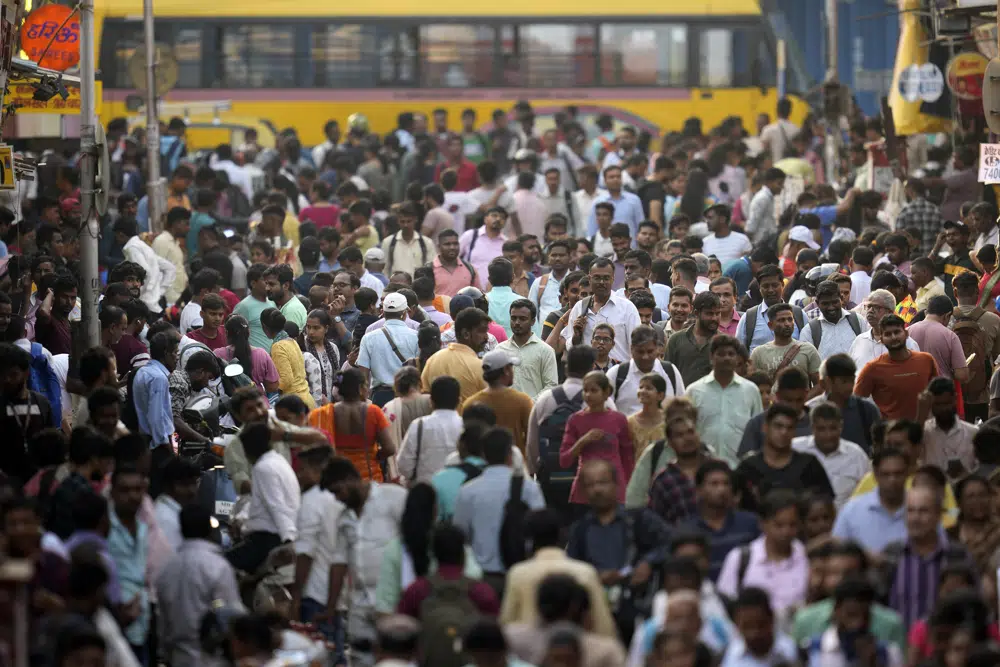
The new census had been planned for 2021 but was postponed due to the COVID-19 pandemic and logistical challenges.
The new exercise will span 36 states and federally-administered territories, more than 7,000 sub-districts, over 9,700 towns and nearly 640,000 villages, with fieldwork carried out by enumerators and supervisors, typically schoolteachers, government staff and local officials.
More than 3 million government workers are expected to be deployed over the course of the year. In 2011, nearly 2.7 million enumerators surveyed more than 240 million households nationwide.
For the first time, the census will be conducted digitally, with enumerators using mobile apps to collect and upload data. Authorities have introduced self-enumeration, letting residents submit details online via a 16-language portal that generates a unique ID for verification by census workers.
The census will be conducted in two phases, House Listing (HLO) and Population Enumeration (PE). The first phase of the count started Wednesday and will roll out around the country through September. The workers will spend about a month in each area collecting information on homes and available facilities and will document housing stock and living conditions.The exercise will blend in-person surveys with a digital option where residents can submit information through a multilingual smartphone application that integrates satellite-based mapping.
The Self-Enumeration exercise is a secure web-based facility through which citizens will be able to directly enter their details online before the door-to-door survey.
Registrar General and Census Commissioner of India Mritunjay Kumar Narayan has assured that necessary measures for data security have been taken. He urged citizens to provide accurate and correct information to surveyors.
The second phase to be conducted from September to next April 1 will record more detailed information like people’s social and economic characteristics, including religion and caste.
The second phase of the census will attempt a broader accounting of caste beyond historically marginalized groups. Caste is an ancient system of social hierarchy in India and is influential in defining social standing and deciding who gets access to resources, education and economic opportunity. There are hundreds of caste groups based on occupation and economic status across India, particularly among Hindus, but the country has limited or outdated data on how many people belong to them.
The last attempt to gather detailed caste information through a census dates to 1931, during British colonial rule. Since independent India’s first census in 1951, it counted only Dalits and Adivasis, members of marginalized groups known as scheduled castes and tribes. Successive governments have resisted conducting a full caste count, arguing it could heighten social tensions and trigger unrest.
33 Questions To Be Answered In Population Census
Indians will be asked 33 questions as the country launches the world’s largest census.
From its origins as a rudimentary headcount under colonial rule, India’s census questionnaire has steadily expanded in scope, mirroring the state’s changing priorities.
The first attempt in 1872 contained 17 questions and was essentially a house register – recording who lived where, along with basic markers such as age, religion, caste and occupation.
By 1881, when the first synchronous nationwide census was conducted, the template had stabilised around identity (name, gender, marital status), social markers (caste, religion, language) and rudimentary education and disability categories.
Over the next decades, questions on language, literacy and occupation were refined, adding secondary work and dependency details. English proficiency was one of 16 questions in the 1901 census.
A shift began with the 1941 census. Fertility, employment status, economic dependency, migration and job search entered the frame, signalling a growing administrative focus on economic behaviour.
After independence, this widened further: the 1951 and 1961 rounds incorporated nationality, displacement (in the shadow of Partition), land ownership and more work categories.
From the 1970s onwards, the census took on a distinctly socio-economic lens. Migration histories, duration of residence, fertility patterns and detailed employment classifications became standard.
In more recent decades, especially in 2001 and 2011, the census has tracked the modernising economy: commuting patterns, marginal versus main work, education attendance and increasingly detailed disability and fertility data.That evolving lens is now extending to how households themselves are defined.
READ ALSO: Trump Issues Another Threat To Iran Over Strait of Hormuz Closure