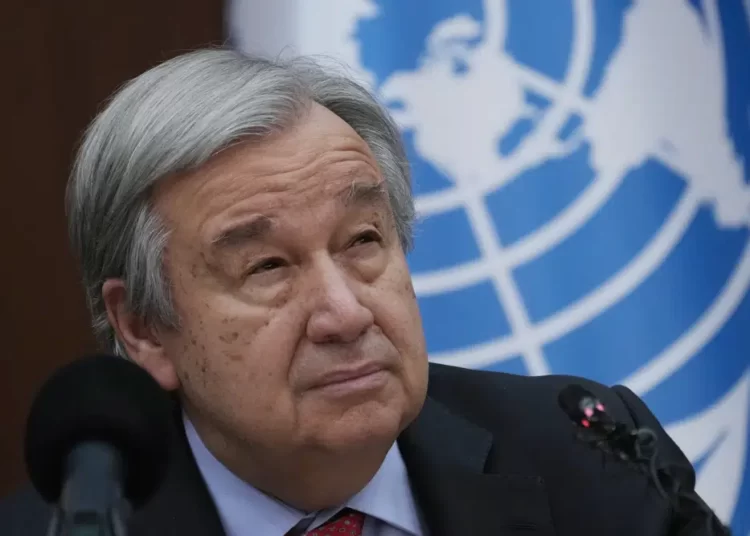
UN Secretary-General Antonio Guterres, has, through his Spokesman, expressed concern over renewed hostilities between US and Iran.
Deputy Spokesperson Farhan Haq told reporters in New York that the UN Chief called on the US and Iran to cease fighting and return to diplomacy.
“The Secretary-General has been worried for some time that if the parties do not return to negotiations, you could have a widening of the conflict, and that seems to be what has been happening in recent hours.
“These are not positive developments, and he wants to make sure that the parties can cease fighting and again return to the diplomatic efforts, including the mediation efforts being pressed forward by Pakistan, Qatar and others.”
Farhan Haq
The comments came as the United States Central Command (CENTCOM) announced that it has launched a “heavy wave of strikes against Iran.” According to a statement posted on X, It claimed to have hit dozens of Islamic Revolutionary Guard Corps (IRGC) targets early today, including “military command centres, missile and drone facilities, coastal surveillance and defence sites, and maritime capabilities.”

Iranian officials said that the US forces struck a residential building on Qeshm Island and killed a couple and their two-year-old child. Explosions were also heard on Kish Island, in Bushehr and in four locations in Khuzestan province, the heart of Iran’s oil industry.
CENTCOM claimed the latest strikes aimed to “further diminish threats posed by Iran and its proxies to American forces, commercial shipping, and neighboring Gulf nations.”
Former Pentagon official David Des Roches opined that the latest US strikes were “not a very overwhelming attack”, adding that Trump is perhaps, “trying to keep things proportionate, or to keep things open for diplomacy.”
Ryan Bohl, a senior Middle East analyst with RANE network, says the US has two likely escalation options.“The first is the repeat of what America was doing prior to last Friday, which is focusing on targets and infrastructure related to Iran’s blockade of Hormuz,” he said.“Or it could be an escalation towards the bridges and power plant strategy that President Trump has repeatedly threatened over and over again.”
The IRGC has said that as long as Washington’s threats continue, Tehran’s resistance will also continue
The latest US attack on Iran follows Iranian missile attacks on US forces a day earlier. US President Donald Trump promised to hit Iran, “very hard”, after it targeted a base in Jordan where US troops are stationed.
Yesterday, the Islamic Revolutionary Guard Corps (IRGC) released footage of overnight strikes on a US military base in Jordan, in what it said came in response to “aggressive actions.” Jordan said all five ballistic missiles were intercepted.
US Announces New Sanctions On Iran
Meanwhile, the US Treasury Department announced new sanctions on Wednesday on two Iranian firms it said are integral to an IRGC-backed “scheme” that forces commercial vessels to buy insurance to transit the strait of Hormuz.
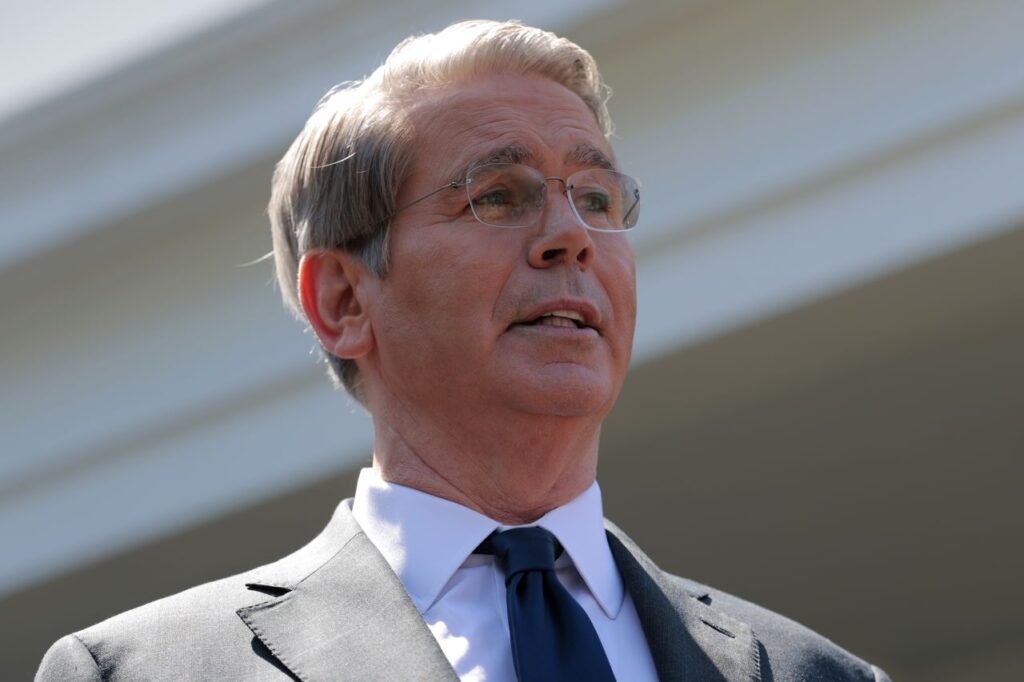
US Treasury Secretary Scott Bessent wrote on X that the United States will not allow Iran “to hold global commerce hostage or use international shipping to finance the IRGC’s terrorism, aggression, and repression.”
The US is eager to end Iran’s control of the Strait of Hormuz, through which a large percentage of global oil shipping passes. Earlier, Iran rejected an Omani proposal on co-managing shipping routes through the strait. Iran’s Deputy Foreign Minister for legal and international affairs, Kazem Gharibabadi, outlined Iran’s position on the Strait of Hormuz, saying a proposal by Oman for a 50-50 management split was unacceptable.
He added that Tehran would not recognise the US-backed southern route near the Gulf country, or a third route under this proposal, while also rejecting de-mining operations in the strategic waterway by other powers.

Gharibabadi asserted that the Iran’s proposal includes all inbound traffic using a route inside Iranian waters, with part of the outbound route also controlled by Iran. Oman could apparently manage the remainder as part of that vision, but exact divisions or coordinates have not been disclosed. The official said exercising varying degrees of control over both directions is also a defensive requirement, not a claim to Omani sovereignty.
“If the route we have proposed is not accepted, no other formula will be accepted. The strait will remain closed, and we are prepared for a restart of war.”
Kazem Gharibabadi
Iranian authorities have stressed that the Strait of Hormuz will not go back to the free and unimpeded access for all that was in place before the US and Israel began attacking Iran in late February.
Tehran has raised national security concerns as a reason for not allowing uninterrupted passage through the southern corridor, saying routes beyond effective Iranian observation could be used to support further US or Israeli military operations.
READ ALSO: Boxer Desmond Pappoe Withdraws from Commonwealth Games Due to Shoulder Injury