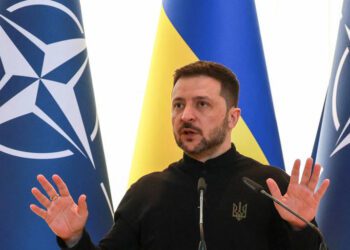
Spain’s Prime Minister, Pedro Sánchez has said that he will ask the European Union to end its association agreement with Israel on Tuesday.
Sánchez, who has been among the most vocal European critics of Israel’s war in Gaz, said on Sunday, “The time has come for the EU to break its association agreement with Israel.”
“We have nothing against the people of Israel – quite the contrary. But a government that breaks international law – and thus breaks the values and principles of the EU – cannot be our partner.”
Pedro Sánchez
More than 390 former EU ministers, ambassadors and top officials have recently urged the EU to wholly or partly suspend the agreement, which created a free trade area and deepened joint work in energy, environment and research agreement. Signatories included the ex-EU Foreign Affairs Chief and former Spanish Foreign Minister Josep Borrell, the former Swedish Foreign Minister and UN weapons inspector Hans Blix, and the former European Commission Vice President Margot Wallström.
Ireland, Spain and Slovenia, among the staunchest supporters of the Palestinian cause in Europe, have called for a discussion of Israel’s human-rights obligations under its association agreement with the EU, when EU Foreign Ministers meet on Tuesday.
The Foreign Ministers of the three countries wrote in a letter to the EU foreign policy Chief Kaja Kallas, “The European Union can no longer remain on the sidelines,” referencing “unbearable” conditions in Gaza and “escalating violence against Palestinians” in the West Bank.
Israel Hits Back At Sánchez
The Israeli government hit back at Sánchez, accusing him of hypocrisy and double standards. “We won’t accept a hypocritical lesson from someone who has a relationship with totalitarian regimes that violate human rights, such as Erdoğan’s Turkey and Maduro’s Venezuela,” Israel’s Foreign Minister, Gideon Sa’ar, posted on X, alongside a photograph that apparently showed a poster of Sánchez’s face and his criticisms of Israel’s war on Iran on an Iranian missile.
In a reference to the poster, Sa’ar said that the Spanish government had received thanks “from Iran’s brutal regime and terrorist organisation”, adding that it has “dedicated itself to spreading antisemitism.”
He then threw Sánchez’s words back at him, “We have nothing against the citizens of Spain – quite the contrary – but we do against the double standard of the government of [Pedro Sánchez].”
Diplomatic relations between Spain and Israel have plummeted following Sánchez’s repeated criticisms of Israel’s actions in Gaza and Iran. In September last year, the Spanish Prime Minister accused Benjamin Netanyahu’s government of “exterminating a defenceless people” by bombing hospitals and “killing innocent boys and girls with hunger.”
Announcing a raft of measures designed to increase the pressure on Netanyahu to stop the military campaign, Sánchez added, “What Prime Minister Netanyahu presented in October 2023 as a military operation in response to the horrific terrorist attacks has ended up becoming a new wave of illegal occupations and an unjustifiable attack against the Palestinian civilian population – an attack that the UN special rapporteur and the majority of experts already describe as a genocide.”
Sánchez’s speech drew an immediate and furious response from the Israeli government, which accused his administration of deploying “wild and hateful rhetoric” and of using a “continuous anti-Israel and antisemitic attack” to distract from corruption allegations.
Sa’ar also announced that two senior leftwing Spanish politicians, the Labour Minister and Deputy Prime Minister, Yolanda Díaz, and the Youth Minister, Sira Rego, would be banned from entering Israel because of their criticisms of Israel’s conduct in Gaza.
Serbia To Lose EU Funds Over Democratic Backsliding
Separately, EU Enlargement Commissioner Marta Kos warned that Serbia could lose access to around 1.5 billion euros ($1.8 billion) in European Union funds if it fails to halt democratic backsliding.
Kos told EU lawmakers, “We are increasingly worried about what is happening in Serbia.” International monitors have said they had witnessed violence and irregularities during last month’s local elections in 10 Serbian municipalities.
She said that the European Commission is “assessing whether the country still fulfills the conditions for payments under the EU’s financial instruments.”
Kos said that the commission’s concerns range from “laws that undermine the independence of the judiciary, to crackdowns on protesters and recurrent meddling in independent media.” Serbia qualifies for a big slice of an EU fund to promote growth in countries trying to join the bloc if they carry out reforms. Kos said Belgrade has received 110 million euros ($130 million), but that still “leaves around 1.5 billion under a question mark.”
The EU has stepped up efforts to integrate Western Balkan nations since Russia’s full-scale invasion of Ukraine in February 2022, fearing Moscow could try to destabilize a region still feeling the effects of its own wars in the 1990s.
READ ALSO: Trump Denies Being Dragged Into Iran War By Israel