A March 2026 poll by Global InfoAnalytics has raised fresh questions about internal cohesion within the National Democratic Congress as Ghana looks ahead to the 2028 general election.
The analysis, presented by Mussa Dankwa, points to early signs of division among party supporters despite the prominence of leading figures such as Dr Cassiel Ato Forson and Johnson Asiedu Nketia.
Mussa Dankwa noted that the data reflects “emerging cracks within the NDC front,” noting that a portion of the party’s voter base is beginning to shift toward alternative political options.
While both Ato Forson and Asiedu Nketia remain central to the party’s leadership structure, the poll indicates that their influence has not fully translated into unified electoral support.
The findings come at a time when both major parties are positioning themselves for the next election cycle, with the New Patriotic Party have elected Dr Mahamudu Bawumia as a presidential candidate.
Ato Forson vs Bawumia
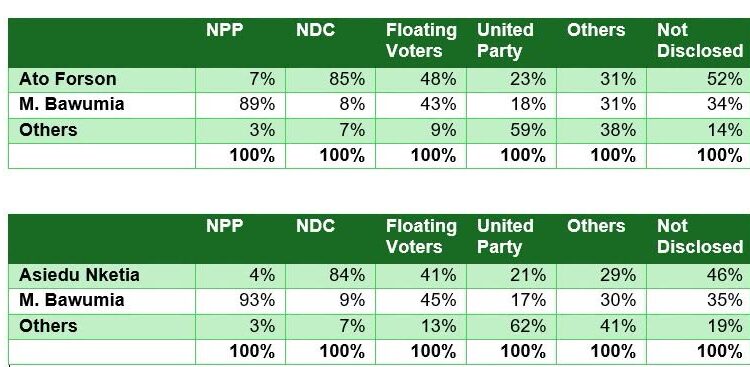
In a hypothetical contest between Ato Forson and Bawumia, the NDC candidate leads with 55 percent against Bawumia’s 37 percent. On the surface, this suggests a comfortable advantage. However, a closer examination of the numbers reveals a less secure foundation for the NDC.
The poll shows that 89 percent of New Patriotic Party supporters are united behind Bawumia, compared to 85 percent of NDC voters backing Ato Forson. This difference points to stronger internal cohesion within the NPP, even as its candidate trails overall.

Cross party voting intentions further highlight this imbalance. While 7 percent of NPP voters indicate a willingness to support Ato Forson, a slightly higher 8 percent of NDC voters say they would vote for Bawumia. This gives Bawumia a narrow advantage among voters willing to cross party lines.
Additional evidence of weaker NDC support is seen in voter openness to third party candidates. Only 3 percent of NPP supporters say they would consider alternatives such as Alan Kyerematen or other emerging figures, while 7 percent of NDC voters express similar intentions.
Mussa Dankwa noted that “this gap reflects a softer base that could shift if conditions change.” Ato Forson’s lead is largely driven by his appeal among floating voters and those who do not disclose party affiliation.
He holds a five point advantage among floating voters and an 18 point lead among non aligned respondents. This suggests broader national appeal, even as questions remain about party consolidation.
Asiedu Nketia Scenario
When the scenario shifts to a matchup between Asiedu Nketia and Bawumia, the NDC still maintains an overall lead, though similar patterns of internal weakness persist. Asiedu Nketia records 51 percent against Bawumia’s 39 percent.
In this scenario, the NPP shows even stronger unity, with 93 percent of its supporters backing Bawumia. Only 4 percent indicate support for Asiedu Nketia. Within the NDC, 84 percent of voters remain loyal to their candidate, while 9 percent would support Bawumia and 7 percent would opt for other candidates.
Mussa Dankwa describes this as “a consistent pattern of stronger cohesion on the NPP side,” adding that the NDC faces a more fragmented support base despite leading in headline figures.
Among floating voters, Bawumia gains an advantage, leading 45 percent to 41 percent. However, Asiedu Nketia performs better among voters who do not disclose their party affiliation, leading 46 percent to 35 percent. These contrasting trends point to different strengths in voter appeal across segments of the electorate.
Support for third party candidates also increases in this scenario. Among United Party aligned voters, 62 percent indicate support for Alan Kyerematen when Asiedu Nketia is the NDC candidate, compared to lower levels when Ato Forson is considered. This suggests that candidate choice within the NDC could influence the strength of alternative political movements.
2028 Outlook
The broader outlook toward 2028 suggests a competitive and potentially unpredictable electoral environment. While the NDC frontrunners maintain leads in direct matchups, the poll underscores the importance of internal unity as a determining factor in future success.
Mussa Dankwa concludes that “the early signs of fragmentation should be taken seriously,” emphasizing that voter loyalty within the NDC cannot be taken for granted. The presence of third-party candidates and shifting allegiances may further complicate the electoral landscape.

For the NPP, the data reinforces the value of maintaining strong internal cohesion. The party’s ability to unify its base behind Bawumia provides a structural advantage that could offset deficits in broader popularity.
As the 2028 election approaches, both major parties face distinct challenges. The NDC must address signs of internal division while sustaining its appeal among undecided voters. The NPP, on the other hand, will seek to build on its strong base support while expanding its reach.
The March 2026 poll offers an early indication of these dynamics, pointing to a race that may be shaped as much by internal party strength as by national voter sentiment.
READ ALSO: BoG Declares Earnings from Ghanaian content creators as Export Revenue