The agricultural backbone of the Afadzato South District in the Volta Region is currently under severe strain as rice farmers face a systemic collapse of their market access, forcing members of the local farming community to voice a desperate plea for government intervention.
The spokesperson for the Afadzato South Farmers Association, Dickson Kodzo Addo, explained to the media that despite successful harvests, hundreds of farmers find themselves trapped in a cycle of debt and waste, unable to convert their physical labor into financial liquidity. This is because of localized infrastructure deficits that prevent rural producers from reaching the urban consumer.
“The lack of a processing facility, such as a rice mill, has rendered all harvest fruitless. The encouragement of local rice consumption is not feasible if producers continue to face these challenges”
Mr. Dickson Kodzo Addo, Spokesperson for the Afadzato South Farmers Association
The crisis in Afadzato South highlights a profound disconnect between the nation’s drive for food self-sufficiency and the complete absence of a state-supported processing facility within the district. For the rice farmers of the Volta Region, a bumper harvest has transitioned from a blessing to a liability.
Without a functioning rice mill, the harvested paddy remains in its raw state, a form that the National Food Buffer Stock Company (NAFCO) refuses to accept. This policy creates a frustrating bottleneck where the government’s own buying agency remains out of reach for the very people it is designed to support.
Mr. Addo detailed the logistical nightmare facing his members, revealing that many farmers are still holding onto stock from the 2025 harvest, which remains unsold as the 2026 planting season approaches.
The association’s attempt to engage with the National Food Buffer Stock Company hit a wall because the agency only deals in processed, bagged rice. This leaves the Afadzato South farmers in a precarious position: they have the product, but they lack the industrial machinery to make it “market-ready.”

The situation reached a breaking point following the failure of the district’s only private processing option. Mr. Samuel Wonaglo, a local farmer, reported that a privately owned mill, which previously served as a small relief valve for the community, has been offline for weeks.
The cause is a faulty transformer that remains unaddressed, effectively paralyzing the district’s ability to process its grain. Without this lone facility, the farmers are stranded, watching their paddy rice sit in domestic storage where it is vulnerable to pests and moisture damage.
Logistics of Failure
However, the infrastructure gap extends beyond milling. The district lacks dedicated storage facilities or warehouses, forcing farmers to turn their personal living spaces into improvised grain stores.
According to Mr. Wonaglo, this lack of specialized storage leads to rapid degradation of the rice quality, further lowering its potential market value. He pointed out that without a central warehouse, the farmers lose any bargaining power they might have had, as they cannot hold stock safely until prices improve.
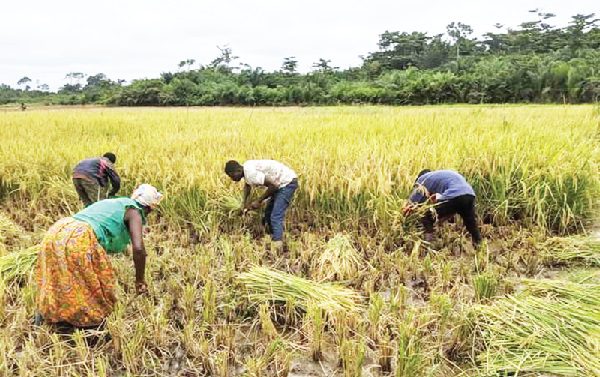
Furthermore, the high cost of manual labor is eating into the shrinking margins of these producers. Madam Afeti Peace Dela highlighted that in the absence of government-supported harvesting centers, farmers are forced to pay between GHS 800 and GHS 1,000 per acre just to get the crop out of the field.
This high entry cost, combined with the lack of a guaranteed buyer, makes rice farming in Afadzato South a high-risk venture with diminishing returns. The economic statistics provided by the farmers paint a grim picture of the 2026 agricultural season.
Mr. Edward Tyson Mensah, a veteran farmer in the district, noted a catastrophic drop in the market price of paddy rice.
A bag that sold for GHS 600 only a year ago now struggles to find a buyer at GHS 280. This price collapse, representing a more than 50% loss in value, occurred simultaneously with rising costs for fuel, labor, and transportation. The result is a classic debt trap.

Many farmers took out microloans to fund the 2025 season, expecting the market to hold steady, yet with the price crash and the lack of processing, they are unable to settle these debts, leading to a financial paralysis that is already impacting the 2026 planting cycle.
Mr. Mensah revealed that he has been forced to scale down his operations significantly, cultivating only 10 acres this year compared to the 20 acres he managed last season. This trend of scaling down across the district is threatening to reduce the total national rice output, directly contradicting the government’s stated goals of reducing imports.
Policy Mismatch
The farmers also criticized current government input programs, specifically the distribution of fertilizer, arguing that the current model of providing limited free supplies is ineffective for serious commercial farming.
They suggested that the government should instead focus on a general reduction in the market price of fertilizer. This would allow farmers to purchase the specific quantities they need through legitimate channels rather than relying on a sporadic and often insufficient handout system.
There is also a growing concern about the future of the workforce. Mr. Peter Kornu warned that the visible struggles of established farmers are serving as a deterrent to the youth. In a region where unemployment is a perennial issue, agriculture is often touted as the solution.
However, Kornu argued that young people will not enter a sector where they see their elders losing money and stock despite hard work. He noted that he currently has over 100 bags of unsold paddy rice, a sight that discourages any young person from following in his footsteps.
The crisis in Afadzato South is a call for a shift in agricultural policy from production-focused to value-chain-focused. The farmers are not asking for more land or more seeds; they are asking for the industrial capacity to process what they have already grown.
For the Afadzato South Farmers Association, the establishment of a district rice mill would not only solve the immediate post-harvest loss issue but would also create a circular economy where local schools and institutions are fed by local farmers.
READ ALSO: Kalybos and Wife Antwiwaa Welcome First Child on His Birthday