Author: Dr. John Osae-Kwapong, Democracy and Development Fellow, CDD-Ghana, and Project Director, the Democracy Project
Scenes of xenophobic attacks in South Africa have been very disheartening to watch. So much for the often-repeated line “one continent, one people.” This is not the first time we have seen these attacks but this time around, it appears the intensity is different.
Where is law enforcement? Who is offering protection to these vulnerable African immigrants who, for economic reasons mainly, have sought to seek “greener pastures in South Africa?”
How intensely are the diplomatic challenges being worked to impress upon the South African government to effectively curb these attacks beyond calling upon those engaged in it to stop?
As we grapple with these questions, the views of Africans on regional relations, as captured by Afrobarometer Round 10 (2024), point to the need for increased efforts to strengthen regional relations.
The data presented covers 37 countries in the region, including South Africa. The aggregate view across all the countries is presented. It is important to note that there is a wide variation across the region. The piece highlights the view of South Africans given the current situation.
The Views
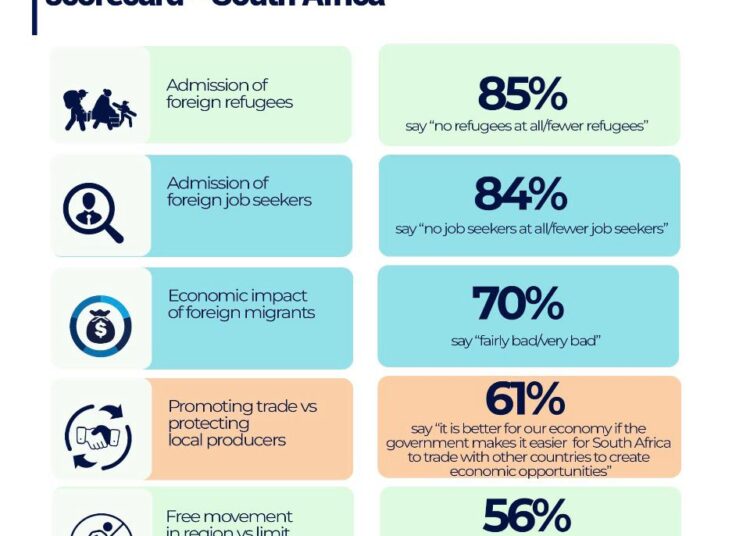
First, there is the perceived impact of foreign workers on an economy. When asked, “Would you say it is generally bad or good for [Country]’s economy if people from other countries come here to live and work for several years?” only 15% answered, “very good.” An additional 30% answered, “fairly good.” In the case of South Africa, only 2% answered “very good,” with another 15% saying “fairly good.”
Second, there is a welcoming attitude towards foreign workers. When asked, “do you think [Country] should allow more or fewer job seekers from other countries to come to live and work in this country?” a majority (65%) answered “fewer job seekers/no job seekers at all.”
In South Africa, a strong majority (84%) and the highest across all the 37 countries in the survey answered, “fewer job seekers/no job seekers at all.” It is interesting to note that in twenty-five (25) out of the thirty-seven countries (37), at least 60% answered “fewer job seekers/no job seekers at all.”
Third, is the view on where Africans stand on the question of free movement in the region. When asked whether there should be “free movement in the region or cross-border movement must be limited,” there was a 57% – 39% split in support of free movement in the region. In the case of South Africa, the split was 56% – 41% in support of free movement in the region.
Fourth, on the issue of whether governments should promote trade to create economic opportunities or limit trade to protect local producers, a majority (63%) of Africans support promoting trade. The same is true of South Africa where 61% support promoting trade.
Fifth, which is related to the above, when asked “if [Country]’s leaders are going to make it easier to trade with other countries to create economic opportunities, which countries should they make it easier to trade with?” the predominant response (66%) was “all countries globally.”
Only 20% said “all African countries,” with another 8% saying “regional countries only.” The same is true of South Africa, where a majority (57%) support global trade compared to 25% who support making trade easier with “all African countries”. Only 13% support making trade easier with “regional countries only”.
In summary, Africans support free cross-border movement and trade promotion to create economic opportunities. However, when it comes to trade, government policy aimed more globally than regionally or sub-regionally is suggested.
Africans, however, do not see foreign workers as having a positive impact on their economy and are less willing to accept more job seekers.
Where Do We Go from Here?
The differences in economic strength across countries in the region mean that some will become more of a destination for immigrants than others, even though most Africans (59%), according to the survey, will prefer to emigrate to North America or Europe.
Keep in mind, though, that in the same survey, 12% will emigrate to the most prominent in the region. If emigration is driven strongly by economic factors, then one can understand why Africa’s largest economy (South Africa) will attract immigrants.
Over the years, the world has witnessed globally the posture of citizens in countries on the issue of immigration, sometimes fueled by politicians who weaponize the issue to gain an electoral advantage.
This unnecessarily leads to tensions and often endangers immigrants. And in the case of the attacks witnessed in South Africa, it is even more disheartening when placed within the context of the efforts to build a stronger, more united continent.
How do governments design public policy within such a context – one that fosters stronger inter-regional and sub-regional relationships while at the same time enabling each country to address domestic challenges on issues such as immigration?
READ ALSO: Cut BECE Subjects to Four, Eduwatch Urges Government