Eurostat has disclosed that soaring oil prices from the Iran war pushed inflation higher in Europe in April.
This comes as growth continued to underperform in a worry combination both for consumers and policymakers at the European Central Bank (ECB).
According to the European Union statistical agency Eurostat report, annual inflation in the eurozone; the 21 countries that use the shared euro currency, rose to 3% from 2.6% in March, fueled by a 10.9% increase in energy prices. Crude oil is trading above $120 per barrel, up from around $73 before the outbreak of the war on February 28, 2026.
Looking at the main components of euro area inflation, energy is expected to have the highest annual rate in April (10.9%, compared with 5.1% in March), followed by services (3.0%, compared with 3.2% in March), food, alcohol & tobacco (2.5%, compared with 2.4% in March) and non-energy industrial goods (0.8%, compared with 0.5% in March).



Meanwhile, eurozone growth for the first three months of the year disappointed with a marginal increase in economic output of 0.1% over the quarter before.
The war is dealing a huge shock to the global economy because Iran has blocked the Strait of Hormuz, the waterway through which around 20% of the world’s oil formerly passed on its way to customers from producers in the Persian Gulf. The surge in oil prices has been quickly reflected at gas stations and in the price of jet fuel.

Rising inflation has raised concerns it may become built into the economy along with slow or nonexistent growth, a policy conundrum dubbed “stagflation” that leaves central banks like the ECB with few attractive choices.
The usual antidote to inflation is for the central bank to raise its benchmark interest rate, but that can slow growth by raising credit costs for buying things.
ECB policymakers left their benchmark interest rate unchanged today, Thursday, April 30, 2026, even though the annual rate of inflation is now clearly above the bank’s target of 2%. The bank’s benchmark rate has been unchanged at 2% since June 2025.
ECB President Christine Lagarde said at a post-decision news conference at the bank’s headquarters in Frankfurt that the bank’s governing council had debated a rate rise today. She said that the council would revisit the bank’s stance with new information at the next meeting June 11 without committing to any particular path for rates.
ECB President Says Eurozone Not Facing Stagflation
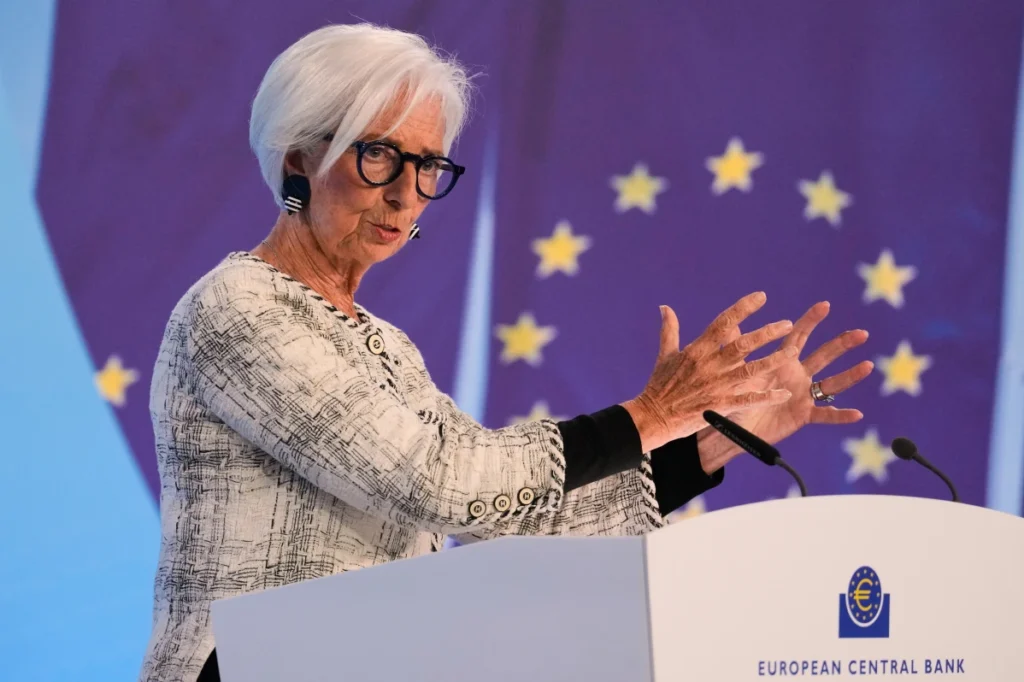
Although some economists have used the term recently, Lagarde said that the eurozone was not facing stagflation like that afflicting Western economies after the oil shocks of the 1970s.
She said the situation today was not comparable, with inflation less ingrained and a stronger labor market supporting an economy that is not in recession.
She said the term was “something that I park in the ‘70s… this is not something we’re seeing for the moment.” “We don’t apply that flashy term, ‘stagflation,’ to the circumstances that we have,” she added
Western economies suffered high inflation after twin oil shocks from the 1973 Arab oil embargo against the US and the 1979 Iranian revolution – bad memories revived by the Hormuz closure. Other central banks are also on pause. The Bank of Japan and the US Federal Reserve both left rates unchanged at meetings this week, and the Bank of England also held steady today.
Meanwhile, Eurostat disclosed in another report that in March 2026, the euro area seasonally adjusted unemployment rate was 6.2%, down from 6.3% in February 2026 as well as in March 2025. The EU unemployment rate was 6.0% in March 2026, stable compared with February 2026 and with March 2025
Eurostat estimates that 13.226 million persons in the EU, of whom 10.984 million in the euro area, were unemployed in March 2026. Compared with February 2026, unemployment decreased by 25 thousand in the EU and by 63 thousand in the euro area. Compared with March 2025, unemployment decreased by 24 thousand in the EU and by 170 thousand in the euro area.
READ ALSO: Khamenei Blames US Military Presence For Middle East Insecurity