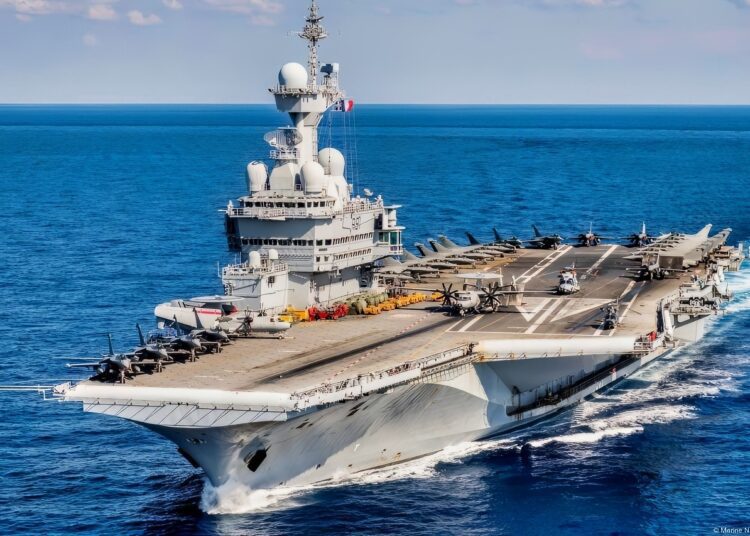
France’s Charles de Gaulle aircraft carrier group is moving into the Red Sea and Gulf of Aden as part of efforts by France and Britain to prepare for a future mission to help freedom of navigation on the strait of Hormuz.
The French Armed Forces ministry said in a statement that the aircraft carrier group had crossed the Suez canal today, en route to the south of the Red Sea.
In a post on X, the French military outlined the movement of its carrier strike group as part of a broader response to rising tensions affecting maritime security in the region.
According to the French Joint Staff, the repositioning of the carrier group is intended as a precautionary and stabilizing measure rather than an escalation. The military described the move as the “pre-positioning of a unique asset in Europe,” aimed at reassuring partners and strengthening regional security amid an increasingly uncertain environment.
French officials emphasized that the deployment is “resolutely defensive” and consistent with international law, underscoring that the objective is to support stability rather than engage in offensive operations. The statement reflects an effort to frame the move as part of a broader international effort to safeguard maritime commerce without contributing to further escalation in an already tense region.
The French military also reiterated its commitment to working alongside other countries to address challenges to maritime security. It highlighted an “unchanged willingness to aggregate the will and means of countries working to restore maritime commerce,” suggesting that France is open to coordinated action with allies and partners.
This French aircraft carrier strike group was deployed to the eastern Mediterranean shortly after the US and Israel launched air strikes on Iran, and it can stay at sea between four to five months.
The southward repositioning of the nuclear-powered Charles de Gaulle and its escorts is the latest stage of a Middle East deployment first announced by French President Emmanuel Macron in a televised address on March 3, the day before Iran closed the strait.

The move south of Suez puts France’s only carrier closer to the Persian Gulf chokepoint where a fifth of the world’s oil normally transits and where Iran has effectively halted commercial traffic since early March.
Col. Guillaume Vernet, Spokesman for the French armed forces chief of staff, asserted that the French operation is distinct from “Project Freedom,” the US escort mission launched Sunday, which has already drawn Iranian fire and threats to the April 8 ceasefire. “It’s a mission that is distinct from the US mission,” Vernet said, calling the French-British plan defensive and consistent with international law.
Macron and British Prime Minister Keir Starmer hosted more than 50 countries at a Paris summit on April 16, and military planners from over 30 nations finalized operational details at a UK-hosted conference April 22-23. “Planning has been done and is ready to go,” Vernet said
Iran shut the strait on March 4 after joint US and Israeli strikes that began Feb. 28 killed Iranian Supreme Leader Ayatollah Ali Khamenei. War-risk insurance premiums have since risen four to five times above preconflict levels, according to industry estimates, and around 2,000 ships remain stranded in the Gulf.
The Charles de Gaulle was ordered from the Baltic on March 3 as part of what France called an “unprecedented” mobilization that also includes eight frigates and two Mistral-class amphibious assault ships. The carrier’s southward move puts French air assets within range of the strait without entering the Gulf, where the US Navy has been blockading Iranian ports since April 13.
France also operates an airbase at Al Dhafra in the United Arab Emirates under a long-standing defense pact with Abu Dhabi, and French Rafale fighters based there have been intercepting Iranian drones and missiles over the UAE since the war began February 28.
Any Operation To Require Agreement Of neighbouring Countries
Vernet stressed that the wider Hormuz coalition, drawn up by France, Britain and more than 50 nations, will not begin operating until two thresholds are cleared: The threat to shipping must come down, and the maritime industry must be reassured enough to use the strait. Even then, he said, any operation would require the agreement of neighboring countries.
He noted that “going south of Suez is new for us,” adding, “Geographically, it’s closer to the Strait of Hormuz and will therefore enable us to react faster, once the conditions are met.”
“Today the Strait of Hormuz is stuck because of the threat, and the insurance premiums are so high. Not a single ship will jeopardize their trip or go there.”
Col. Guillaume Vernet
Vernet didn’t specify a date for the French-British operation, saying that the carrier was being positioned to be close enough to act if and when the conditions are met.
READ ALSO: Japan, Philippines Reaffirm Opposition To China’s Actions In Disputed Waters