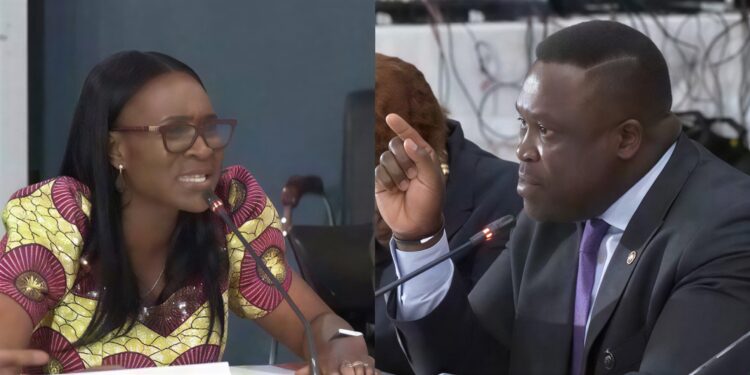
The senior advisor for African Parliamentary Network Against Corruption, Prof David Abdulai has raised concerns over rising tensions between Honourable Sam George and Honourable Abena Osei-Asare during Public Accounts Committee proceedings.
He said recent developments point to weakening adherence to parliamentary standing orders that regulate orderly debate.
Prof Abdulai observed that discussions within committee engagements have increasingly taken a confrontational direction that undermines legislative decorum. He added that such patterns affect the institutional image of lawmakers who are expected to uphold civility in public service.
The senior advisor indicated that parliamentary rules such as Order 115, 123, 129 and 132 are designed to guide conduct during deliberations. He explained that these provisions exist to ensure debates remain civil and focused on accountability issues.
He further noted that leadership responsibility requires restraint in committee environments even when disagreements arise. He stressed that conduct on both sides of parliamentary engagement contributes to the tone of proceedings.
“So, I think when these committees invite government appointees to appear, it is not a fight and it is not a contest of aggression. You have to engage them in a civil manner. Even when you do your work and remain firm, you still have to be civil.”
Professor David Abdulai
Prof Abdulai emphasised that assertiveness in parliamentary work must not be however mistaken for aggression. He explained that firm questioning can be achieved without confrontational behaviour.
Transitioning to the issue of emotional influence, he noted that strongly charged exchanges in deliberations reduce the clarity of legislative arguments. He therefore informed that structured communication strengthens the quality of oversight work.
The senior advisor stressed that leadership behaviour directly influences how Parliament is perceived by the public. He explained that disciplined engagement strengthens institutional credibility.
Prof Abdulai further noted that rational engagement enhances decision making within committees. He explained that policy discussions require calm analysis rather than emotionally driven exchanges.
Moreover, he called for stronger enforcement of parliamentary rules to improve discipline in proceedings. He added that consistent application of procedures remains central to restoring order in the House.
He identified the Speaker of Parliament’s role as essential in ensuring compliance with standing orders and explained that the visible enforcement discourages repeated disorderly conduct.
“I think the Speaker of Parliament is not really cracking the whip. We have seen many instances where some of our parliamentarians have behaved inappropriately, yet we do not see the whip being enforced. The Speaker has to crack the whip.”
Professor David Abdulai
Consequently, he noted that firm intervention from the Speaker can deter similar conduct among members during proceedings.
PAC Links Leadership Gaps To Oversight Challenges
Prof Abdulai also highlighted concerns over how leadership dynamics within committees affect parliamentary oversight. He noted that financial scrutiny sessions have become increasingly tense in recent times.
He explained that oversight responsibilities require calm and structured questioning to ensure clarity in financial discussions. He added that confrontational exchanges reduce the effectiveness of accountability processes.
The senior advisor observed that leadership within committees plays a central role in shaping the tone of engagements. He explained that firm procedural direction ensures productive interaction with public officials.
He stressed that the credibility of oversight institutions depends on disciplined conduct during hearings. He added that adherence to procedure strengthens public trust in financial accountability outcomes.
Prof Abdulai noted that committee members must balance firmness with respect during proceedings. He explained that this balance helps maintain focus on governance and expenditure issues.
He warned that repeated confrontations within committee settings can weaken institutional authority. He added that disciplined communication supports effective parliamentary oversight.
The senior advisor pointed out that reforms within Parliament should include clearer behavioural expectations for members. He explained that such measures would improve efficiency in accountability processes.
He added that enforcement systems must be applied consistently to address disruptions. He stressed that consistency in application strengthens overall parliamentary discipline.
Prof Abdulai highlighted that effective oversight depends on cooperation between leadership and committee members. He explained that structured engagement allows for accurate assessment of public expenditure.
He observed that improved conduct within committees enhances transparency in governance processes. He added that disciplined proceedings reinforce Parliament’s role in national accountability.
READ ALSO: GBA Rebukes Afenyo-Markin Over Remarks Against Judge