
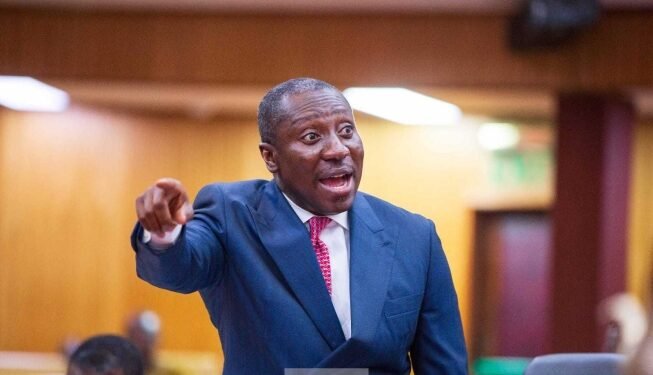
The Minority Leader and Member of Parliament for Effutu, Hon. Alexander Kwamena Afenyo-Markin, has reiterated that he will not withdraw his criticisms of a Circuit Court 9 judge, insisting that his comments are grounded in constitutional rights and ethical responsibility.
In a renewed statement, the Effutu Member of Parliament maintained that his concerns relate to what he describes as a consistent pattern of conduct by the Circuit Court 9 judge in politically sensitive cases.
He argued that judicial accountability remains essential in a constitutional democracy and that public officials have a duty to speak out when they observe what they consider procedural or ethical concerns within the justice system.
“It is both ethical and within my constitutional rights to call out a Judge who has no respect for the law and the rights of citizens. There is a pattern in the conduct of the Circuit Court 9 Judge in political cases that go before him.”
Minority Leader and Member of Parliament for Effutu, Hon. Alexander Kwamena Afenyo-Markin
Calls for Institutional Scrutiny and Parliamentary Response
The Effutu Member of Parliament further stated that the Minority Caucus in Parliament will not ignore what he considers troubling judicial behaviour.

He indicated that parliamentary and constitutional mechanisms may be activated to address the matter, reinforcing his view that no judicial officer is beyond accountability.
“I cannot, in good conscience, respect a Judge who has no respect for the law. The Minority Caucus in Parliament will not shut its eyes to the conduct of this Judge”.
Minority Leader and Member of Parliament for Effutu, Hon. Alexander Kwamena Afenyo-Markin
He also stressed that raising concerns about judicial conduct should not be interpreted as a personal attack on the judge involved. Instead, he argued that it is a legitimate critique of institutional behaviour and judicial performance.
The Minority Leader also urged the Chief Justice to take a closer interest in the operations of the Circuit Court 9 judge, suggesting that judicial leadership must ensure adherence to professional standards and ethics within the judiciary.
Earlier Remarks on Court Proceedings and Abronye Case
The renewed comments follow earlier statements in which the Effutu MP raised concerns about procedural issues in a criminal case involving Kwame Baffoe Abronye, also known as Abronye.
In those earlier remarks, he questioned the timing of a written court order following a ruling by the Circuit Court 9 judge. He noted that although the judge delivered his ruling in open court on Wednesday, 13 May 2026, and issued consequential orders, the written order had not been released as of Monday, 18 May 2026.

He argued that this delay raised concerns about transparency and consistency in judicial processes, particularly in cases with political implications.
He also referenced broader concerns about restrictions on public commentary on court rulings, suggesting that citizens face potential legal consequences such as contempt proceedings or disciplinary action when they question judicial decisions.
Public Reaction and Legal Debate
The Minority Leader’s comments have generated mixed reactions, with public debate focusing on the boundaries between judicial independence and political accountability.
Earlier statements attributed to Afenyo-Markin included direct criticism of the judge’s competence and interpretation of the law. He reportedly described the judge as an “NDC Judge” and questioned his legal understanding, stating that the jurist “does not speak law.”
He further remarked, “I don’t think he read the law,” and added that he had no respect for the judge, arguing that the judicial actions in question exceeded proper authority.
These remarks have intensified discussions about the appropriate limits of political commentary on judicial proceedings, especially when cases are ongoing.
Institutional and Professional Concerns
The Ghana Bar Association has reportedly condemned aspects of the Minority Leader’s statements, stating that they fall short of ethical expectations for legal professionals and public office holders.
Legal analysts note that while court decisions can be challenged through established legal channels, public statements questioning a judge’s integrity may risk undermining confidence in the judiciary.

The controversy has therefore sparked wider reflection on how to balance accountability with the protection of judicial independence in a politically charged environment.
The dispute continues to generate national attention, with differing views on whether the Minority Leader’s remarks represent legitimate democratic oversight or an inappropriate challenge to judicial authority.
The Minority Leader, however, maintains that he will continue to speak out, insisting that accountability within the justice system is necessary and that he will not retreat from his position.
READ ALSO: Standard Chartered to Cut 7,800 Jobs as AI Shakes Up Banking Industry