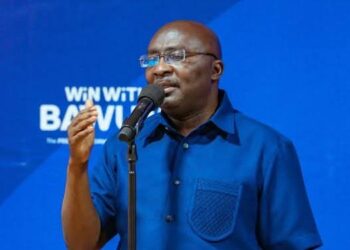
The Deputy Attorney-General and Deputy Minister of Justice, Dr Justice Srem-Sai, has disclosed that the Attorney-General’s views were never sought before a court issued orders affecting prosecutions undertaken by the Office of the Special Prosecutor.
Dr Srem-Sai explained that the Attorney-General only learnt about the proceedings in the same manner as the general public, despite the ruling containing specific directives requiring the office to take action. The Deputy Attorney-General clarified that the Attorney-General’s office would comply with the court’s orders because the government has no intention of disobeying a judicial directive, even as legal questions surrounding the ruling continue to receive attention.
“The Attorney-General was never a party to any of these proceedings. Our views were never sought in respect of any of these proceedings.”
Dr Justice Srem-Sai

According to him, the case has implications for prosecutions currently being handled by the OSP, particularly where the court has directed the Attorney-General’s Office to take over proceedings pending the acquisition of the necessary authorisation.
The legal implications, he explained, could differ depending on the stage reached in each case and the nature of the court process involved. Plea bargains, convictions and ongoing prosecutions could therefore require separate consideration based on the circumstances surrounding each matter.
Analysing convictions already secured by the OSP, Dr Srem-Sai indicated that the ruling would not automatically result in the release of persons convicted by the office because the OSP is yet to secure a conviction in the specific circumstances under discussion.
Plea bargaining arrangements, he added, could raise separate legal questions because an accused person who enters such an agreement submits to a judgment based on the terms of the arrangement. The effect of the ruling on those agreements would therefore depend on the legal foundation upon which each plea was entered.
The immediate issue, however, concerns cases still before the courts. The Deputy Attorney General explained that the ruling had directed the Attorney-General’s Office to take over such prosecutions pending the OSP’s application for and acquisition of the required authority.
Dr Srem-Sai also rejected suggestions that the applicant in the case acted on behalf of the Attorney-General or had any known connection with the office. He explained that the individual was pursuing a personal legal defence against prosecution.
Court Ruling Draws Attention To OSP Prosecution Authority
Dr Justice Srem-Sai explained that the Attorney General could delegate prosecutorial powers through two recognised avenues, each carrying a distinct legal basis. The first involves an Executive Instrument which grants public officials prosecutorial authority within the scope of their official duties.
A second route involves a fiat issued to a private individual appointed by the Attorney General to prosecute a particular case. According to the Deputy Attorney-General, either form of authorisation must exist where prosecutorial powers have been delegated.
The question arising from the proceedings, he indicated, was whether the OSP was able to produce evidence of the necessary authorisation. The court’s findings have therefore created a legal discussion over the foundation upon which certain prosecutions were initiated.

Beyond the immediate dispute, the debate has revived a longstanding constitutional question about the creation of an independent prosecutorial authority in Ghana. Dr Srem-Sai argued that Article 88 of the Constitution would have to be amended to establish such an authority independently.
He explained that ordinary legislation could not alter a constitutional provision through a process reserved for regular Acts of Parliament. The Constitution, he noted, provides a specific procedure for constitutional amendments which must be followed when fundamental provisions are being changed.
His position, he explained, os consistent with the view held by several legal practitioners and individuals who have occupied or continued to occupy the office of Special Prosecutor. The constitutional provision, in his view, sets the framework for prosecutorial authority and cannot be altered through ordinary legislation.
Previous review commissions and implementation committees, he noted, have operated on the understanding that constitutional change must follow the procedures expressly provided by the Constitution.
Parliament has also encountered similar legal limitations in previous attempts to alter constitutional provisions through ordinary legislation. The Supreme Court has repeatedly emphasised the need to follow the special amendment procedures where a proposed change affects the Constitution.
On this basis, Dr Srem-Sai questioned whether the Special Prosecutor’s Act could independently create a prosecutorial authority with powers that bypass the constitutional framework. The wording of the law, particularly the phrase “subject to”, also forms part of his interpretation.
He explained that the phrase suggests that the legislation operates within the limits of the Constitution. For him, the OSP Act must therefore be read alongside the constitutional provisions governing prosecutorial authority.
READ ALSO: Palestinian President Urges International Action Over Israeli Settler Violence