Spain’s Prime Minister, Pedro Sánchez has announced a snap election for November 29, bringing forward a vote that had been expected in 2027 after his minority government suffered a parliamentary defeat over measures aimed at addressing the country’s worsening housing crisis.
Sánchez announced the election during a televised address to the nation from the Palace of Moncloa, his official residence in Madrid, saying, “The time has come for the Spanish people to decide what future they want for themselves and for their country.”
The announcement came days after Spain’s Congress rejected two decrees introduced by Sánchez’s government to address mounting pressure over housing affordability. The measures included provisions concerning rental contracts, evictions, rent regulation and protections for vulnerable tenants.
The defeat represented another setback for Sánchez’s minority coalition, which has struggled to secure sufficient parliamentary support for key legislation. The two housing decrees were rejected on Friday after the government failed to secure the votes required for their passage.
The housing measures had been drafted amid growing public anger over the cost and availability of housing in Spain. The issue gained further prominence following the eviction of an 87-year-old woman, Maricarmen Abascal, from her Madrid home after she was unable to meet a substantial increase in rent.
The eviction helped trigger a wave of demonstrations, with thousands of people taking to the streets in Madrid and other Spanish cities to demand government action. Hundreds of protesters also established a camp in Madrid’s central Puerta del Sol, turning the location into a focal point for the housing campaign.
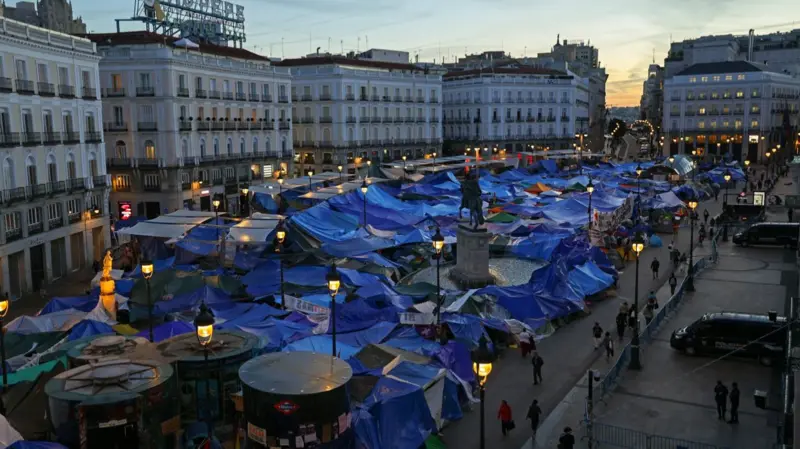
On Saturday, tens of thousands of people demonstrated across Spain, including a major protest in Madrid. Government figures put the number of participants in the capital at about 70,000, while organisers gave a substantially higher estimate.
The protests added to pressure on Sánchez as his government faced difficulties maintaining parliamentary support. The Prime Minister has been in office since 2018. The Socialist Party finished second in the last election, in 2023.
Although the conservative People’s Party won the most seats, it fell short of a majority. Sánchez remained in power after striking agreements with left-wing parties and securing support from Catalan and Basque nationalist and pro-independence groups. The next general election had originally been expected in the summer of 2027.
In his televised address, Sánchez acknowledged shortcomings during his time in government, saying that his administration had “made mistakes and have not managed to do everything we set out to do.”
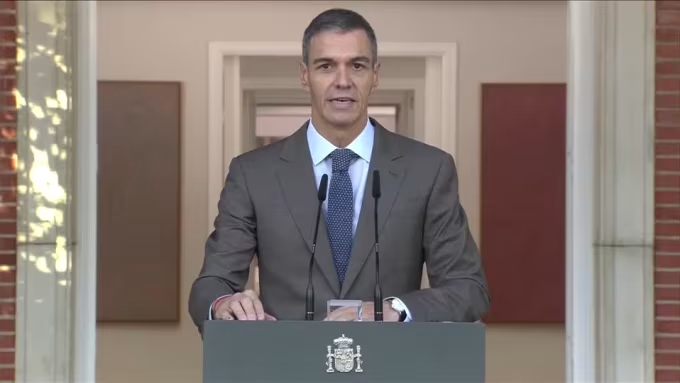
He also said that there were “still many injustices to correct” and argued that the government needed “to renew and broaden public support to undertake the necessary reforms so that citizens can reduce these levels of inequality.”
Sánchez highlighted the challenges Spain had faced in recent years, including the war in Ukraine and conflicts and crises in the Middle East. He also defended his government’s record, pointing to economic growth and other achievements despite what he described as efforts to “boycott” its progress. “Spain has become a world example of peace, feminism and prosperity,” he said.
Following his election announcement, Sánchez said that Spain needed to “renew and broaden people’s support” and called for voters to give parliament a “much broader progressive majority.”
The election will now place the housing crisis at the centre of the political debate, with parties expected to campaign over competing approaches to affordability, rents, evictions and the supply of homes.
Spain’s Political Parties React To Snap Election Announcement
Spanish political parties quickly responded to Sánchez’s decision to call the November 29 election, signalling the beginning of a campaign likely to be dominated by housing and the future direction of the country.
The conservative People’s Party, or PP, welcomed the announcement with the words “Por fin,” meaning “at last,” in a post on X accompanied by a video showing people celebrating the decision.
Sumar, a political platform comprising left-wing parties that broadly sit to the left of Sánchez’s Spanish Socialist Workers’ Party, struck a more defiant tone. In a post on Bluesky, the group said, “We are ready, and there are more of us.”
Vox also responded to the announcement, with its Spokesperson Pepa de Millán writing on X, “Sanchez or Spain.”
Meanwhile, Sánchez’s Spanish Socialist Workers’ Party (PSOE) urged its supporters to prepare for the campaign, saying, “Let’s give it our all, let’s work to inspire and to win again.”
The competing reactions reflect the political divisions that are expected to shape the campaign ahead of the November vote, with Sánchez seeking a broader progressive mandate while opposition parties look to capitalise on his government’s parliamentary difficulties.