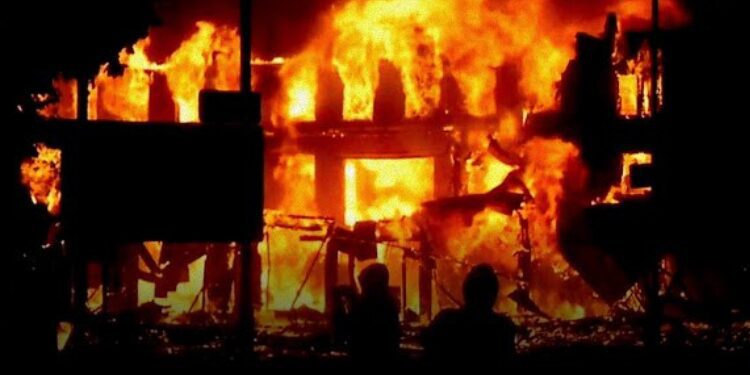
Sixteen students have been killed following a devastating fire that broke out at Utumishi Girls Boarding School in Gilgil, about 120km west of Kenya’s capital, Nairobi, in an incident that has shocked the country and triggered urgent rescue and investigation efforts.
According to a police officer at the scene, seventy-four other students have been injured and are currently receiving treatment in the hospital, with some reported to be in critical condition. Emergency responders, including teams from the Kenya Red Cross, have been deployed to the school to assist in rescue operations and provide medical and psychological support to survivors and families.
Authorities noted the fire started in the early hours of Thursday morning while students were asleep in their dormitories, raising concerns about how quickly it spread through the boarding facilities before evacuation could be fully carried out. The exact cause of the blaze remains unknown, with police confirming that investigations have been launched to determine what triggered the deadly incident.
Police Commander Masoud Mwinyi, who addressed distressed parents and onlookers gathered outside the school, described the situation as “sad and distressing.” He indicated that search-and-rescue operations were still ongoing as authorities continued to account for all students and assess the full scale of the damage.



He added, “as we speak, our officers are combing the area because some students fled in shock and fear during the night.”
The school has since been cordoned off by security officials, with access restricted primarily to parents and authorised personnel as emergency teams continue their work at the site. The atmosphere outside the institution has been tense, with families anxiously waiting for updates on their children.
Meanwhile, fires in Kenyan boarding schools are not uncommon, with several fatal incidents recorded in recent years. Many of these tragedies have previously been linked to overcrowding in dormitories, inadequate infrastructure, and failure to fully comply with fire safety regulations.
These recurring concerns have repeatedly raised questions about safety standards in residential schools across the country.
A Pattern of Tragedy: Kenya’s History of Boarding School Fires
Kenya has endured a long and painful history of boarding school fires, with repeated tragedies exposing deep and persistent safety concerns in residential learning institutions across the country. From deadly infernos in dormitories to repeated arson incidents linked to student unrest, the pattern has raised urgent questions about the enforcement of safety standards and the vulnerability of boarding school infrastructure.
One of the most recent incidents adding to this troubling record occurred at Hillside Endarasha Primary School, where a dormitory housing 156 boys aged between 10 and 14 was razed by fire. Officials later began the difficult process of recovering bodies and accounting for missing students, with authorities confirming that more than 100 boys had been accounted for while dozens remained untraced.
The tragedy prompted national mourning, with President William Ruto declaring three days of mourning as investigations into the cause of the fire continued. Government spokesperson Isaac Mwaura also urged patience as agencies worked through the scene, noting that initial figures remained preliminary.
In 2017, a fire in Nairobi claimed the lives of 10 students, an incident later linked to student unrest, with one student charged with murder.
Another major tragedy dates back to 2001, when 67 students died in a dormitory fire in Machakos County, marking one of the deadliest school fire disasters in the country’s history
Moreover, in 2024, a fire at a primary boarding school in Nyeri County killed 21 students, though the cause of that blaze has not been definitively established. Across the country, official records indicate that more than 60 cases of arson in public secondary schools were recorded in a single year, underscoring how frequent such incidents have become.
Reports from education authorities and researchers suggested that many of these fires are linked to student protests over harsh disciplinary measures, overcrowding, and poor living conditions. In some cases, students are believed to have set fires deliberately during unrest, while in others, inadequate infrastructure and weak enforcement of safety regulations have been blamed.
Government officials have repeatedly called on school administrators to comply with boarding safety guidelines, including ensuring that dormitories are spacious, fitted with multiple exits, and designed to allow quick evacuation in emergencies. However, enforcement gaps have persisted, leaving many schools vulnerable.
As investigations into the latest tragedy continue, Kenya once again finds itself confronting the painful reality of a recurring crisis.
READ ALSO: GoldBod Extends Responsible Small-Scale Mining Survey Initiative to Northern Ghana