
The Ashanti Region has long served as the New Patriotic Party’s most reliable stronghold, the foundation it returns to in every election cycle. But fresh polling data from Global InfoAnalytics suggests that foundation may be cracking among the very voters the party will need most in the years ahead.
Mussa Dankwa, Executive Director of Global InfoAnalytics, said the region’s June Tracking Poll results confirm a pattern he had already flagged at the national level.
“Analysis of the Ashanti region polling data for June and the first-time voters is revealing a phenomenon I have observed and explained earlier in my analysis,” Dankwa said, referring to what he has previously described as the NPP’s ageing voter problem. In Ashanti, he said, that problem looks worse than it does nationally.
The Generational Gap Widens
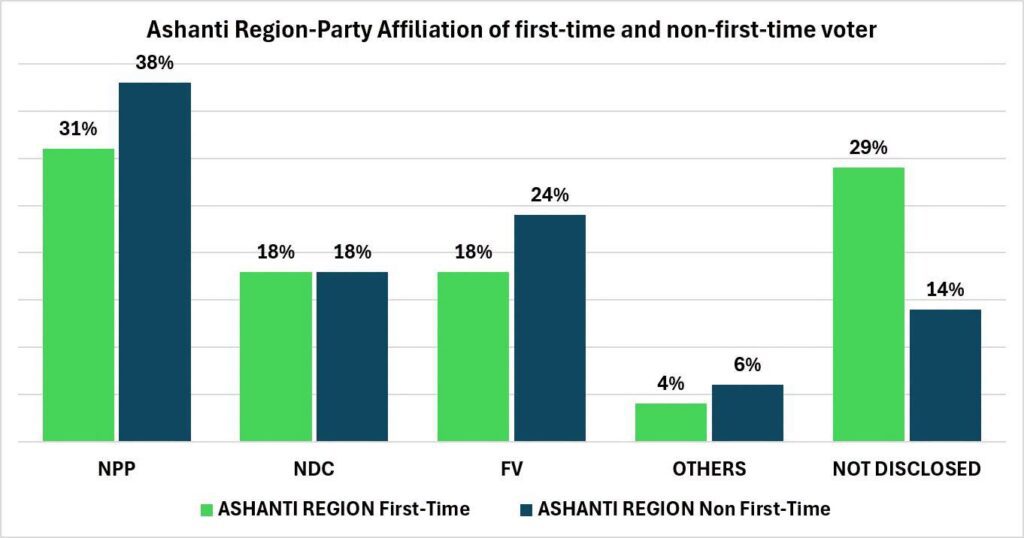
The numbers tell the story clearly. Among non-first-time voters in Ashanti Region, the NPP holds 38 percent support, compared to 18 percent for the NDC, a lead of 20 percentage points.
Among first-time voters, however, NPP support drops to 31 percent while the NDC holds steady at 18 percent, narrowing the gap to 13 points. That seven-point erosion, Mr Dankwa said, points to a deeper structural issue.
“NPP’s world bank base is bleeding youth supporters,” he said, using the term commonly applied to the Ashanti Region’s status as the party’s most dependable voting bloc.
A 20-point advantage among older voters shrinking to 13 points among the newest entrants to the electorate suggests the party’s grip on young Ashanti voters is loosening, even if it has not yet broken.
The Undisclosed Voters Raise Bigger Questions
The most striking figure in the data, according to Mr Dankwa, has nothing to do with either party directly. It involves the voters who refuse to say where their loyalties lie.
Among first-time voters in the Ashanti Region, 29 percent declined to disclose their party affiliation, compared to just 14 percent of non-first-time voters. Mr Dankwa called this gap a major red flag.
He offered a possible explanation rooted in the political culture of the region itself. Young voters in an NPP stronghold may fear backlash for expressing support elsewhere, he said, and may also feel less personal loyalty to the party than older generations who lived through its formative political battles.

This silence among young voters may also help explain another shift in the data. NDC support among Ashanti’s first-time voters fell from 30 percent in March 2026 to 18 percent in June 2026.
Mr Dankwa suggested that drop may not reflect a genuine decline in NDC sympathy so much as voters retreating into non-disclosure rather than openly stating a preference that runs counter to the regional norm.
A Scenario That Could Reshape the Region
Mussa Dankwa laid out what could happen if that theory holds. If the 29 percent of undisclosed first-time voters are, in truth, NDC supporters who are simply concealing their preference, and if they eventually break publicly in the NDC’s favor, the consequences for the NPP could be severe.
In the 2024 election, the NPP carried Ashanti Region by a 32-point margin, winning 65 percent of the vote to the NDC’s 33 percent. Mr Dankwa warned that if the hidden first-time voter bloc swings toward the NDC in future elections, that 32-point margin could be cut in half.
Such a shift would not flip the region outright, but it would mark a dramatic narrowing of what has historically been the NPP’s safest territory. For a party already grappling with signs of an ageing base nationally, a weakened Ashanti stronghold would remove much of the cushion it has relied on to offset losses elsewhere.
A Call for Strategic Reassessment
Mr Dankwa urged the NPP not to dismiss the findings simply because the analysis was made publicly available at no cost. “NPP should not downplay this free data analysis,” he said.

He called for what he described as a full strategic review, urging the party to undertake a 360-degree scan of its standing and reposition itself for the future. The data, he suggested, offers the NPP an early warning while there is still time to respond, rather than a verdict on what has already happened.
READ ALSO: North Korea Commissions New Warship