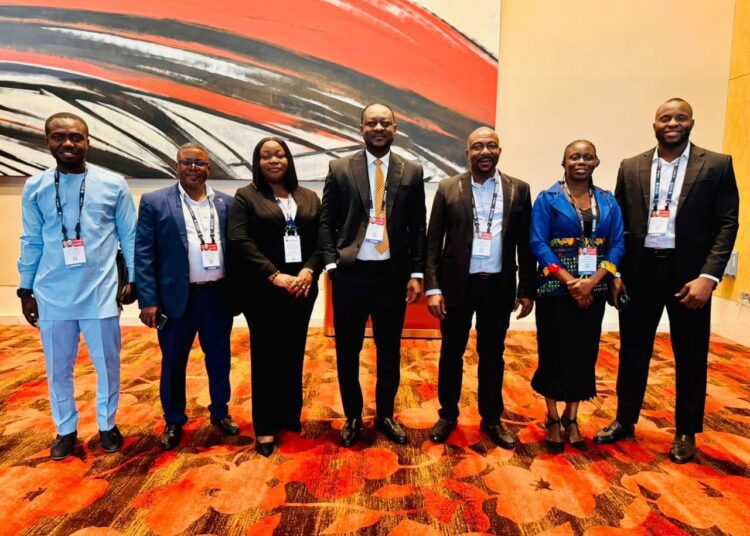
Tema Oil Refinery (TOR) has taken a strategic leap toward restructuring its structural operations and technical governance as a high-powered corporate delegation participates in the premier global internal audit convention in Singapore.
Led by the Managing Director, Mr. Edmond Kombat, the refinery’s leadership is actively engaging with leading international authorities to integrate cutting-edge auditing protocols directly into Ghana’s premier state-owned downstream oil facility.
This calculated deployment targets the immediate adoption of elite corporate mechanisms designed to optimize asset protection, mitigate systemic operational risks, and position the long-standing national refinery for sustainable commercial revitalization.
“Internal audit is integral to the refinery’s operations, helping us manage risks and improve processes. In this regard, our Managing Director, Mr. Edmond Kombat, together with members of TOR’s audit team, is in Singapore for the IIA conference to keep abreast of emerging developments in internal audit controls and governance. The sessions and experiences so far shared have been worthwhile, and the insights gained will definitely contribute to improved operations and governance at TOR.”
Tema Oil Refinery (TOR)

The international capacity-building mission serves as a critical turning point for the refinery’s long-term corporate governance strategy.
By embedding Mr. Kombat alongside key senior members of the internal audit unit within this global ecosystem, the institution is systematically modernizing its internal control frameworks to align with rapidly evolving international parameters.
The intensive program, which has successfully convened a diverse cohort of global audit and governance professionals, fosters an environment focused heavily on exchanging operational ideas and breaking down modern benchmarks.
As the three-day convention reaches its official conclusion on June 24, 2026, the strategic expertise acquired is slated for immediate localization across the refinery’s operational workflows.
Global Insights to Catalyze Domestic Refining Efficiency
Details in modern oil refinery management reveals that the implementation of cutting-edge risk frameworks is vital to transforming heavy processing infrastructures.

In an era where downstream energy systems face high margins of volatility, advanced structural auditing serves as the primary line of defense against financial leakages and technical breakdowns.
For a facility like the Tema Oil Refinery which has recently shown vital signs of a structural comeback through tolling agreements and localized processing agreements the integration of standardized automated audit systems can significantly reduce technical losses.
Industry analysts emphasize that modern auditing extends far beyond traditional bookkeeping; it directly impacts mechanical integrity, supply chain transparency, and fuel asset preservation.

By exposing the corporate delegation to modern computerized risk tools and real-time inventory governance schemas utilized by advanced Asian hubs, the refinery positions itself to eliminate long-standing operational bottlenecking.
Furthermore, applying rigorous predictive risk metrics to processing schedules ensures that routine plant maintenance turns from a reactive cost center into a carefully managed preventative strategy.
Institutional Alignment and Future Governance Milestones
Implementing the comprehensive tools acquired at the global summit provides an immediate roadmap for boosting overall commercial reliability.

With major international oil entities exploring renewed upstream and downstream partnerships within the West African sub-region, establishing an airtight corporate governance structure remains non-negotiable for securing institutional investments.
The application of international auditing protocols creates clear financial transparency, ensuring that state-allocated feedstocks, processing yields, and refined distributions remain fully accountable under strict scrutiny.
Ultimately, localizing the governance paradigms brought back from Singapore bridges the operational gap between regional processing standards and elite international practices.
As the leadership team brings these practical frameworks from the global stage straight into the plant’s daily workflows, the state asset shifts closer to running as an efficient, self-sustaining hub for regional energy security.
READ ALSO: I Didn’t Deserve The MOTM Award – Bellingham