
The Cyber Security Authority (CSA) has issued a public alert over a sharp rise in food delivery scams involving fraudsters impersonating legitimate restaurants and food vendors on Google Search, Google Maps, and other online platforms. The warning, issued by the authority, follows a significant increase in reported cases and financial losses during the first half of the year.
According to the CSA, cybercriminals are manipulating business listings, replacing genuine contact details with fraudulent phone numbers and payment channels to deceive customers into paying for food orders that are never delivered.
The Authority has urged the public and businesses to verify contact details, avoid suspicious payment requests, and strengthen online security measures to prevent further losses.
Food Delivery Scams Record Sharp Increase
The Cyber Security Authority said it is tracking a growing trend of restaurant and food vendor impersonation scams targeting unsuspecting customers across Ghana. Between January and June 2026, the Authority recorded 112 reported cases involving vendors and customers, compared with 61 cases during the same period last year.
Financial losses also rose sharply. Victims lost a combined GHS296,083.68 during the first six months of 2026, up from GHS84,592.00 recorded over the corresponding period in 2025. The Authority attributed the increase to cybercriminals exploiting online business listings to impersonate legitimate restaurants and food vendors.

The CSA explained that fraudsters either create fake business profiles or alter the contact details of legitimate restaurants on Google Search, Google Maps, and similar online platforms.
According to the Authority, the criminals typically exploit Google’s “suggest an edit” feature, claim unverified business profiles, or create duplicate listings that replace genuine business telephone numbers with fraudulent ones.
In some instances, the fraudsters purchase sponsored search advertisements to ensure their fake contact details appear prominently at the top of search results, increasing the likelihood that customers will contact them instead of the legitimate business.
Unsuspecting customers then place food orders, believing they are dealing directly with a genuine restaurant or food vendor.
Victims Lose Money Through Mobile Money and Fake Payment Links
After receiving customers’ orders, the fraudsters instruct victims to transfer payment to a designated mobile money account before delivery. Once payment is completed, communication stops and the ordered food is never delivered.
The Cyber Security Authority also warned that some victims are directed to fraudulent payment links under the pretext of confirming orders or processing payments. These malicious websites request personal information including customers’ names, delivery addresses, and mobile money numbers.
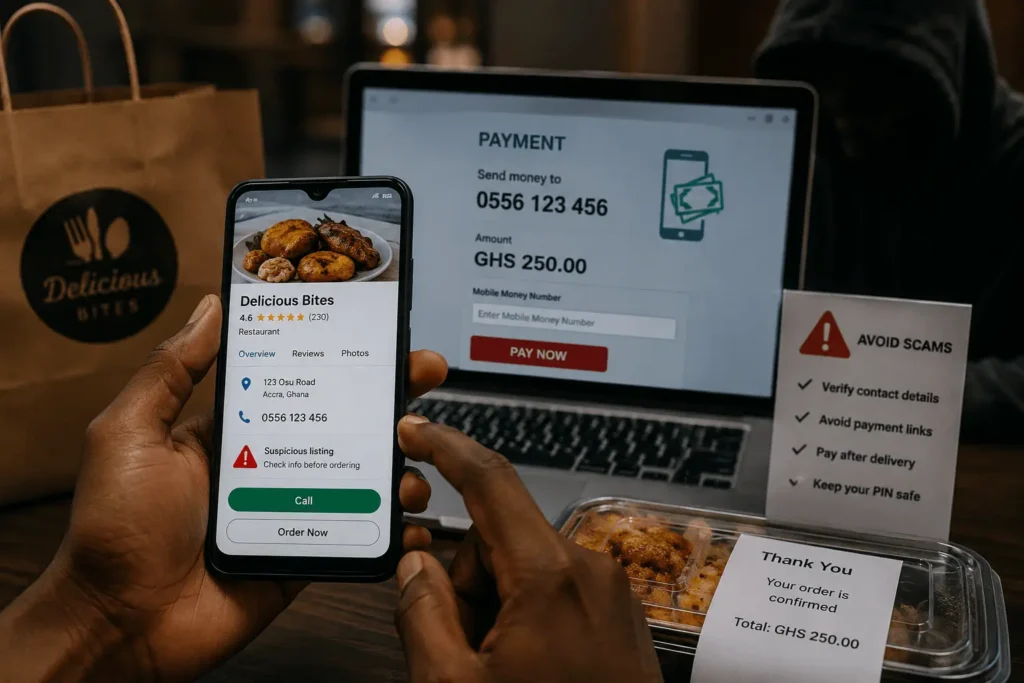
Once victims provide the requested details, cybercriminals use the information to conduct unauthorised transactions, resulting in additional financial losses beyond the initial food payment.
CSA Advises Public to Verify Business Details
The Cyber Security Authority urged consumers to verify restaurant and food vendor contact information before placing online orders. The Authority advised customers to confirm business details through official websites, verified social media pages, or trusted food delivery platforms instead of relying solely on search engine results.
Consumers were also urged to exercise caution when asked to make payments through unfamiliar links. The CSA encouraged customers to insist on paying only after food has been delivered and inspected where possible.
It further warned the public never to disclose mobile money PINs, one time passwords, banking credentials, or other sensitive personal information to any website or individual.
The Authority also advised customers not to approve mobile money payment prompts they did not initiate and to verify payment instructions directly with restaurants using independently confirmed contact details.
In addition, consumers were encouraged to regularly monitor their mobile money accounts for unauthorised transactions and immediately report suspicious activity to their mobile network operators.
Restaurants Urged to Secure Online Business Profiles
The Cyber Security Authority also outlined measures for restaurants, food vendors, and other online businesses to protect themselves against impersonation. Businesses have been encouraged to claim and verify their Google Business Profiles to take control of their online listings.
According to the Authority, businesses with existing but unverified profiles should search for their listing on Google Maps, select “Claim this business,” choose “Manage now,” and complete Google’s verification process.
The CSA further advised businesses to display their official telephone numbers and approved payment channels prominently on their verified websites and social media pages. Restaurants and vendors should also inform customers that they will never request mobile money PINs or one time passwords.

The Authority urged businesses to regularly review their listed phone numbers and profile information, enable notifications for profile changes, monitor suggested edits, and check for duplicate listings.
Where fraudulent profiles or unauthorised changes are detected, businesses should report them directly to Google through the Business Redressal Complaint Form.
CSA Offers Cybercrime Reporting Support
The Cyber Security Authority reminded the public that it operates a 24 hour Cybersecurity and Cybercrime Incident Reporting Point of Contact to assist victims and provide guidance on online security incidents.
Members of the public can report suspected cybercrime by calling or texting 292, sending a WhatsApp message to 0501603111, or emailing [email protected]. The Authority said timely reporting can help limit financial losses and support investigations into cybercriminal activities.
With online food ordering becoming increasingly popular, the Cyber Security Authority urged both consumers and businesses to remain vigilant against evolving cyber threats.
The Authority emphasised that verifying business information, protecting personal and financial credentials, and promptly reporting suspicious activity remain essential steps in reducing the growing threat posed by restaurant and food vendor impersonation scams.
READ ALSO: Fiscal Discipline Must Become Ghana’s National Culture, Ato Forson Declares