
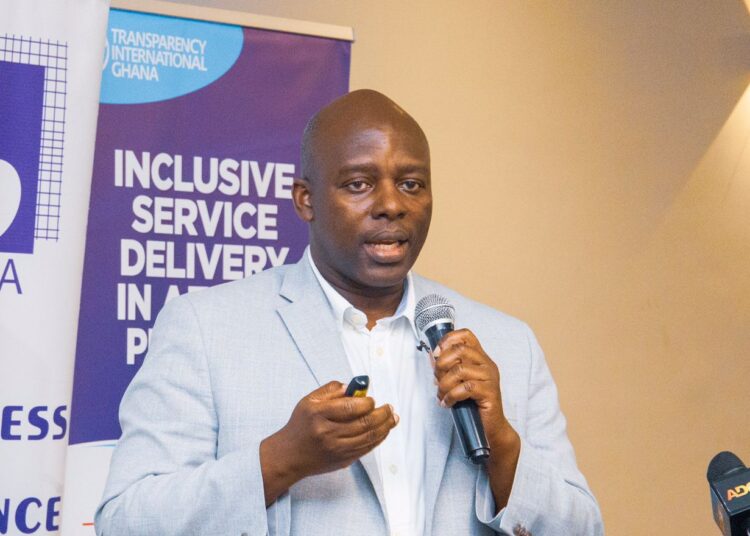
Dr. John Osae-Kwapong, a renowned political scientist, has warned that the hardest question left open by the Supreme Court’s ruling on party primaries is one the judges did not answer, namely who counts as a member in good standing.
The court struck down the delegate system and gave parties one year to let every registered member in good standing vote directly in presidential and parliamentary primaries, but left each party to set the qualification itself.
Speaking in an exclusive interview with The Vaultz News, Osae-Kwapong, a Democracy and Development Fellow at CDD-Ghana and Project Director of The Democracy Project, said the parties must now decide whether good standing rests on money, on participation, or on both.
He expects payment of dues to emerge as the anchor because attendance and participation tests are far harder to administer, and he cautioned that whatever rules emerge could send the matter straight back to court.
Defining a member in good standing
Osae-Kwapong framed the problem as one the parties cannot avoid once they start drafting internal rules. “The question is what the qualifications for good standing will be, and whether they will combine financial and non-financial requirements,” he said.

For Dr Osae-Kwapong, the distinction matters because each type of requirement carries a different administrative burden. A financial test produces a record automatically. A participation test requires the party to observe, record, and verify behaviour across every constituency, month after month.
He set out a hypothetical rulebook to show what compliance would demand in practice. “Suppose a party says you must register, pay an annual due of, say, ten cedis, and attend at least two party meetings during the year. That means the party has to track who has registered, who is paying dues, and who is attending meetings,” he said.
None of that runs itself. Each element assumes record keeping systems, staff and money, spread across hundreds of constituencies and thousands of branches, in a political culture where membership records have never carried this weight.
“That is not an easy thing to do, because it demands both financial and non-financial resources. Keeping a sign-up sheet and validating it against your register of members could become cumbersome”.
Dr. John Osae-Kwapong, Democracy and Development Fellow, CDD-Ghana, and Project Director, the Democracy Project
The verification problem sits at the heart of it. A signature collected at a branch meeting means little until someone matches it against a central register of members, and that register must itself be accurate enough to bear the result of a primary.
Why payment of dues may become the anchor
Given those constraints, Dr Osae-Kwapong expects the parties to gravitate toward the test that is easiest to prove and cheapest to keep.
“So it will be very interesting to see the rules the parties come up with. My suspicion is that the key qualification will be monetary: have you paid your dues? I suspect that will be the anchor, because the other tests are harder to administer”.
Dr. John Osae-Kwapong, Democracy and Development Fellow, CDD-Ghana, and Project Director, the Democracy Project
A dues based rule carries an obvious appeal. It generates its own audit trail, it can be verified from a single record, and it settles disputes about eligibility without argument over who attended which meeting. It also draws a line through the membership that has nothing to do with loyalty, service or years spent working for the party.

Asked whether it is democratic to reduce good standing to a payment, Dr Osae-Kwapong pointed to how the phrase already functions in Ghanaian associational life. “In our world it has become the obvious marker,” he said. He offered the example of an old students’ association, where the same standard governs who is recognised and who is not.
“Every so often, the global executive circulates a notice of year groups in good standing, showing who has paid their year group dues, and within our own year group it shows who has paid and who has not. That is what makes you a member in good standing”.
Dr. John Osae-Kwapong, Democracy and Development Fellow, CDD-Ghana, and Project Director, the Democracy Project
Familiarity, however, does not settle the constitutional question, and he conceded the point rather than dismissing it.
The rules themselves could return to court
Dr Osae-Kwapong sees a clear possibility that the litigation ending the delegate system has simply opened a second front over the terms of party membership. “But you are right that it raises a question. Whatever rules the parties settle on, someone may well say these rules are undemocratic and go back to the court to challenge them,” he said.
That prospect places a premium on how carefully the parties draft. Rules written quickly, or written to protect incumbents, invite the same judicial scrutiny that dismantled the delegate system in the first place.
Dr Osae-Kwapong turned to comparative practice to show that membership tests are not a universal feature of open primaries, and that some systems deliberately keep the entry requirement low.
“In countries that use open primaries, such as the United States, some states run genuinely open primaries, where you do not even have to be registered with a party to vote in its primary. Others run closed primaries, open only to registered members of that party”.
Dr. John Osae-Kwapong, Democracy and Development Fellow, CDD-Ghana, and Project Director, the Democracy Project

Even the closed version, he noted, asks far less of a voter than the rulebook Ghanaian parties may be preparing to write.
“But the only qualification in a closed primary is showing that you are a registered Republican or a registered Democrat, which in most cases is done through the driver’s licence registration process.
“You show your voter ID indicating that you identify with a particular party, and you can participate. There are no additional membership tests. Nobody asks whether you have paid your dues”.
Dr. John Osae-Kwapong, Democracy and Development Fellow, CDD-Ghana, and Project Director, the Democracy Project
The contrast leaves Ghana’s parties with a choice the court did not make for them. They can set a low threshold that admits the widest possible membership, or build a stricter definition that narrows the electorate the judgment sought to widen.
READ ALSO: Osae-Kwapong: Open Primaries Will Make Vote Buying Too Expensive To Sustain