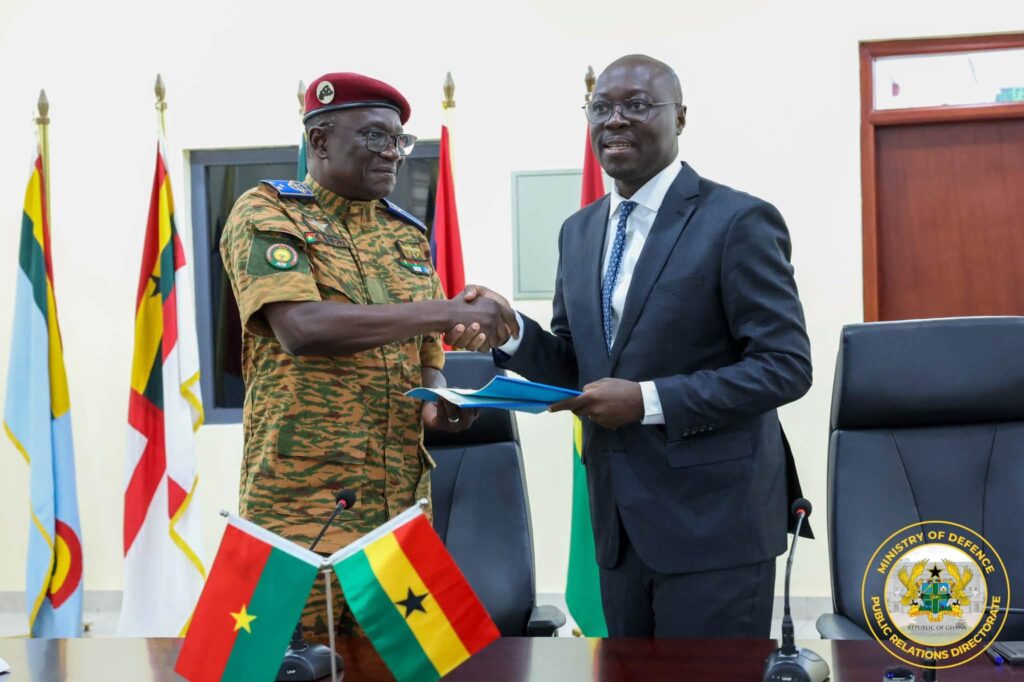
Ghana and Burkina Faso have signed a Defence Cooperation Agreement committing both countries to provide security and escort support along the cross-border trade corridors that carry goods between them.
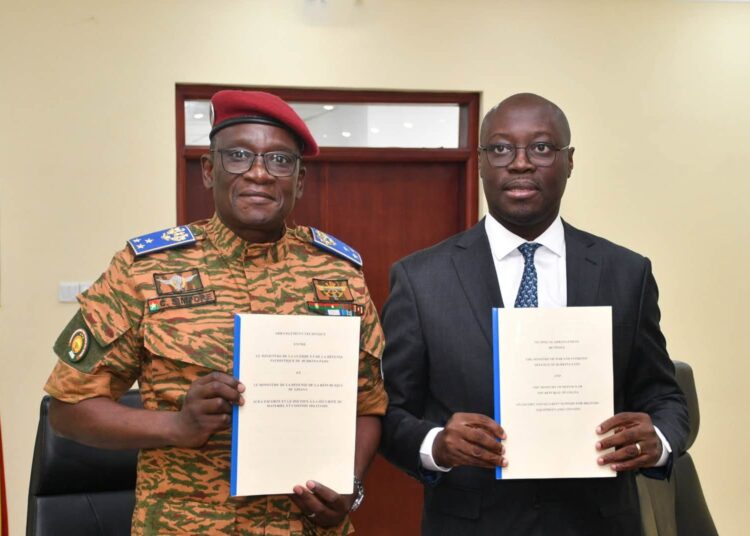
Ghana’s Finance Minister Dr Cassiel Ato Baah Forson, who holds the defence portfolio in an acting capacity, signed for Ghana with Burkina Faso’s Minister of State and Minister of War and Patriotic Defence, Major General Célestin Simporé.
The agreement links commerce directly to security, treating the movement of trucks and traders as a defence matter rather than a purely economic one. Both ministries framed the pact as an instrument to safeguard economic stability, secure critical supply routes and strengthen bilateral defence ties at a moment when armed groups operating in the Sahel have pushed closer to Ghana’s northern frontier.
Security and escort support along trade corridors
The Ministry of Defence said the agreement was signed with the Ministry of War and Patriotic Defence of Burkina Faso to provide security and escort support along vital cross-border trade corridors.
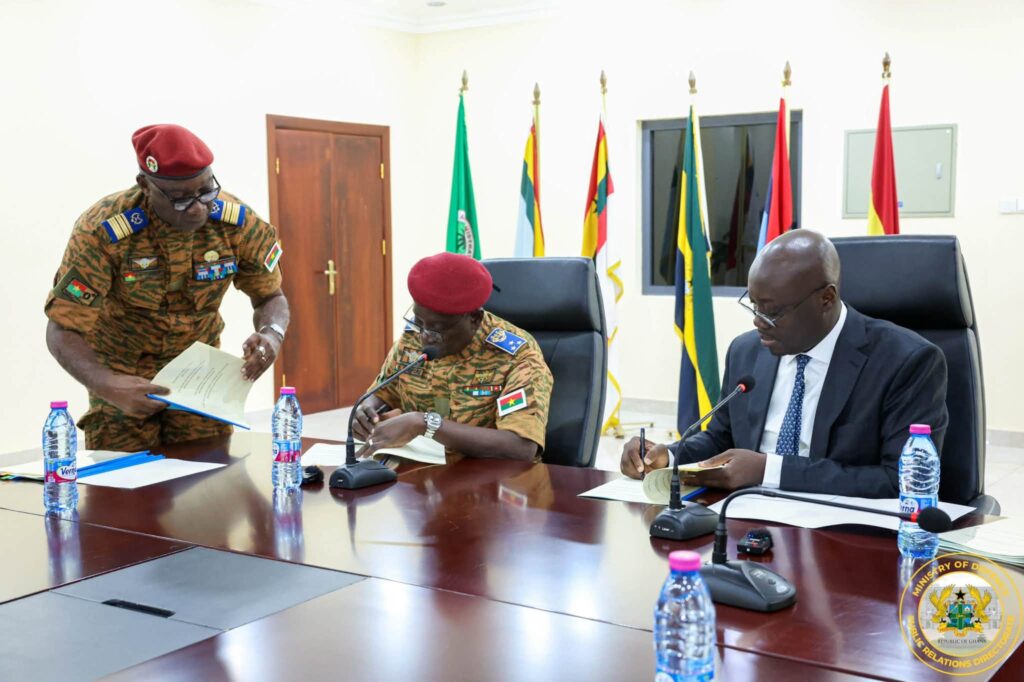
Ato Forson set out the purpose in his own account of the signing. “Ghana and Burkina Faso have signed a Defence Cooperation Agreement to secure vital cross-border trade corridors, safeguard economic activity and deepen defence cooperation between our two countries,” he wrote, adding that he signed the agreement with his Burkinabè counterpart.
Escort support is the operative phrase. It implies armed accompaniment for commercial convoys on routes where attacks, abductions and improvised explosive devices have disrupted movement, and it commits each country’s forces to a role that extends beyond patrolling its own territory.
Who witnessed the signing
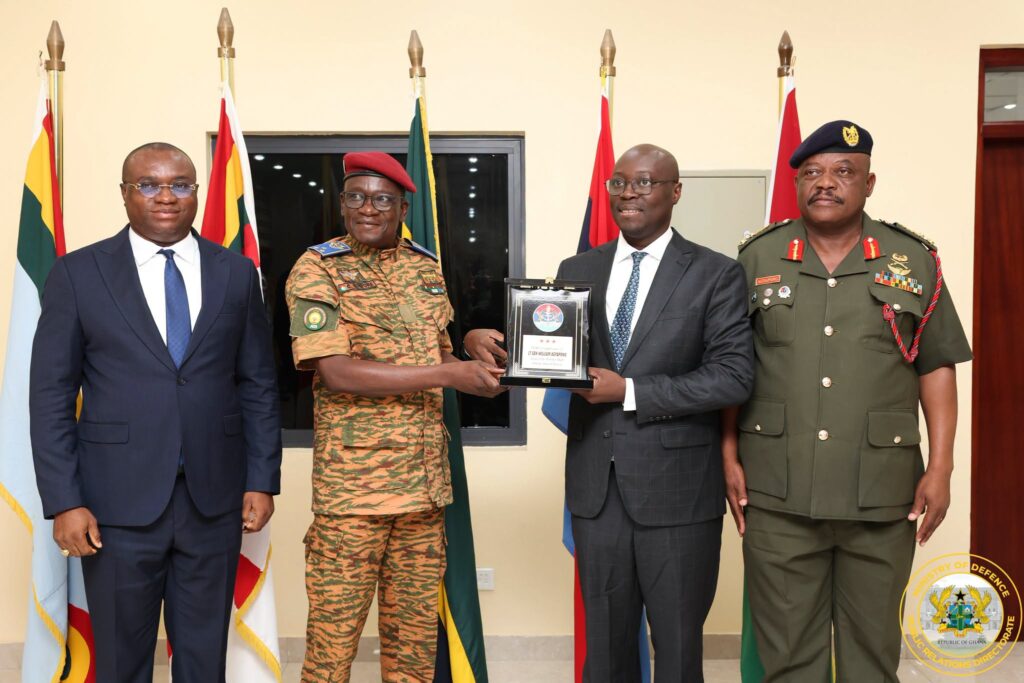
The ceremony drew the senior leadership of Ghana’s defence establishment. The Deputy Minister for Defence, Ernest Brogya Genfi, and the Chief Director of the Ministry, Mr Emmanuel Kartey, attended, alongside the Burkina Faso Ambassador to Ghana, Mr David Kabre.
The Chief of the Defence Staff, Lieutenant General William Agyapong, was also present, together with directors of the Ministry, heads of various directorates of the Ghana Armed Forces and members of the Burkinabè delegation.
The composition of the room matters for implementation. Corridor security requires coordination at the level of operational commands rather than ministries alone, and the presence of the Chief of the Defence Staff and directorate heads signals that the agreement is intended to translate into deployments.
Why the corridors carry so much weight
Trade between the two countries runs through a small number of crossings that connect landlocked Burkina Faso to Ghanaian ports. Livestock, grains, tomatoes and manufactured goods travel those routes daily, and the corridors also serve as Burkina Faso’s access to the sea for imports arriving through Tema and Takoradi.
Insecurity along them carries costs on both sides. Delays and diversions raise the price of food in Ghanaian markets, restrict earnings for Burkinabè producers, and push transporters toward informal routes that are harder to police.
Commercial disputes have flared on top of the security problem, with Ghanaian and Burkinabè traders having clashed over cross-border tomato trade restrictions, an example of how economic friction and security strain feed one another.
Building on a wider diplomatic reset
The defence agreement extends a relationship that both governments have worked to repair over the past year. In February 2026, the two countries convened their joint ministerial commission in Ouagadougou and signed seven agreements covering transport and transit, mutual recognition of driving licences, disaster and humanitarian crisis management, and cooperation against drug trafficking, among others.
Foreign Minister Samuel Okudzeto Ablakwa held talks in Ouagadougou with his counterpart Karamoko Jean-Marie Traoré during that visit, and the two sides condemned terrorist attacks in the sub-region and committed to designing a strengthened bilateral security framework against terrorism and violent extremism.
They also agreed to address the recurring spillage of the Bagré Dam, which floods communities in northern Ghana. Seen against that sequence, the Defence Cooperation Agreement converts a stated intention into an instrument with named signatories and a defined operational purpose.
The security backdrop in the Sahel
The urgency behind the pact comes from the deterioration across the border. Burkina Faso, together with other Sahel states, accounted for nearly half of all terrorism-related deaths globally for the third consecutive year in 2025. Jihadist groups have carried out repeated assaults on military positions in the country’s north.
Ghana has remained comparatively calm, though researchers have observed that armed groups from Burkina Faso often use northern Ghana to rest, refuel and evade authorities rather than as a theatre of attack. That pattern makes corridor security a matter of prevention for Accra as much as protection for Ouagadougou.
Ghana has meanwhile broadened its security partnerships elsewhere, signing its first pact with the European Union in March 2026 to counter growing insecurity in West Africa.
However, the announcement does not specify which corridors fall within its scope, how escort operations will be commanded when forces from one country operate near or across the border, or what funding either side has committed.
It also leaves unstated how the arrangement interacts with regional structures, including the Accra Initiative, through which Ghana has sought to coordinate responses to Sahelian spillover with neighbouring states.
A further question concerns Parliament. International agreements executed in the name of Ghana are subject to ratification under Article 75 of the 1992 Constitution, and neither ministry has indicated whether this one will be laid before the House.
Those details will determine whether the agreement changes conditions on the ground or joins the longer list of bilateral instruments signed and never fully operationalised. For traders who load trucks at Paga and Hamile each week, the test will be simple enough to measure by whether the journey becomes safer.
READ ALSO: Chief Justice: Lawyers Cannot Abstain from Cases Over Legal Vacation