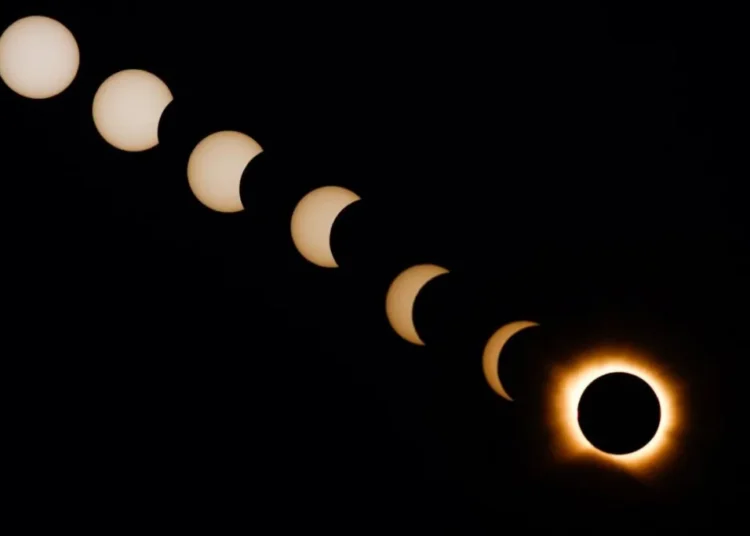
Millions of people across the United Kingdom and Europe have turned their eyes to the skies for one of the most dramatic solar eclipses witnessed in the region in decades, as the Moon swept across the face of the Sun in a spectacular celestial event that transformed daylight and drew huge crowds to viewing sites.
The eclipse, which reached its peak on Wednesday evening, August 12, gave people across much of the UK an unusually close view of totality, with more than 90% of the Sun covered by the Moon at the height of the event.
While Britain experienced a partial eclipse, parts of Greenland, Iceland and northern Spain fell directly within the path of totality, allowing observers to witness the Sun disappear almost completely behind the Moon.
The event represented the most significant solar eclipse visible from the UK since 1999, when parts of Britain experienced a total eclipse. The Royal Observatory Greenwich described the 2026 event as the best solar eclipse visible from the UK and Ireland so far this century, with around 90% of the Sun expected to be obscured in much of the region.
Across Britain, the eclipse began during the early evening, with the Moon gradually moving across the Sun and producing an increasingly pronounced crescent of sunlight. In London, the eclipse began shortly after 18:00 BST and reached its maximum at about 19:13, although the precise timing and degree of coverage varied depending on location.
In Cornwall, coverage approached 96%, making the event particularly striking along the country’s south-western coast. Other parts of the UK also experienced coverage above 90%, creating an unusual evening spectacle as the Sun appeared to shrink before gradually returning to its normal form.
The skies, however, were not equally generous everywhere. Much of central and southern England and Wales enjoyed relatively clear conditions, allowing large numbers of people to gather at parks, observatories, landmarks and open spaces. In northern England, Scotland and Northern Ireland, cloudier conditions complicated viewing, although crowds still turned out in anticipation of the rare event.
The shortage of certified eclipse glasses became one of the unexpected features of the occasion. Demand surged in the days leading up to the eclipse, with specialist retailers and other businesses reporting shortages.
A solar eclipse occurs when the Moon passes between the Earth and the Sun, temporarily blocking some or all of the Sun’s light from reaching particular areas of the Earth’s surface. Whether an observer sees a partial or total eclipse depends on the position of the observer relative to the Moon’s shadow.
In UK, the three bodies were not perfectly aligned, meaning the Moon covered most, but not all, of the Sun. The result was a partial eclipse in which more than nine-tenths of the solar disc disappeared in many locations.
But for observers within the narrow path of totality, the experience was dramatically different.
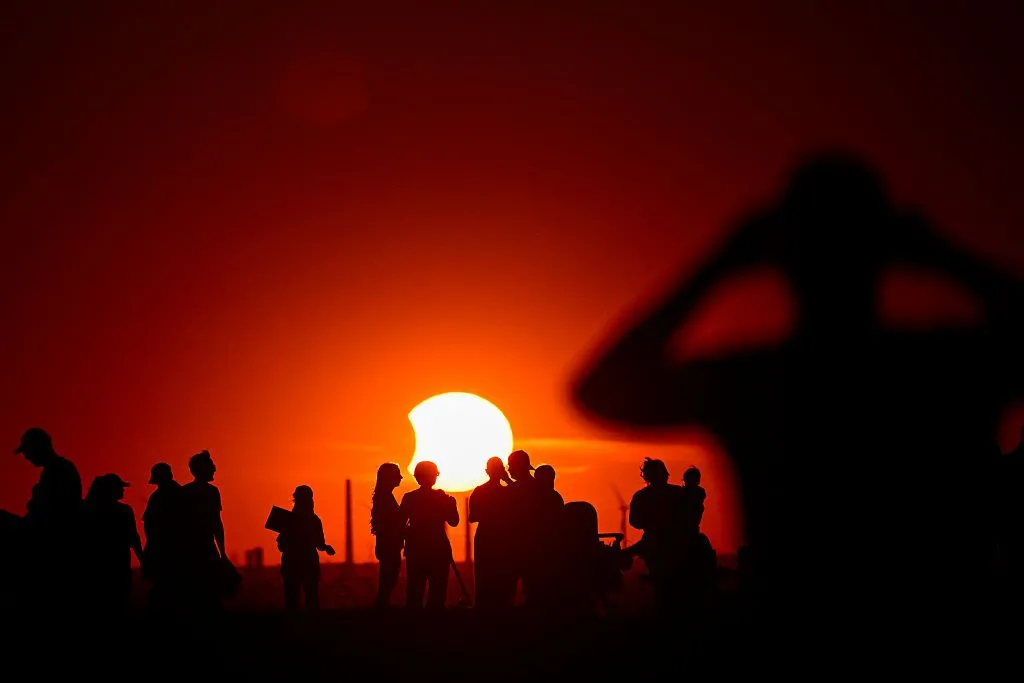
In parts of Spain, the Sun was completely covered by the Moon, plunging the surrounding landscape into an eerie twilight. The darkness revealed the Sun’s corona, its outer atmosphere, which is normally hidden by the overwhelming brightness of the solar surface.
The event was particularly significant for Spain, where the eclipse marked the first total solar eclipse visible from mainland Spain in more than a century. Thousands of visitors travelled to northern and central parts of the country to experience the brief period of darkness.
Chilean Scientist Yasmin Catricheo, who travelled to Coruña in north-west Spain to witness the eclipse, described the moment of totality as overwhelming.
“At the totality, everyone was cheering and sharing the excitement of what we were seeing. No words could describe the feeling. The universe is amazing.”
Yasmin Catricheo
The eclipse’s path began in the Arctic before moving across Greenland and Iceland and then reaching Spain, creating a sweeping corridor in which observers could experience totality. Elsewhere across Europe, countries including France, Portugal and parts of Italy experienced substantial partial coverage.
Rare Totality Highlights Extraordinary Coincidence of Sun and Moon
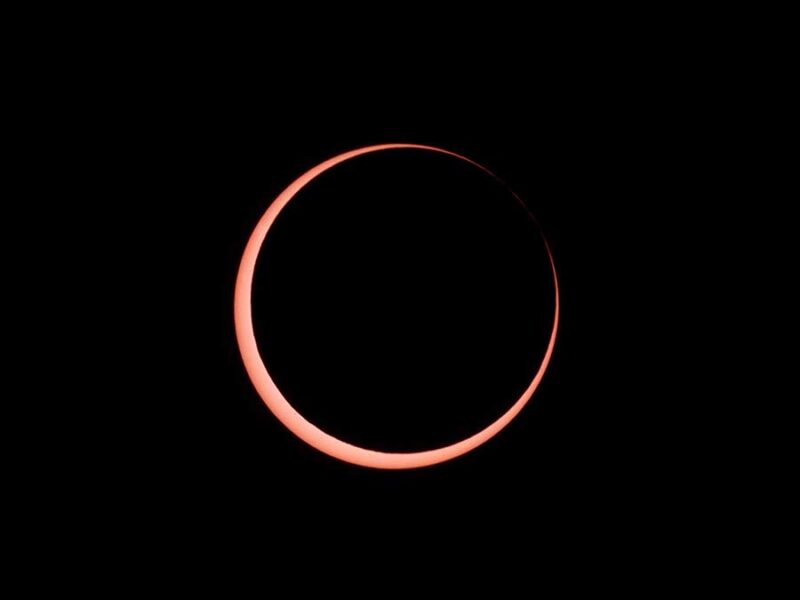
For those who experienced totality, the most remarkable moment came when the Moon completely covered the Sun.
The phenomenon lasted only briefly, but during those moments observers could see features of the solar atmosphere that are normally impossible to observe with the naked eye.
The corona appeared around the dark silhouette of the Moon as a faint, luminous halo. Some observers could also glimpse prominences loops of hot gas extending from the Sun’s surface and shaped by its powerful magnetic field.
As the Moon continued along its orbit, sunlight gradually returned, ending the period of darkness and restoring the familiar daytime sky.
The rarity of such a sight helps explain why thousands of people travelled across Europe to witness it.
A total solar eclipse occurs somewhere on Earth roughly every 18 months. But because the Moon’s shadow covers only a relatively narrow area, total eclipses are extraordinarily uncommon from any individual location.
The Royal Observatory Greenwich estimates that a total solar eclipse occurs from any particular place on Earth only about once every 400 years.
The phenomenon is also the product of an extraordinary astronomical coincidence.
The Sun is approximately 150 million kilometres from Earth, while the Moon is vastly closer. Yet the Sun is roughly 400 times larger in diameter than the Moon and approximately 400 times farther away. This makes the two objects appear remarkably similar in size when viewed from Earth.
That apparent match allows the Moon to cover the Sun almost perfectly during a total eclipse.
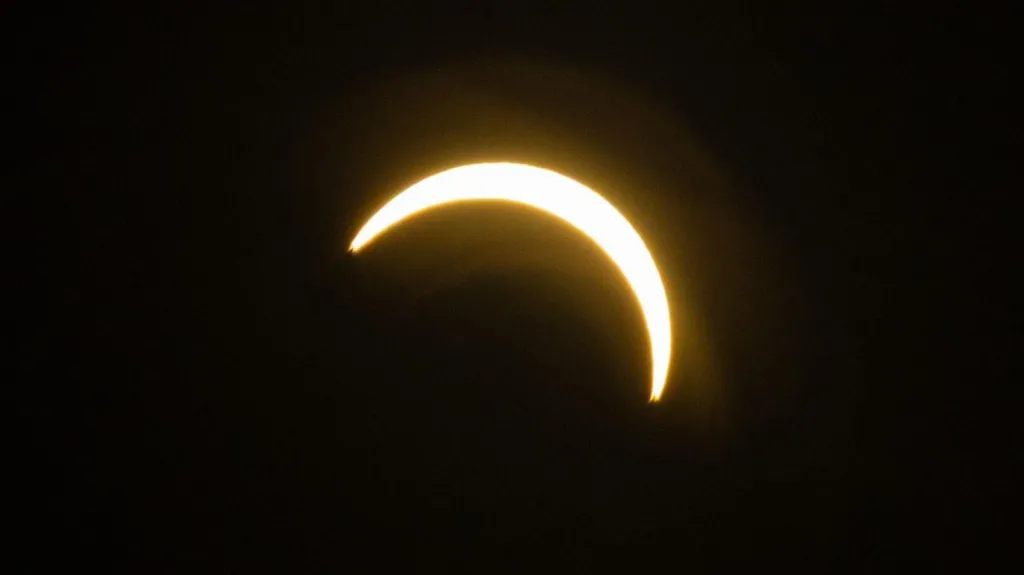
If the Moon were significantly smaller, or if its orbit placed it considerably farther from Earth, observers would never experience the dramatic total eclipses that have fascinated humanity for centuries.
The 2026 event has also opened what astronomers and eclipse enthusiasts describe as a particularly exciting period for eclipse viewing.
Between 2026 and 2028, three major solar eclipses will create opportunities for eclipse chasers to travel around the world in search of total or near-total events. Spain is at the centre of this sequence, with another total eclipse expected in 2027 and an annular eclipse in 2028. Spanish authorities have promoted the period as an unprecedented astronomical opportunity for tourism and scientific observation.
For Britain, however, opportunities to witness a comparable eclipse remain limited. UK will experience another significant partial solar eclipse in 2027, but it will not match the extraordinary coverage witnessed in 2026. The next total solar eclipse visible from the UK is not expected until 2090, according to the Royal Observatory Greenwich.
READ ALSO: Somali Referee Artan Makes History as PSG Beat Villa to Retain Super Cup