
The Director-General of the Road Safety Authority, Abraham Amaliba has warned that the absence of police officers from major roads could be encouraging reckless driving and worsening road crashes across the country. Speaking about the Ofankor barrier accident in which 11 people have lost their lives, Mr Amaliba urged the Police Motor Traffic and Transport Department to return officers to accident hotspots to strengthen enforcement.
The Ofankor incident, according to the Road Safety Director, highlights the danger created when a minor road incident develops into a larger crash. He explained that preliminary information pointed to an Aboboyaa rider being knocked down before a Tipper truck reportedly crashed into other vehicles amid the resulting traffic situation.
Mr Amaliba indicated that investigators would need to establish whether mechanical failure, including brake failure, played a role in the Tipper truck incident. He nonetheless stressed that traffic management becomes critical immediately after an accident, particularly on busy urban roads where stationary vehicles can create further hazards.
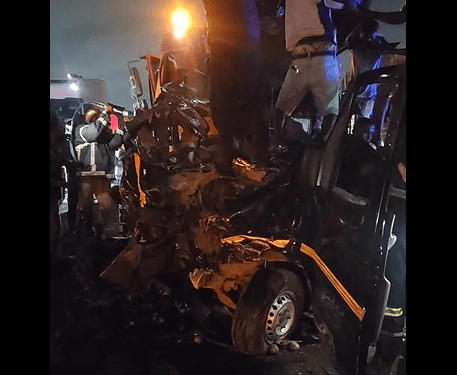
The Road Safety Authority therefore wants the Police MTTD to respond quickly to such incidents and manage traffic until the danger is cleared. Directing traffic at the scene, he explained, could prevent motorists from approaching an obstruction at high speed and reduce the possibility of secondary crashes.
The Director-General also identified careless driving as part of increse in road accidents, which he linked to distractions behind the wheel. Mobile phone use, changing radio stations and failing to concentrate on the road as part of the causes for a driver to lose control within seconds.
“Any least loss of concentration can lead to driving into another vehicle or driving or killing somebody.”
Abraham Amaliba
The warning comes amid repeated crashes on major routes, particularly the Accra -Kumasi highway where several sections have been identified as accident hotspots. Mr Amaliba believes enforcement at such locations can influence driver behaviour because motorists are more likely to reduce their speed when they see police presence.
Traffic Technology Set To Strengthen Road Safety Enforcement
The Road Safety Authority is also preparing to introduce a technology driven enforcement system designed to detect traffic offences across the country. Mr Amaliba disclosed that the Traffic Tech project would use cameras to monitor motorists and reduce reliance on direct roadside intervention by police officers.
The planned system will involve permanently installed cameras as well as mobile cameras mounted on vehicles and tripods. These devices are expected to capture traffic offences and transmit information to a central back room where violations can be monitored and processed.
According to the Road Safety Director, the technology is expected to detect more than 16 offences committed by motorists. These include speeding, reckless driving and other violations that contribute to crashes on Ghanaian roads.
The system is also expected to introduce a formal process for dealing with motorists who breach traffic regulations. Once an offence is captured, a text notification will be sent to the vehicle owner or driver with instructions on the required penalty.
Mr Amaliba explained that motorists who fail to settle penalties within the stipulated period could face additional sanctions. Persistent failure to comply could eventually result in the withdrawal of a driving licence, preventing the offender from legally operating a vehicle.
The proposed technology is intended to complement human enforcement across both urban centres and major highways. Where permanent cameras are unavailable, mobile units would allow monitoring teams to position equipment at locations where speeding and other dangerous practices frequently occur.
This approach would also help address some of the difficulties associated with roadside enforcement. The use of cameras, according to Mr Amaliba, could reduce direct interaction between motorists and officers while creating an electronic record of offences.
Beyond technology, the Road Safety Authority continues to place emphasis on enforcement as a key component of road safety management. The Director General argued that motorists need to know that violations attract consequences if the country is to make meaningful progress in reducing road deaths.
The Ofankor crash has therefore renewed the discussion about how quickly authorities respond to road incidents and how effectively dangerous driving is controlled. The loss of 11 lives has placed renewed emphasis on the need for immediate interventions while longer term systems are being prepared.
For the Road Safety Authority, the immediate priority is to prevent another tragedy before the Traffic Tech project is fully rolled out. Mr Amaliba consequently called for police officers to return to identified hotspots while the technological system is developed to provide an additional layer of enforcement.
The wider strategy combines police visibility, traffic monitoring, public education and technology to influence motorists and improve compliance. Such measures, he believes, can help create safer roads while reducing the circumstances that allow a single act of careless driving to develop into a fatal chain of events.
READ ALSO: Diana Hopeson Returns With Her Powerful New Gospel Album Megyae