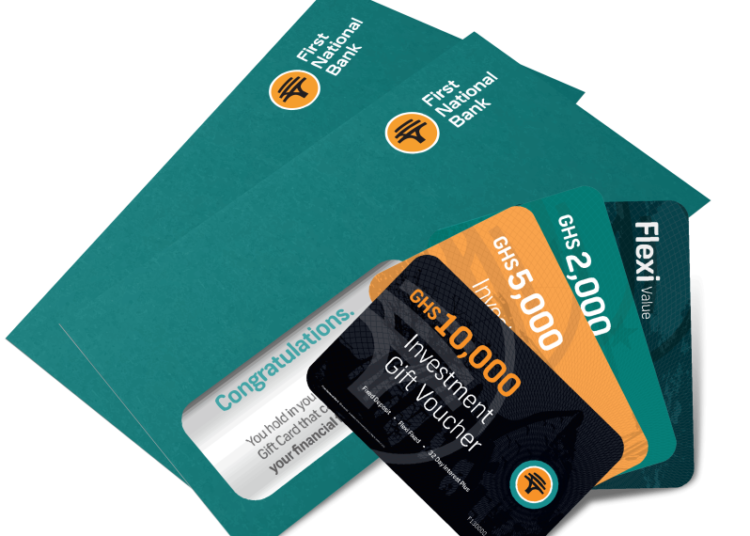
First National Bank Ghana has unveiled a new financial product that could fundamentally change the way Ghanaians think about gifting, saving and building wealth.
The bank has launched its Investment Gift Card, an initiative designed to transform traditional presents into long-term financial assets. Instead of giving gifts that may be consumed or quickly lose value, customers can now give loved ones an investment that has the potential to grow over time.
The product is available in denominations of GH¢2,000, GH¢5,000 and GH¢10,000, with customers also able to choose flexible values.
The initiative forms part of FNB Ghana’s broader push to deepen financial inclusion by moving beyond basic access to banking services and encouraging more people to participate in long-term saving and investment.
A New Era of Gifting
For generations, birthdays, graduations, weddings and other milestones have been occasions for exchanging cash, household items, electronics, clothing and other traditional presents.
FNB Ghana is now attempting to introduce a radically different option.
With the Investment Gift Card, a parent can give a child an investment. A husband or wife can present their partner with an asset. Friends can mark an important milestone by helping someone begin a wealth creation journey.
The concept is simple but potentially powerful: turn an ordinary gift into an opportunity for financial growth.
Rather than providing only immediate satisfaction, the bank believes an investment gift can encourage recipients to think about their future financial needs and develop stronger money management habits.
GH¢10,000 Gift Could Start a Wealth Journey
The availability of cards worth up to GH¢10,000 gives customers an opportunity to make significant financial contributions to the future of their loved ones.
The GH¢2,000, GH¢5,000 and GH¢10,000 denominations provide different entry points, while flexible values allow customers to tailor the gift according to their financial capacity.
The bigger idea, however, goes beyond the amount placed into the investment.
FNB Ghana wants recipients to become familiar with the principles of saving, investing, financial planning and long-term wealth creation.
That could be particularly important for young people who may not traditionally consider investment products until they are older or have accumulated substantial disposable income.
FNB Ghana Targets Financial Inclusion Beyond Bank Accounts
Financial inclusion has traditionally focused on ensuring people can access bank accounts, payment services and other formal financial products.
FNB Ghana’s latest initiative takes that concept a step further.
The bank is effectively asking whether being included in the financial system should also mean having opportunities to build assets.
Having a bank account provides a foundation, but long-term financial security can also depend on the ability to save, invest and accumulate assets.
By packaging investment as a gift, FNB Ghana hopes to make investing more familiar and accessible to households that may otherwise postpone taking their first investment step.
Early Investing Could Make a Major Difference
One of the strongest arguments behind the initiative is the power of time.
Money invested over a longer period can potentially benefit from compound growth, depending on the performance and structure of the underlying investment.
This means that introducing young people to investing earlier could give them more time to learn, contribute additional funds and potentially allow their investments to grow.
For parents and guardians, the product therefore offers an alternative way to think about preparing children for adulthood.
Instead of focusing entirely on immediate consumption, families can use important milestones as opportunities to introduce children to financial responsibility.
A Financial Lesson Hidden Inside Every Gift
FNB Ghana’s Head of Retail Banking, Akweley Laryea, said the product reflects the bank’s commitment to helping Ghanaians build generational wealth and develop sound financial habits from an early age.
Her argument highlights one of the most important features of the initiative.
The Investment Gift Card is not simply about transferring money. It is also about creating an experience that could encourage recipients to understand how investments work.
A recipient may eventually have to decide whether to reinvest returns, preserve the underlying asset or continue contributing to it.
Those decisions can potentially develop patience, accountability and financial discipline.
Parents Could Become Major Users
The product could prove particularly attractive to parents and guardians looking for meaningful gifts for children.
A birthday gift, graduation present or reward for an academic achievement could become the beginning of a long-term investment journey.
Laryea has emphasised that one of the most valuable things families can give children is financial preparedness.
That philosophy could resonate in a country where families are increasingly confronted with major financial demands involving education, housing, retirement and future healthcare needs.
Investment Culture Could Get a Major Boost
The bigger question is whether the new product can help change Ghana’s investment culture.
If recipients continue investing after receiving their initial gift, the impact could extend well beyond the original transaction.
Young people who begin with a gift could eventually become regular investors. Families could become more comfortable discussing investment decisions. Parents could introduce children to concepts such as compound growth, asset ownership and long-term planning.
That could gradually help shift investing from something perceived as complicated or reserved for wealthy individuals into a more familiar part of everyday financial life.
Investment Gift Cards Hit Branches September 1
FNB Ghana has announced that the Investment Gift Cards will be available for purchase at all its branches nationwide from September 1.
The launch represents an ambitious attempt to merge everyday Ghanaian gifting traditions with financial planning.
Whether the product becomes a major success will ultimately depend on what recipients do after receiving the investment.
If they continue saving and investing, FNB Ghana’s new product could become more than another banking innovation. It could help turn birthdays, weddings and graduations into opportunities to build lasting wealth.
For a financial sector increasingly focused on financial inclusion, that could be a significant development.
READ ALSO: Ghana Places 4th In Cocoa Bean Exports to Europe, Fitch Says