A new push by the Ghana Revenue Authority (GRA), Eban Capital and the Association of Small-Scale Industries (ASSI) could give thousands of informal businesses a stronger pathway into Ghana’s formal financial system.
At the centre of the initiative is the Modified Taxation Scheme (MTS), which is being positioned not only as a tool to improve tax compliance, but also as a potential bridge between small businesses and financial institutions.
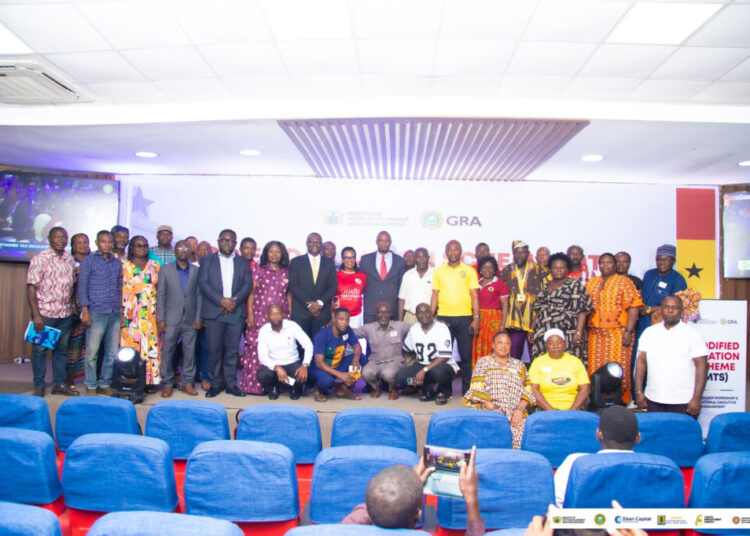
The initiative was highlighted at a national stakeholder workshop attended by approximately 300 participants, including representatives of banks, mobile network operators, insurance companies, pension providers, government agencies and trade associations.
For many informal businesses, the challenge has never been simply about generating income. Access to formal credit, insurance, pensions and other financial services has often remained difficult because businesses lack verifiable financial records.
The MTS seeks to change that equation by linking tax registration and payments to digital platforms, creating records that can potentially help businesses demonstrate their economic activity to financial service providers.
Tax Records Could Strengthen Credit Access
One of the most significant financial implications of the scheme is its potential to improve the ability of small businesses to access formal credit.
Without reliable business records, financial institutions can struggle to assess the income, cash flow and repayment capacity of informal operators. This can leave otherwise viable businesses dependent on personal savings, family support or informal lending arrangements.
Through digital tax payments and registration, however, businesses can begin building a more visible financial history.
The workshop therefore brought together major banks including Ecobank, Zenith Bank, CalBank, ARB Apex Bank, OmniBSIC Bank, Fidelity Bank, Access Bank and GCB, alongside Mobile Network Operators and other financial service providers.
The broader objective is to create an ecosystem where tax compliance can become connected to financial inclusion rather than being viewed only as a government revenue exercise.
GRA Targets a Wider Financial Ecosystem
Technical Advisor to the Commissioner-General of the GRA and Chair of the MTS Implementation Committee, Elsie Appau-Klu, indicated that widening the tax net is a key priority of the President of the Republic of Ghana in relation to national development.
She recognised the significant role of informal-sector businesses in Ghana’s economy and emphasised the need for the revenue authority to understand the needs of these active sector players and to develop pragmatic solutions together with them.
She noted that Ghana’s tax-to-GDP ratio currently hovers around 13.5 to 14 per cent and that there remains considerable potential to do more.
The GRA team also presented the tax bands under the Modified Taxation Scheme, including the 3% flat rate for informal businesses with annual turnover between GHS 20,000 and GHS 750,000.
For businesses within this range, the simplified structure could make formalisation less complicated while creating a clearer connection between their commercial activities and the financial system.
Banks and Fintechs Positioned to Benefit
The involvement of banks and mobile financial service providers is particularly important because the success of the initiative will depend heavily on what happens after businesses are registered and begin making digital payments.
Chief Executive Officer of Eban Capital and MTS Project Management Office Lead, Jim Sewornu Amegah, took ASSI participants through the digital infrastructure that will enable a seamless collection process for tax and related financial services opportunities for the informal sector.
He highlighted the importance of bringing trade associations together so that members can access financial inclusion support from partner banks and MNOs and be brought into both the tax net and the mainstream financial ecosystem to contribute to national development.
This creates room for financial institutions to potentially serve a larger pool of businesses with transaction accounts, savings products, credit facilities, insurance and pension solutions.
For banks, a more formalised informal sector could also provide access to new customer segments that have traditionally remained difficult to assess.

Small Businesses Seek Simplicity
National President of ASSI, Rev. Christian Balagi, affirmed the readiness of small-scale businesses across the country to support the government initiative.
He stressed, however, that success will require a collaborative effort among key stakeholders and intensified education of members so that compliance with the tax scheme can be achieved.
He welcomed the introduction of a modified system with a threshold below GHS 750,000, noting that most ASSI members fall within this band and that the simplified approach will help them contribute to national development without the process coming as a shock.
His comments underline an important consideration for the financial sector: businesses are more likely to participate when the formalisation process is understandable, affordable and capable of delivering tangible benefits.
Financial Inclusion Becomes a Central Opportunity
The workshop ultimately produced a shared understanding of the MTS framework, clarified institutional roles and established a pathway for association-led mobilisation and digital onboarding.
Beyond tax collection, the initiative could have wider implications for Ghana’s financial inclusion agenda.
If digital tax records become useful in assessing businesses for financial services, thousands of informal operators could gradually develop stronger relationships with banks, insurers and pension providers.
The involvement of major financial institutions also signals an effort to make the formal financial system more accessible to businesses that have historically operated largely outside it.
For Ghana’s banking sector, the development could create a larger and more traceable customer base. For small businesses, it could mean that tax compliance becomes linked to opportunities for credit and other financial services.
The success of the initiative, however, will ultimately depend on implementation, education and trust. The national rollout will need to convince informal businesses that participation offers practical value while ensuring that the digital systems are simple enough for widespread adoption.
READ ALSO: IFC Pipeline Raises Ghana’s Productive Investment Stakes