Malaysia has offered to invite Myanmar’s military-backed leader Min Aung Hlaing for an official visit as part of efforts to accelerate the repatriation of Rohingya refugees, a move that could provide another avenue for engagement with a government that remains diplomatically isolated within Southeast Asia.
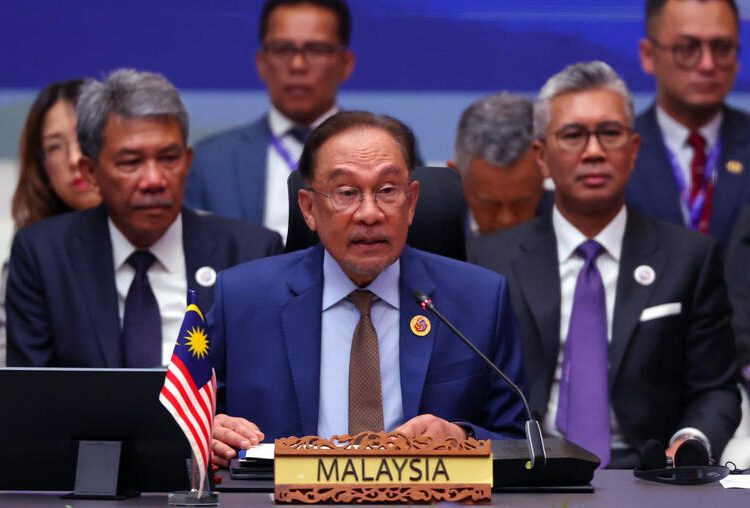
Malaysian Prime Minister, Anwar Ibrahim made the offer, saying that closer engagement with Myanmar’s authorities was necessary to find a lasting solution to the plight of Rohingya refugees living in Malaysia.
An acceptance by Min Aung Hlaing would mark another step toward international engagement for the former general, who seized power in a 2021 military coup and transitioned from junta leader to president in April after a military-backed election.
The election was widely criticised by the United Nations and international rights groups, which questioned its credibility and described it as an effort to legitimise military rule.
Anwar said that recognising and engaging Myanmar’s government was necessary if Malaysia was to make progress on the Rohingya issue. “I invited him to say we can be friends, we can trade, we can accept Myanmar, but Myanmar must accept them [Rohingya refugees] back,” Anwar said on a podcast.
The Malaysian leader acknowledged that his position differs from the approach taken by the Association of Southeast Asian Nations, which has barred Myanmar’s top officials from attending the bloc’s meetings since the 2021 coup.
Anwar argued that direct engagement would provide Malaysia with a channel through which it could negotiate the return of Rohingya refugees.
“To me, that’s better diplomacy than just shouting angrily at Myanmar. Who’s going to take them? Where do we send them? They don’t even have Myanmar citizenship.”
Anwar Ibrahim
He also questioned the practicality of refusing direct relations with Myanmar while seeking to resolve issues involving the country. “We, following ASEAN, don’t want direct relations with Myanmar so who are we supposed to negotiate with?” Anwar said.
The Malaysian Prime Minister defended his willingness to maintain relations with countries whose governments face criticism over their records.
“Everyone is saying we cannot accept the Myanmar government, they are harsh and [rule with an] iron fist.
“We have ties with dozens of other countries that are ruled with an iron fist, we have ties with many nations that are cruel. Why not with Myanmar?”
Anwar Ibrahim
Myanmar has remained engulfed in civil war since the military takeover, with the conflict killing an estimated 100,000 people. The military has also faced widespread accusations of atrocities against the predominantly Muslim Rohingya population, allegations it has denied.
ASEAN has refused to recognise Myanmar’s military-backed election and has continued to exclude the country’s senior leaders from its summits.
Malaysia, meanwhile, has long served as a destination for Rohingya fleeing persecution and instability in Myanmar. Although the country is not a signatory to the 1951 United Nations Refugee Convention and does not formally recognise refugee status, it hosts more than 126,000 Rohingya from Myanmar.
Anwar’s proposal comes amid efforts by Malaysia and Myanmar to establish arrangements for the return of some Rohingya refugees.
Malaysia Sets Date For Voluntary Rohingya Repatriation
Malaysia has finalised the first phase of a voluntary repatriation programme under which at least 1,500 eligible Myanmar refugees are expected to return to Myanmar on September 29.
The programme follows an agreement announced by Anwar in July, under which Myanmar’s military-backed government agreed to take back 5,000 members of the Rohingya minority.
The first group was initially expected to return within weeks, with Malaysia saying it would cover food and clothing costs associated with the journey.
Anwar has stressed that any repatriation must be voluntary and accompanied by guarantees for the safety of those returning, particularly Rohingya refugees who have previously faced persecution and violence in Myanmar. “If they bring them back and kill them like before, we cannot accept that either,” Anwar said.
He said that negotiations with Myanmar were therefore not limited to arranging the return of refugees but also involved securing conditions under which they could live safely.
“The negotiations are not only to send them back. We also ask to guarantee their safety, where they can have a safe zone in Rakhine for Muslims so they are not disturbed.”
Anwar Ibrahim
The proposed visit by Min Aung Hlaing and the repatriation programme therefore form part of Malaysia’s broader effort to engage directly with Myanmar’s authorities over the Rohingya crisis, despite the diplomatic difficulties surrounding the military-backed government.
READ ALSO: Belarus Frees 25 Prisoners In US Deal