Seven competitive matches, seven victories, 36 goals and an attack that appears to have discovered another gear. Hansi Flick’s Barcelona are not merely winning at the beginning of the 2026/27 season but they are overwhelming opponents, often before those opponents have had time to settle into games.
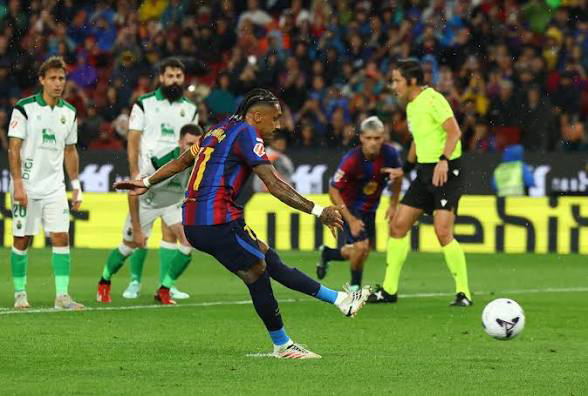
The latest evidence came on Wednesday night when Barcelona demolished Racing Santander 7-2 at the Spotify Camp Nou in the Spanish La Liga. The victory gave Flick a piece of club history: no Barcelona manager had previously won his first seven matches of a season across all competitions and now the German manager stands alone at the apex.
The numbers behind the start are even more striking. Barcelona have scored 28 goals in their opening six LaLiga matches, averaging 4.6 per game.
That is the club’s best return after six league matchdays, surpassing the previous mark of 23 goals set in 2011/12 and 1950/51. They have also scored at least five goals in five of their seven competitive matches, putting five past Elche, Valencia, Rayo Vallecano, Feyenoord and Racing Santander.
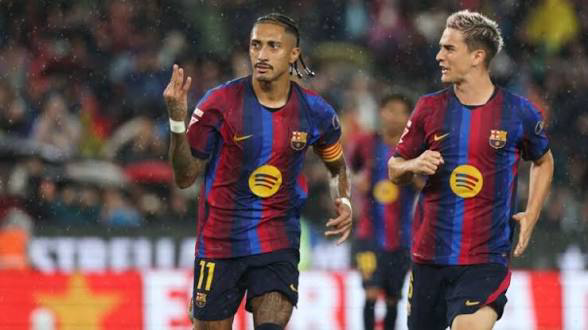
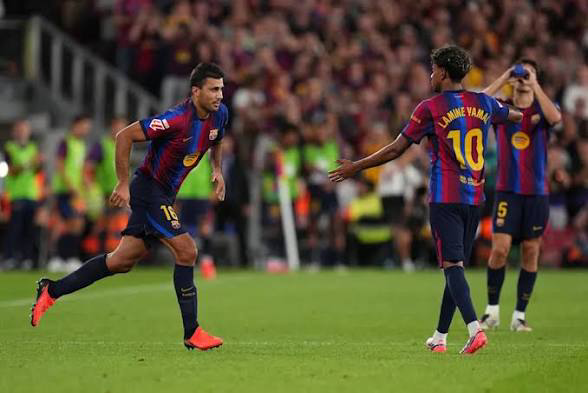
This is not simply collective attacking efficiency either. Raphinha and Lamine Yamal have combined for 16 of those 28 league goals. Raphinha now has 11 goals in seven matches, while Yamal has scored in four consecutive LaLiga games, another personal milestone.
The Brazilian’s scoring rate is particularly extraordinary, with no Blaugrana player starting a season with 11 goals in seven games for the club since Mariano Martín in 1943/44.
Flick’s greatest achievement, however, may be that the machine has continued functioning beyond the spectacular first season.
He inherited a Barcelona side surrounded by questions and immediately delivered a domestic treble in 2024/25. He then retained LaLiga and the Spanish Super Cup in 2025/26, winning the league with 94 points and 95 goals.
That makes Xavi Hernández’s warning before his departure in May 2024 particularly interesting in retrospect. Xavi said his successor would “suffer” because Barcelona remained a difficult club, citing the financial situation and the pressure surrounding the job.
Flick did not exactly walk into an easy assignment. Yet rather than becoming consumed by the problems Xavi highlighted, he has gradually built a team whose football has made many of those concerns secondary.
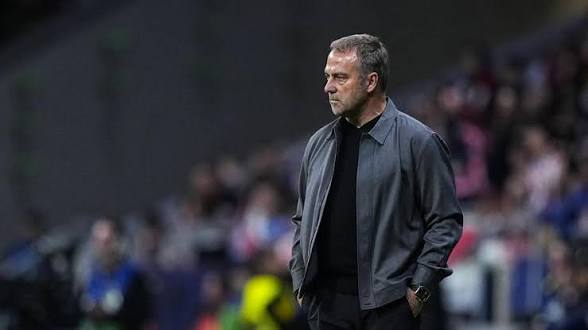
Two consecutive league titles, a Copa del Rey and two Spanish Super Cups have followed. The Champions League, however, remains the unfinished business.
The Champions League is the Real Examination
The Champions League is where Barcelona’s current brilliance needs to be judged more carefully. Domestic dominance is one thing. Europe is another.
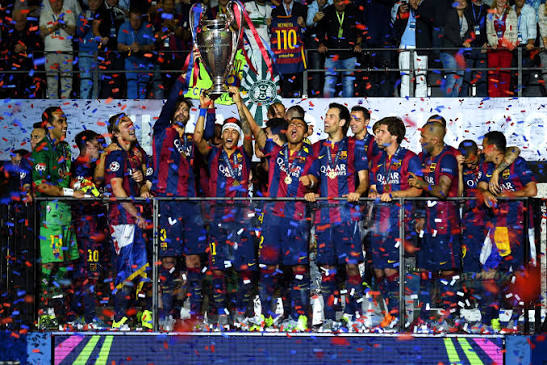
Barcelona have not lifted the Champions League since 2015, when Luis Enrique’s side defeated Juventus 3-1 in the final in Berlin. Since then, the club has endured some painful European collapses, while Flick himself has already experienced disappointment in the competition with Barça.
A late Inter Milan fightback denied them a place in the final last two seasons losing 7-6 on aggregate when they were just minutes away from the final. Last season, his team reached the quarter-finals before Atlético Madrid eliminated them.
The encouraging part is that Flick has already demonstrated that his football can translate into spectacular European nights. Barcelona destroyed Newcastle 7-2 in the second leg of their Round of 16 encounter in the 2025/26 Champions League and reached the quarter-finals.
But the question this season is not whether Barcelona can destroy teams. They clearly can. The question is whether they can remain structurally sound when confronted by elite opposition capable of punishing every mistake.
There is already a warning sign. Barcelona’s defensive lapses remain a concern despite their extraordinary attacking output. They have conceded seven times, averaging a goal against per game.
That matters enormously in the Champions League, where one careless defensive sequence can undo 90 minutes of dominance as the case of their semi final exit against Inter Milan two seasons ago.
Have Barcelona Peaked Too Early?
There is another possibility. Perhaps this is not the finished Barcelona but the explosive opening chapter of a long season.
The schedule will eventually become heavier, opponents will adjust, injuries will arrive and the intensity required to sustain Flick’s football will be tested.
Barcelona are currently scoring at a rate that is difficult to maintain across an entire campaign. Even Flick appears conscious of the danger of becoming obsessed with records, saying before the Racing match that he was interested in winning matches rather than setting milestones.
That distinction is important. A seven-game winning streak does not win the Champions League. Neither does 36 goals in the opening seven games of the season.
What makes this Barcelona genuinely intriguing is that Flick’s first two seasons suggest the current explosion is built on something more substantial than a temporary hot streak.
He has established a recognizable system, developed a productive attacking partnership between Raphinha and Yamal, and repeatedly converted domestic dominance into trophies.
The Champions League will ultimately determine how far this functioning machinery has evolved.
For now, Barcelona look devastating. Whether they will finally become European champions again, however, will require this machine to keep functioning when the margins become fine, the opponents become stronger and the season reaches its most unforgiving stage.
READ ALSO: Cardinal Namdini to Empower Local Mining Suppliers Through Local Content