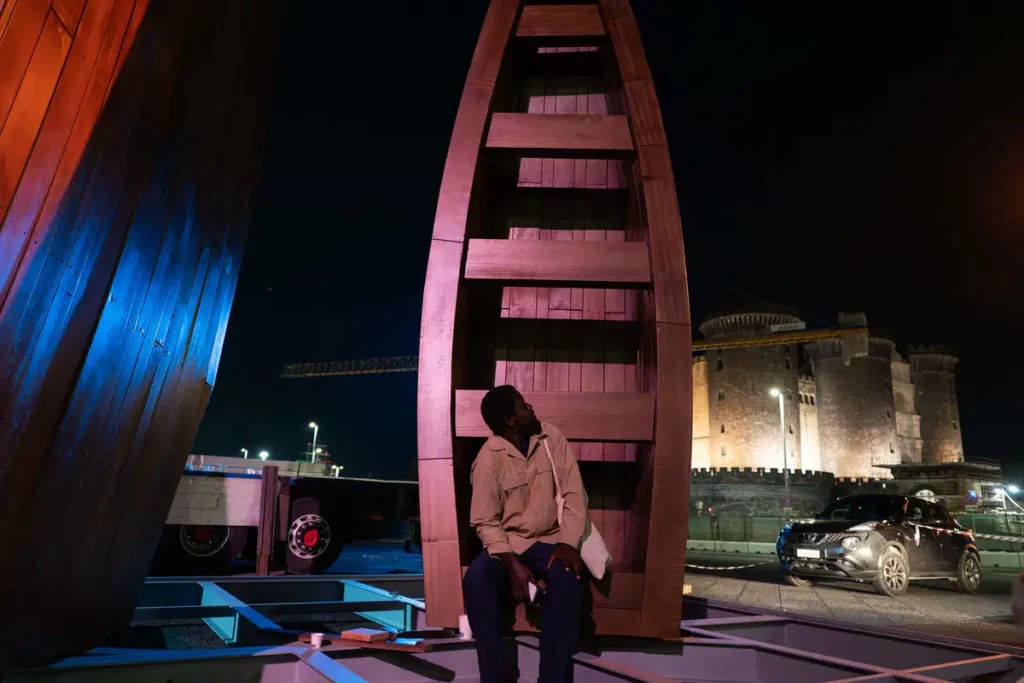
Three monumental wooden boats rise from the pavement of Piazza Municipio in Naples, their hulls partially buried in the ground as if emerging from or sinking into the earth. Created by Ghanaian artist Ibrahim Mahama, the installation titled “Voyageur” transforms one of the city’s most iconic public spaces into a profound meditation on migration, history, and memory.
Unveiled on September 21, 2026, and remaining on view until November 18, the work features three boats standing approximately 5, 7, and 8 meters tall. Constructed using traditional Ghanaian designs and techniques, they were made specifically for this location.
Positioned in the square redesigned by Portuguese architect Álvaro Siza and overlooking the port of Naples, the vessels forge a visual and conceptual link between West Africa and the Mediterranean Sea.
Mahama, born in 1987 in Tamale, Ghana, ranks among the most influential figures in contemporary art. He gained international recognition for large-scale installations that incorporate materials imbued with histories of labor, trade, and colonial legacies, notably jute sacks once used to transport cocoa.
His works have appeared at the Venice Biennale, Documenta, and major institutions worldwide. In Naples, “Voyageur” continues his inquiry into how objects and sites encode stories of human movement and exchange.
“In Naples, a city so deeply connected to archaeology, the sea, and a long history of exchanges and crossings, I thought of these three vessels as forms of travel,” Mahama said.
“They are boats that do not sail, but stand within the city’s space: they carry with them the idea of movement and, at the same time, that of something that remains”
Ibrahim Mahama, Ghanaian Contemporary Artist
The installation forms part of Naples’ ongoing public art program. It follows earlier commissions by Michelangelo Pistoletto in 2023, Gaetano Pesce in 2024, and Jaume Plensa in 2025. Curated by Vincenzo Trione, the project was inaugurated with Mayor Gaetano Manfredi present and included a performance by musician Enzo Avitabile. Avitabile’s songs paid tribute to those who reach land by sea and those who find their final resting place in the water.
The Meaning of the Boats
The boats carry layered meanings. They evoke contemporary migrants who cross the Mediterranean driven by economic hardship, social pressures, and political instability, seeking safety and opportunity. Their partial burial in the square’s surface suggests the tragic outcomes of journeys that end short of the shore.
At the same time, the upright forms resemble sails held against the wind, standing as emblems of hope, endurance, and the potential for new beginnings.
Curator Vincenzo Trione described the sculptures as ambiguous images that heighten the square’s metaphysical atmosphere. “On the one hand, they evoke the tragic fate of those attempting to cross the Mediterranean; on the other, they recall sails hoisted in the wind, facing the port of Naples,” he noted. “Together, they are monuments to memory and to the possibility of travel, metaphors for small yet necessary utopias, forms of hope.”
Naples offers a resonant setting. The square lies near the historical sites of ancient Greek and Roman harbors. During construction of the metro station, archaeologists uncovered wooden boats dating back some 2,500 years. By installing newly crafted Ghanaian vessels in the same vicinity, Mahama connects centuries of seafaring, commerce, and cultural interchange.
The Mediterranean has long served as a crossroads, and the work invites contemplation of both enduring historical ties and the urgent realities of present-day mobility.
Although these boats are newly built rather than scavenged, they introduce traditional Ghanaian craftsmanship into the Italian urban fabric. This transfer of knowledge and skill echoes the themes of circulation of people, goods, and ideas,that define much of Mahama’s practice.
His earlier projects often involved collaborative labor with local communities, embedding personal and collective histories into the materials themselves.
Mayor Manfredi emphasized the installation’s timely message amid preparations for the America’s Cup pre-regattas. “The new installation of Mahama in Piazza Municipio brings to the center of the urban space themes of great topicality: the exchange between cultures, the peaceful coexistence between peoples, and the sea as a crossroads of encounters,” he stated. “In the square overlooking the port of Naples, three large wooden boats will look toward the sea, testifying the city’s commitment to peace and hospitality.”
The project received funding of about 139,000 euros. Discussions continue regarding a possible permanent acquisition by the city. Early public responses have been favorable, with many appreciating the contemplative quality the boats bring to the busy square.
Beyond their striking appearance, the sculptures raise questions about borders, belonging, and the narratives that materials can convey. In a period marked by intense debates over migration, the stationary boats resist simple stories of departure or arrival.
They occupy the space, encouraging residents, visitors, and passersby to pause and consider the journeys that define human lives.
Mahama previously spent time in Naples, producing collages at the Madre museum that overlaid maps of Ghana onto local industrial landscapes. His return with this ambitious public work reaffirms the city’s position as a site of dialogue between Africa and Europe.
The boats, though fixed in place, imply movement across eras and geographies, linking the hands of Ghanaian artisans to the ancient mariners of the Bay of Naples and to today’s seekers of safer shores.
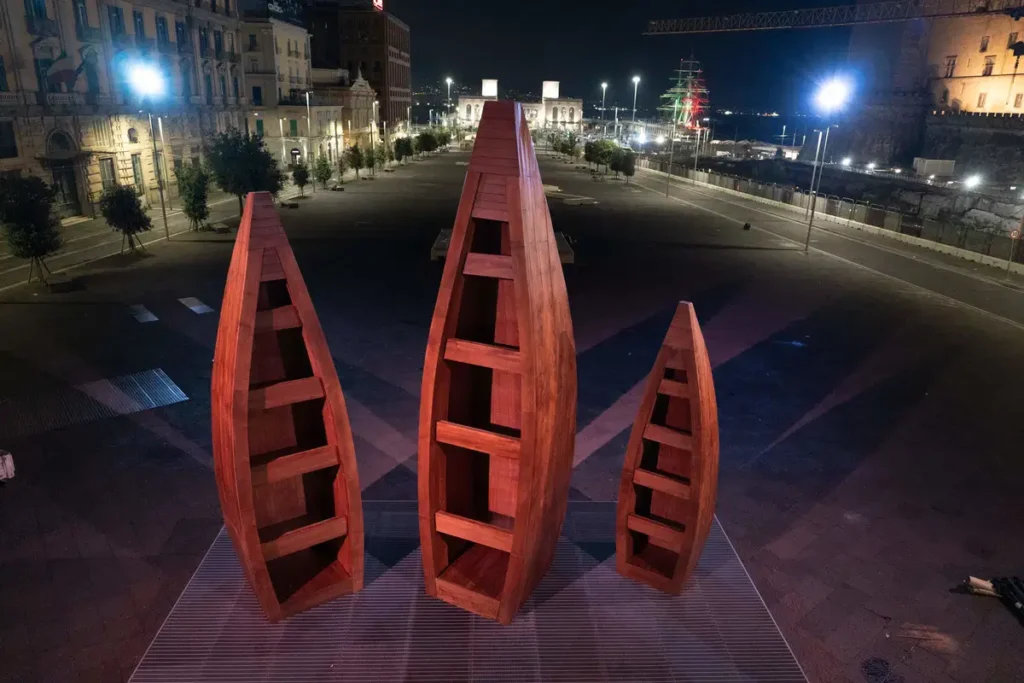
As evening light falls across the reddish wood, the forms take on a quiet, almost otherworldly presence. Rising against the skyline, they belong neither fully to the ground nor free to drift on water. In this in-between state, they capture the tension between rootedness and mobility, between remembered pasts and uncertain futures.
“Voyageur” provides no definitive conclusions. It instead opens a space for reflection where history intersects with the present. Through these three boats, Ibrahim Mahama converts a public square into a place of measured power, demonstrating that art can carry the weight of complex human stories and invite everyone to engage with them.
READ ALSO:GES Cautions School Heads Over Illegal Fee Collection in SHS