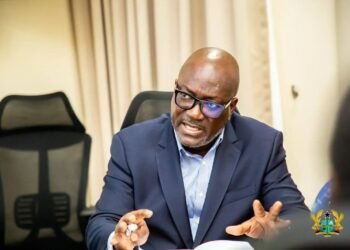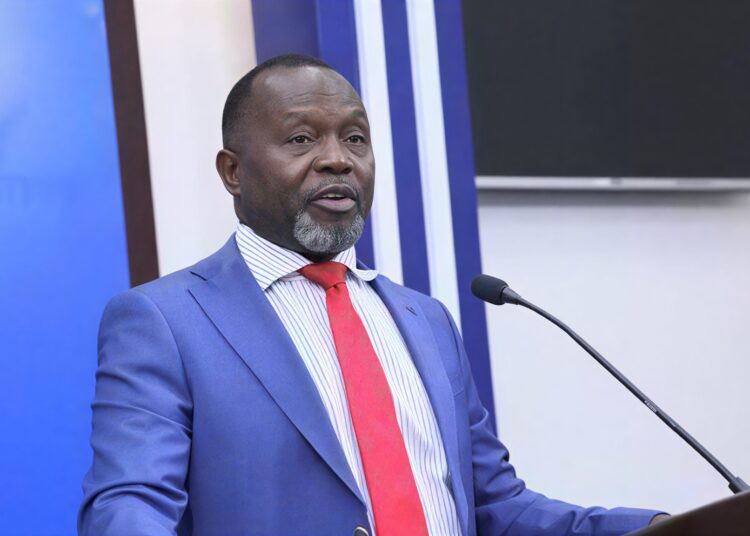
The Minister of Justice and Attorney-General, Honourable Dominic Akuritinga Ayine, has challenged Ghanaian lawyers to take a direct role in shaping the country’s legal framework instead of limiting their contribution to interpreting existing laws.
He argued that effective legal development requires practitioners to engage with legislation from its drafting stage through parliamentary consideration and eventual implementation.
Addressing the maiden Ghana Law Society Conference in Accra, the Attorney-General explained that his office depends heavily on legal expertise in translating government policy into workable legislation. He therefore called for stronger participation from practitioners in the legislative drafting process, particularly as Ghana undertakes changes to parts of its legal architecture.

Honourable Ayine identified the Legislative Drafting Division of his office as a critical area requiring renewed professional attention. The division prepares legislation for ministries, departments and agencies, making its capacity important to how policy decisions are converted into enforceable laws.
Focusing on the shortage of lawyers interested in legislative drafting, the Minister of Justice disclosed that the specialised area could face serious capacity challenges if more practitioners do not develop an interest in it. He described the work as demanding and specialised, requiring lawyers to remain involved beyond the initial preparation of bills.
“The Legislative Drafting Division of my office carries out that arduous task for every ministry, department, and agency of state on a daily basis, and I am hoping that the Ghana Law Society will take a keen interest in this aspect.”
Honourable Dominic Akuritinga Ayine
The Attorney-General linked professional participation to the government’s work on constitutional reform, noting that lawyers would be particularly important as proposals move from technical review into draft amendment Bills. He urged the Ghana Law Society to scrutinise the process and provide substantive input as the proposals progress.
Meanwhile, Honourable Ayine outlined other areas where specialised legal expertise is required, including state contracts and public financial management. He noted that lawyers working in these fields must be able to identify weaknesses in contractual arrangements and financial commitments while ensuring legitimate government transactions are not unnecessarily obstructed.
The Minister of Justice also disclosed that his office is preparing the Legal Practitioners Standards Board Bill for Cabinet consideration before its eventual passage through Parliament. The proposed framework has previously been announced as an attempt to establish an independent system for professional standards and disciplinary matters involving lawyers.
Directing lawyers towards practical involvement, Honourable Ayine argued that the profession’s contribution cannot end with commentary after legislation has been completed. He maintained that practitioners need to participate while policies are being translated into laws, tested through legislative scrutiny and prepared for implementation.
Thus, the Attorney-General positioned the legal profession as an active component of Ghana’s institutional development, with lawyers expected to contribute expertise at the points where legal rules are created, reviewed and applied.
Political Independence Essential to Legal Profession’s Credibility
The Minister of Justice and Attorney-General, Honourable Dominic Akuritinga Ayine, also challenged the Ghanaian legal profession to protect its independence and remain willing to scrutinise government actions without becoming aligned with partisan interests. He argued that the credibility of lawyers in public discourse depends substantially on their ability to offer professional judgments without political affiliation determining their positions.
The Attorney-General emphasised that he does not expect a legal profession that automatically agrees with the actions of his office. Instead, he called for a Bar that can openly examine the state of Ghana’s laws, courts and institutions while maintaining sufficient distance from political parties.
The Minister of Justice explained that professional independence is particularly important when lawyers participate in debates about legal reform and constitutional governance. He noted that an association perceived as politically aligned could find its interventions judged through partisan considerations instead of the professional standards it seeks to uphold.
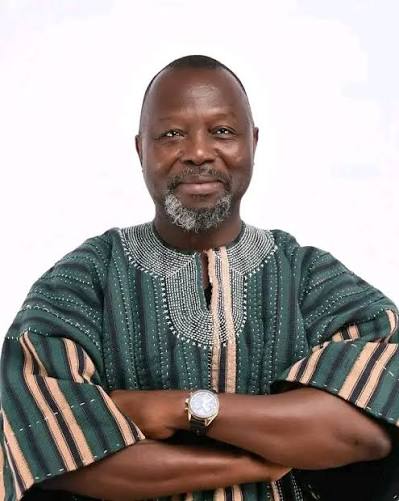
However, Honourable Ayine made clear that independence should not translate into withdrawal from public affairs. He wants lawyers to remain visible in national discourse and use their expertise to assess how laws operate in practice and whether they continue to serve the interests of society.
“And I want to issue a warning, and you all know me as someone who shoots straight from the hip: the day you become an appendage of the NDC, that will be the day I criticise you publicly. I want you to be a professional body that sees to the welfare not only of its members, but also of society as a whole.”
Honourable Dominic Akuritinga Ayine
Turning to the relationship between the legal profession and political power, the Attorney-General stressed that professional independence should apply regardless of which political party is in government. His position places responsibility on lawyers to scrutinise state actions while preserving the institutional credibility required to challenge public authorities when necessary.
Nevertheless, Honourable Ayine also connected independence with the historical role of Ghanaian lawyers in constitutional development. He pointed to lawyers who participated in constitutional advancement during the Gold Coast era and those involved in creating the institutions established under the 1992 Constitution.
Beyond professional associations, the Minister of Justice extended the responsibility to individual practitioners, academics, judges, in-house counsel and young lawyers. He argued that legal practice should involve questioning whether existing rules continue to address the needs of the society they govern.
The Attorney-General therefore presented professional independence as part of the legal profession’s public responsibility, requiring lawyers to combine technical competence with an active interest in how laws affect society. His appeal comes amid wider discussions within Ghana’s legal community about professional regulation, disciplinary structures and the relationship between the Bar and political authority.
Additionally, Honourable Ayine urged the Ghana Law Society to approach legal reform with an independent voice capable of supporting sound proposals while challenging weaknesses. He indicated that such engagement would strengthen the profession’s contribution to Ghana’s constitutional and institutional development.
READ ALSO: NPA Tank-Gauging Project Faces Value-For-Money Questions