
Alfred Appiah, data and policy analyst has emphasized that execution timing in gold trading has become paramount as the market experiences sharp international price drops following earlier upward trajectories.
Highlighting the changing mechanics of state-backed precious metal trading, Appiah noted that recent global market fluctuations make precise timing essential to maximizing revenue and safeguarding liquidity.
“The operating model has changed, and we need to read the numbers in that context. The other thing that has changed externally is movement in gold prices. Last year, gold prices were in an upward trajectory. This year has seen significant declines from the peak in February. That makes timing of the trade even more crucial.”
Alfred Appiah,
Expanding on the operational shifts, Appiah explained that holding physical commodity reserves naturally introduces specific financial obligations, particularly when purchases are backed by credit or leveraged financing arrangements.
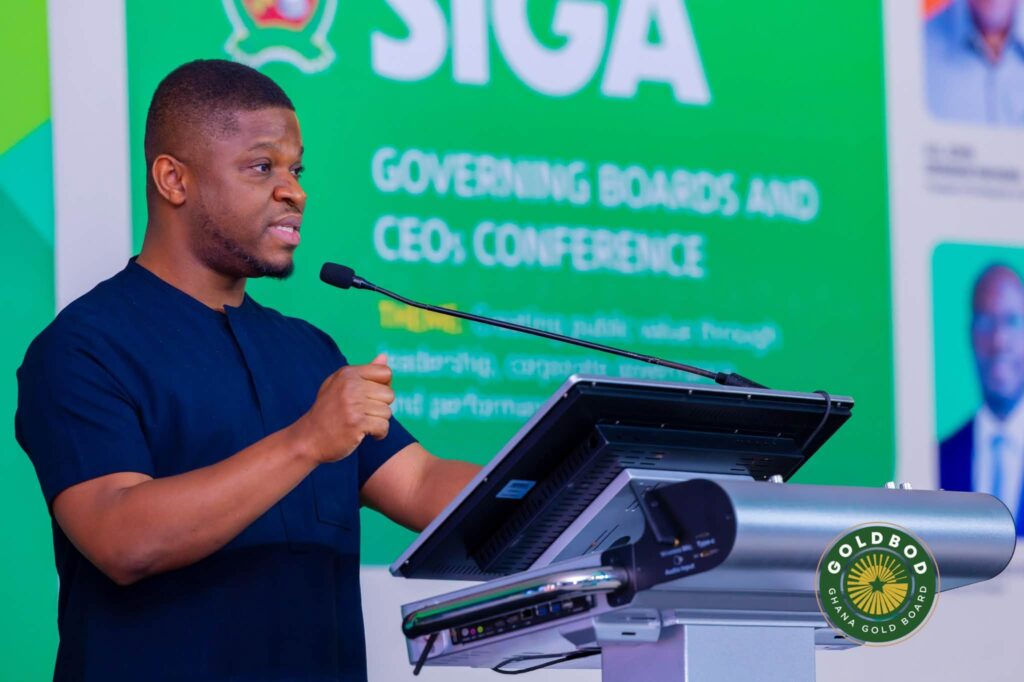
As gold prices shift downward from their earlier highs, these financial commitments reflect inventory in transit, ongoing foreign exchange repatriation, and pending settlement structures rather than actual monetary loss, requiring stakeholders to assess corporate financial health through this updated operating lens.
Strategic Imperatives Underpinning the Operating Model Shift
The imperative behind this revised operational strategy lies in Ghana’s broader macroeconomic drive to leverage its vast mineral wealth to stabilize the national economy.
By establishing direct buying and holding mechanisms, institutional bodies like Gold Board aim to capture greater value from artisanal and small-scale mining, ensuring that local extraction directly feeds foreign exchange reserves.
Without such institutional purchasing frameworks, a significant portion of domestically mined gold risks capital flight and informal exportation, depriving the central treasury of critical foreign exchange liquidity.
Alfred Appiah points out that “the purchases are financed,” meaning that while GoldBod holds the physical metal, “it has obligations to its financiers.”
Understanding this arrangement prevents misinterpreting short-term financial liabilities as structural failure, clarifying that outstanding balance obligations frequently correspond directly to gold acquired but not yet offloaded, or pending forex that “has not yet been repatriated.”
Navigating Volatility to Preserve National Economic Gains
Global commodity markets remain inherently volatile, and the transition from last year’s bullish run to recent price dips presents distinct execution risks.
When market valuations pull back from seasonal peaks, holding un-hedged physical inventory exposes purchasing entities to margin compression if sales are not executed swiftly.
Alfred Appiah stresses that “seeing reports of GoldBod owing money does not automatically mean that the money has been lost,” reassuring investors and the general public that interim debt often represents asset-backed inventory positioned for strategic liquidation.

Through careful trade timing, the agency aims to buy efficiently from local producers while minimizing exposure to downward market slides during the settlement cycle.
This strategic discipline ensures that temporary price swings do not erode institutional capital, thereby keeping the operating structure resilient against global market shocks.
Sustaining Institutional Accountability and Long-Term Success
Ultimately, maintaining transparent monitoring while acknowledging structural transformation remains vital for national extractive governance. Appiah asserts that “the goal remains the same: for GoldBod to operate efficiently while generating economic benefits for Ghana.”
Balancing public scrutiny with operational reality ensures that national institutions can build essential financial buffers, secure steady foreign exchange influxes, and protect domestic resources.
As Appiah affirms, there are “genuine efforts to reduce losses while preserving those benefits,” emphasizing that constructive evaluation must run parallel to supporting institutional progress.
By refining market execution, upholding financier obligations, and mastering trade timing, the overarching mandate endures ensuring that Ghana’s rich gold reserves translate into lasting economic resilience.
READ ALSO: G7 Nations To Release 100 Million Barrels of Oil Reserves Amid Fuel Price Surge