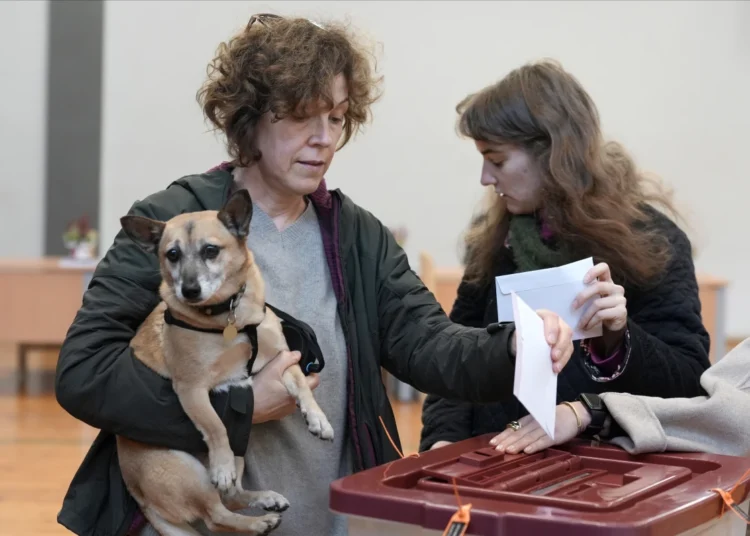
Latvians have gone to the polls in a parliamentary election shaped by concerns over regional security, Russia’s war in Ukraine and rising living costs, with Prime Minister Andris Kulbergs seeking a full mandate after taking office earlier this year.
Polling stations opened at 05:00 GMT on Saturday and are due to close at 17:00 GMT, with around 1.56 million people eligible to elect all 100 members of the single-chamber Saeima for a four-year term.
The election is the first national electoral test for Kulbergs since he became Prime Minister in May following the collapse of the previous government. He came to power in May this year when his predecessor resigned due to a backlash from stray drone incursions from Ukraine.
The vote is taking place against heightened security concerns in the Baltic state, which shares a border with Russia and has been closely monitoring the wider security consequences of Moscow’s war against Ukraine. Recent drone incursions have also contributed to public concern and political tensions.
Despite the security concerns, the election campaign has also focused heavily on domestic economic pressures. Rising living costs, low wages, strains on healthcare services and Latvia’s long-term population decline have featured prominently in political debates.
Latvia remains highly fragmented politically, with coalition governments a regular feature of its parliamentary system. Fourteen electoral lists are contesting this year’s election, while polling has suggested that only about seven could cross the 5% threshold required to enter parliament.
The fragmented political landscape means that even parties performing strongly at the polls are unlikely to govern alone. Coalition negotiations are therefore expected to play a major role in determining the composition of the next government.
Most of the major political parties support Ukraine, although the campaign has exposed differences over how much Latvia should spend on supporting Kyiv compared with addressing domestic economic challenges.
The populist Sovereign Power party, which says it wants Ukraine to prevail but argues that resources devoted to supporting Kyiv should instead be spent at home, has emerged as one of the significant challengers. Several other parties have ruled out joining a coalition with it.
Latvia First, another populist nationalist party that supports Ukraine, has also been identified as a potential coalition partner for Kulbergs. The pro-European Progressives are another party expected to cross the parliamentary threshold.
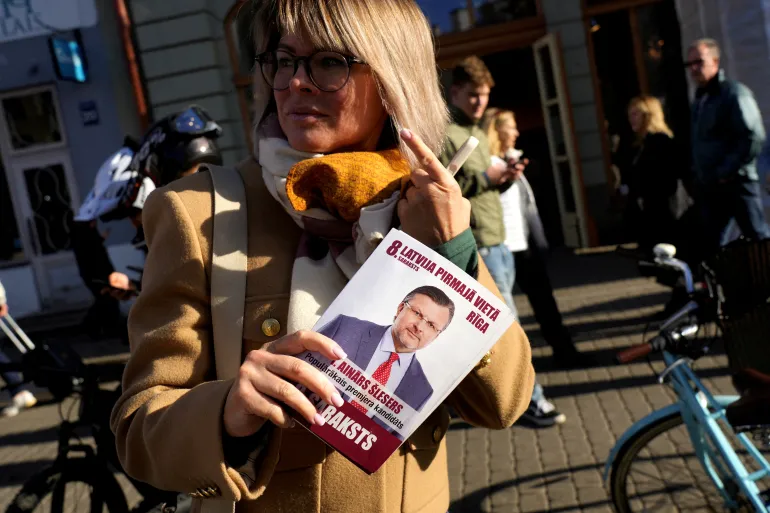
The election is also being closely watched for indications of how Latvia’s Russian-speaking population will vote. Ethnic Russians account for roughly one-quarter of Latvian citizens, but economic and social concerns are increasingly influencing political preferences alongside questions of identity and relations with Moscow.
Security remains a major priority for Latvia. The country has significantly increased defence spending since Russia launched its full-scale invasion of Ukraine in 2022, with the government committing to allocate 5% of gross domestic product to defence. The current government has also identified national security, air defence and border protection among its priorities.
With 100 parliamentary seats at stake, parties must secure at least 5% of the vote to gain representation. The results will therefore determine not only the balance of power in parliament but also which combinations of parties can form the next governing coalition.
Kulbergs Seeks Mandate To Strengthen Latvia’s Defence and Economy
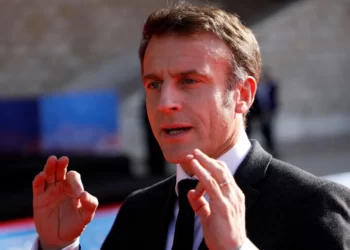
Prime Minister Andris Kulbergs has called on Latvian voters to give his party the mandate needed to pursue changes in national defence and the economy as he seeks to continue leading the country.
After casting his ballot at a polling station in Riga, Kulbergs said that he hoped his party would secure a strong result and use it to address the country’s security and economic challenges.
“I hope we get a good result. This would give us an opportunity to make changes, put Latvia on the right track for defense and economy.”
Andris Kulbergs
Kulbergs also linked Latvia’s economic strength to its ability to maintain national security, highlighting defence as a central priority for the next parliamentary term.
“A strong economy can only bring strong defense, so that is the mission for the next four years if I’m given the right to lead the country. Our party is ready to make changes.”
Andris Kulbergs
Kulbergs took office in May after President Edgars Rinkēvičs invited him to form a government following the collapse of the previous administration. His cabinet subsequently received parliamentary backing and was formed by four parties.
His United List has been leading pre-election polling, but the fragmented nature of Latvian politics means that even a strong electoral performance would not necessarily translate into a parliamentary majority. Recent polling has indicated that several parties could enter the Saeima, making coalition negotiations central to the formation of the next government.
Kulbergs has placed national defence prominently on his political agenda, with his government committed to spending 5% of GDP on defence and strengthening air defence capabilities.