France has stepped up efforts to contain escalating student protests, with Prime Minister Sébastien Lecornu convening an emergency meeting and ordering ministers to cancel official trips as demonstrations spread across the country.
The protests, which began at several high schools in the Paris region last week, have expanded into a nationwide wave of unrest, with students raising concerns about inadequate school resources, lengthy school hours and other grievances.
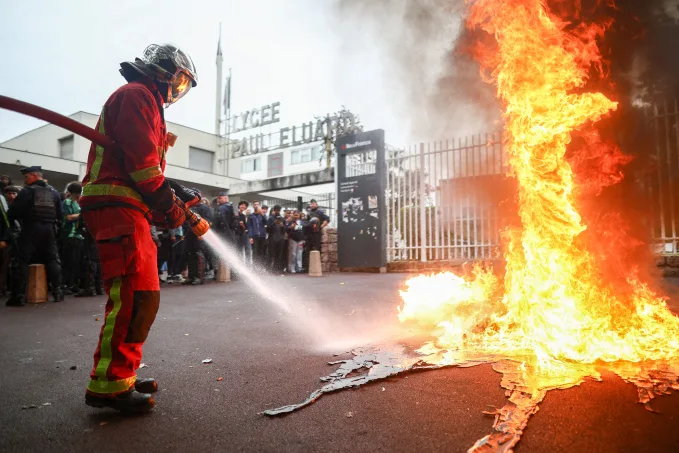
The demonstrations intensified on Wednesday and Thursday, with protesters setting fires, blocking school entrances and clashing with police in several cities. The unrest has resulted in hundreds of arrests and numerous injuries among protesters, students, teaching staff and security personnel.
France’s Interior Minister, Laurent Nuñez, said police detained approximately 625 people on Wednesday, most of them young demonstrators. He also reported that 83 police officers had been injured during confrontations.
Government figures put the number of injured students and teaching staff at 159 during the days of demonstrations. Among them was a student who reportedly lost part of the use of his hand after a firework exploded.
The escalation has prompted the government to intensify its response, with Lecornu convening an inter-ministerial crisis meeting on Thursday to coordinate measures to address the unrest.
His office also announced that ministers had been instructed to cancel planned official engagements in the coming days to allow government officials and security agencies to concentrate on managing the demonstrations.
The protests gained momentum on Tuesday, coinciding with a nationwide day of demonstrations organised by trade unions, workers and students against the government’s proposed budget. However, the unrest outside high schools continued to escalate on Wednesday and Thursday, with violent confrontations overshadowing the wider demonstrations.
Today, clashes intensified in several cities, including Nantes, where the Lycée Nelson Mandela was set on fire. University students also joined the demonstrations, further widening the scope of the protests.
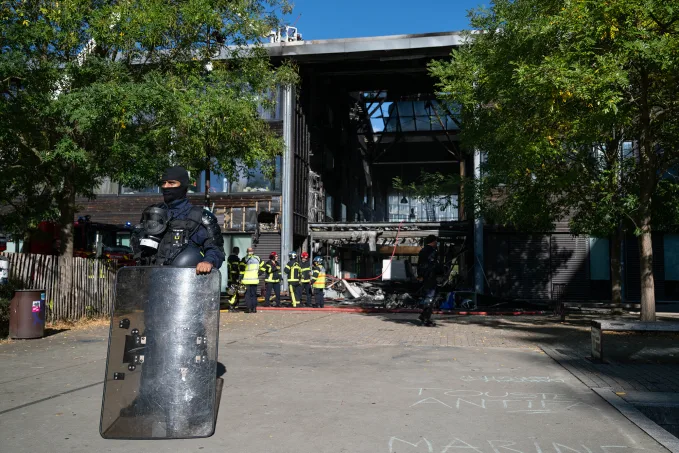
Authorities have reported growing injuries and damage to public property as some demonstrations have been marked by arson, thrown objects and other acts of violence. Police have been instructed to dismantle blockades preventing students from attending classes and to address vandalism and violent confrontations.
Education Minister Édouard Geffray said that the violence today included the setting of a school on fire and incidents in which staff members were doused with petrol.
In response to the disruption, Geffray directed schools to move lessons online where blockades or damage to school facilities posed risks to students and staff. “Violence will not deprive our students of their fundamental right to education,” he said in a post on X, emphasising the government’s responsibility to ensure that students can continue their education despite the unrest.
The demonstrations have also created additional pressure on the French government, which is already grappling with mounting financial challenges and the preparation of its proposed 2027 budget.
The unrest has further complicated the political environment ahead of next year’s presidential election, in which President Emmanuel Macron is constitutionally barred from seeking a third consecutive term.
As the protests continue to spread, the government faces the challenge of addressing students’ concerns while restoring order and ensuring that schools remain accessible.
Macron Condemns Violence As Political Dispute Deepens
The escalating demonstrations have also triggered a political dispute over the government’s handling of the unrest, with President Emmanuel Macron condemning violence and far-left politicians criticising the authorities’ response.
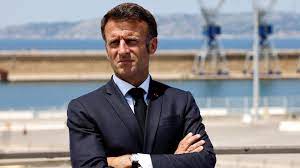
Speaking to journalists during a state visit to Spain on Wednesday, Macron acknowledged the frustrations among young people but insisted that their grievances did not justify violence or vandalism.
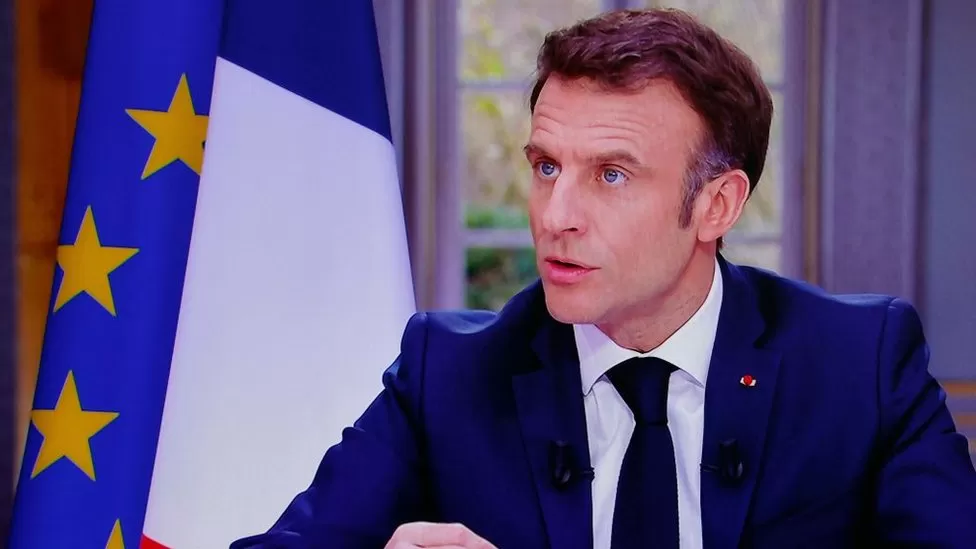
“I understand the anxieties, sometimes the anger that our young people can have,” he said, while warning against the use of violence during demonstrations. “However, none of these fears, none of this debate, legitimises violence,” he said, adding that politicians should not encourage or justify violent conduct.
“And in no case can those politically responsible (elected officials) – it’s a term that’s perhaps poorly chosen – legitimize violence. We’ve seen lots of politicians in front of schools drumming up students, I think that it’s serious.”
Emmanuel Macron
His remarks drew attention to growing political divisions over the demonstrations, particularly following the involvement of members of the far-left France Unbowed party, led by presidential hopeful Jean-Luc Mélenchon.
Mélenchon has denounced the government’s response as repressive, while critics have accused his party of encouraging violence and exploiting the unrest to strengthen its position ahead of the presidential election.
Several France Unbowed lawmakers have visited schools affected by the demonstrations to express support for the protesters. Among them was Bally Bagayoko, the Mayor of Saint-Denis, who defended the right of young people to express their grievances while acknowledging the need for accountability.
Bagayoko told journalists, “Violence can be legitimate,” although he added that it was preferable to avoid it whenever possible.
He also maintained that young demonstrators should be held accountable for breaking the law but argued that young people should be allowed to make mistakes. “Every time we can avoid it, it’s better,” he said, adding that young people had the right to make mistakes.
The contrasting positions have intensified the political debate surrounding the demonstrations. The unrest is also emerging as a significant issue in the campaign to succeed Macron, whose second presidential term is approaching its end.
With the government facing financial pressures and preparing its proposed cost-cutting budget for 2027, the continuing demonstrations have added another challenge to an already demanding political environment.
READ ALSO: US Accuses UNHRC Of Undermining Immigration Enforcement